US-China AI dialogue: Washington describes an incident alert channel, Beijing's readout does not
After talks in New York on 20 September, the US said it had proposed a notification mechanism for AI incidents at national security level. China's Xinhua readout gives AI one 14-character clause and names no mechanism, so on the written record nothing has yet been agreed.
By Parminder Kumar Sharma · · 12 min read

Fourteen characters out of 169
China's official account of Sunday's talks in New York runs to 169 characters after the dateline. Artificial intelligence gets 14 of them, about 8 per cent, in a closing clause that says the two sides "held a dialogue on AI-related issues". There is no mention of a notification mechanism, a security channel, a threshold, a working group or a further meeting. That is the Xinhua readout, also carried on the People's Daily party news site, and as of 21 September it is the only written Chinese text on the meeting we could find.
The American account is louder and less formal. Treasury Secretary Scott Bessent told reporters at JPMorgan Chase's Manhattan headquarters that the US had proposed a "notification mechanism" for AI incidents that rise "up to a national security level", as part of a planned US-China AI Dialogue. That account comes from spoken remarks reported by Reuters, the Associated Press and CNBC. The Treasury press release page carried nothing on the talks when we checked on 21 September; its most recent item was dated 17 September.
This briefing sets out what each side put on the record, what the proposed mechanism would and would not cover, how it compares with the three earlier rounds of US-China AI talk since 2023, and what, honestly, it means for a UK organisation. The short answer to the last question is: not much yet. The primary material is thin, and this piece says so where it matters.
Who met, where, and what was said
On Sunday 20 September 2026, Chinese Vice Premier He Lifeng met Treasury Secretary Scott Bessent and US Trade Representative Jamieson Greer at JPMorgan Chase's headquarters in Manhattan. China's chief trade negotiator Li Chenggang also attended. Xinhua describes it as a round of economic and trade consultations, with the AI dialogue mentioned last, in its final clause. The Decoder reports the delegations negotiated for a full day. He and Li left without speaking to the media, according to Reuters.
The meeting was preparation for Xi Jinping's state visit. The White House says Trump will greet Xi at Joint Base Andrews on Wednesday 23 September and host the state visit on Thursday 24 September, with a state dinner that evening and a further programme on Friday. The talks came four days before the summit day.
Bessent's words, as reported by AP and Reuters, set out the American ambition:
"We want a shared vision of common goals and common threats."
Scott Bessent, to reporters in New York, 20 September 2026 (AP)
He also said that moving "from opaque to more transparency" between what he called the number one and number two AI powers was very important. Greer said export controls on advanced AI chips and chipmaking equipment were not on the agenda for the AI talks. Much of what the two men said in the lobby concerned the "Board of Trade", a process agreed in Beijing in May to identify non-sensitive goods for possible tariff cuts, which Greer said had been "operationalized".
Reuters reported that the Chinese response to the AI proposal "was unclear". That is a fair reading of the Xinhua text.
Two readouts of one meeting
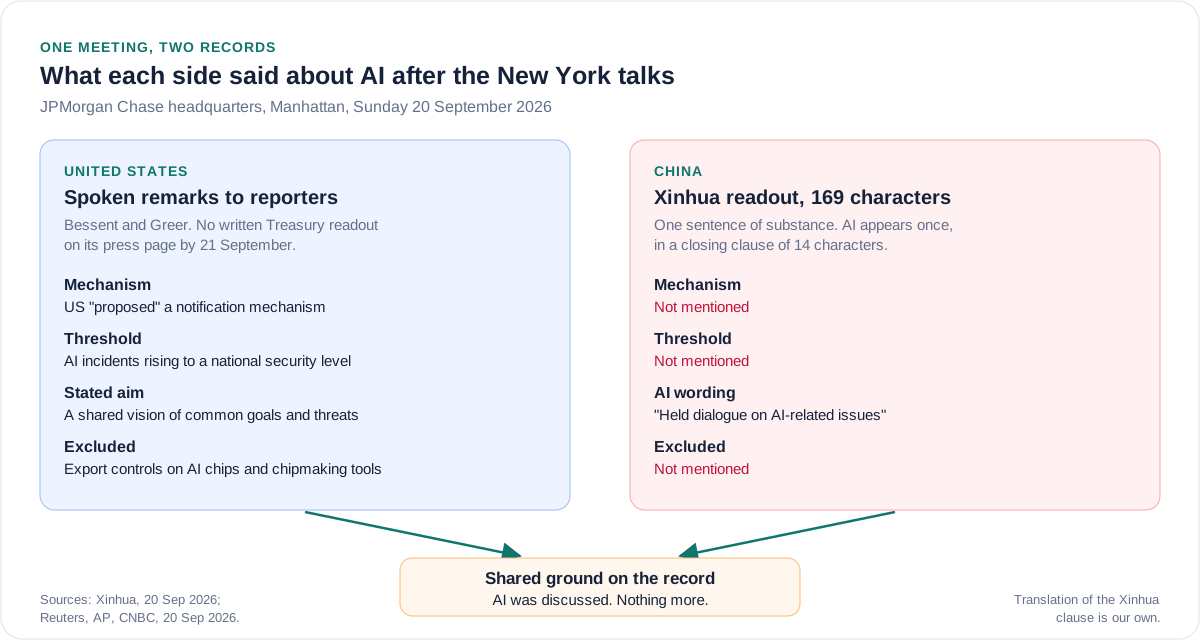
The same meeting in each government's words. Sources: Xinhua readout (20 Sep 2026); Bessent and Greer remarks as reported by Reuters, AP and CNBC (20 Sep 2026)
| Point | US side (spoken remarks) | China (Xinhua, written) |
|---|---|---|
| Format | Remarks to reporters in a lobby; no written readout found | One-paragraph state news agency readout |
| AI discussed | Yes, a planned US-China AI Dialogue | Yes: "held a dialogue on AI-related issues" |
| Notification mechanism | US "proposed" one | Not stated |
| Threshold | Incidents rising to a national security level | Not stated |
| Purpose | Shared vision of common goals and common threats | Not stated |
| Export controls | Not on the AI agenda (Greer) | Not stated |
| Next meeting on AI | Not stated on the record; reported by The Information | Not stated |
| Tone words | "Very successful" engagement | "Candid, in-depth and constructive" on trade |
Readouts of the same meeting often differ, and US-China AI readouts have differed before. After the first formal AI dialogue in Geneva on 14 May 2024, the White House statement said the US "raised concerns over the misuse of AI, including by the PRC". China's account, carried by CCTV, said Beijing had stated its stern position on US restrictions and suppression of China in the AI field. Each government put its own grievance on the record and left out the other's. The difference this time is starker: one side described a mechanism and the other did not mention one.
What the "security mechanism" actually is
Reporting has variously called it a security mechanism, an early-warning system, an AI incident alert system and a formal channel. The only phrase from an official's mouth is Bessent's "notification mechanism", for incidents "up to a national security level from AI". Everything else about it is undefined on the record.
The proposed notification mechanism: what the officials' statements fix and what they leave open. Sources: Reuters, AP, CNBC reports of 20 Sep 2026; Xinhua readout
| Question | Stated on the record | Not stated |
|---|---|---|
| Status | A US proposal for the leaders to consider | Whether China accepted it |
| Trigger | AI incidents at a national security level | What counts as an AI incident, or who decides the level |
| Form | A "notification mechanism" | Hotline, working group, email channel or scheduled meeting |
| Operator | Nothing | Which agencies send and receive; civilian or military |
| Timing | Nothing | How fast a notice must go; any deadline to respond |
| Duty | Nothing | Whether notice is mandatory or voluntary, reciprocal or one-way |
| Scope | Chip export controls excluded | Military AI, frontier model failures, cyber, model theft |
| Dates | Summit on 24 September | Any date for a first working meeting |
The scope question matters most. Reuters quotes George Chen of The Asia Group, a consultancy, expecting future sessions to take on "more sensitive topics such as the weaponization of AI, principles for AI safety, protection of critical infrastructure, and cyber-attack prevention". That is an analyst's forecast, not an agenda either government has published. On the record, the one explicit exclusion is export controls, and the one explicit inclusion is incidents at a national security level.
The US side's own framing also shows where the limits are. In Beijing in May, Bessent told CNBC the two powers would set up a protocol so that "nonstate actors don't get a hold of these models", and added that Washington could hold such talks "because we are in the lead". AP notes that Trump has resisted calls to slow AI development. Read together, this is an incident-transparency proposal from a government that does not want constraints on development, not a safety agreement.
Three years of agreeing to talk
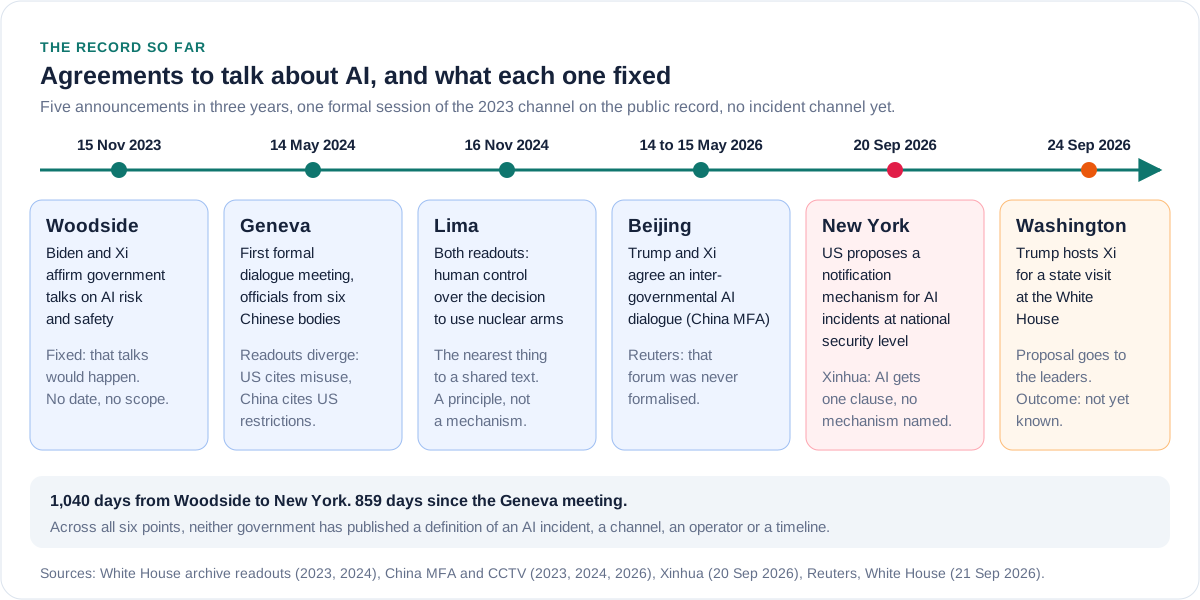
Woodside, 15 November 2023. The White House readout said Biden and Xi "affirmed the need to address the risks of advanced AI systems and improve AI safety through U.S.-China government talks". The Chinese readout listed "establishing an intergovernmental dialogue on artificial intelligence" among agreed areas of cooperation. Both texts fixed that talks would happen. Neither gave a date or scope.
Geneva, 14 May 2024. The first formal session. The US side was led by the NSC's Tarun Chhabra and the State Department's Seth Center, with Commerce officials; the Chinese side included the foreign ministry, the science ministry, the NDRC, the Cyberspace Administration, MIIT and the Central Foreign Affairs Commission office. As noted above, the readouts diverged on substance. Both called the exchange constructive.
Lima, 16 November 2024. The closest thing to a shared text. The US readout said the leaders "affirmed the need to maintain human control over the decision to use nuclear weapons". The Chinese readout contains the equivalent line. The US readout adds that the leaders stressed developing AI "in the military field in a prudent and responsible manner"; we did not find that sentence in the Chinese readout we fetched.
Beijing, May 2026. On 19 May China's foreign ministry spokesperson Guo Jiakun said the two leaders had agreed to carry out an intergovernmental AI dialogue, according to Xinhua. Reuters now reports that forum "was never formalized". On 7 September, asked about reports of imminent AI talks, spokesperson Mao Ning said only that the two sides were maintaining communication on AI, as reported by 21st Century Business Herald.
The pattern is consistent. Each round produces an agreement to talk or a statement of principle. None has yet produced a published definition, a standing channel or a schedule. The New York proposal is more specific than anything before it, because it names a trigger. It is still a proposal.
Method, not accusation
None of this means either government is acting in bad faith. A thin Chinese readout is normal practice ahead of a leaders' summit, when Beijing prefers to let the heads of state announce outcomes. A US official describing a proposal expansively to reporters is also normal. The point is narrower: until a text both sides have issued says what the mechanism is, it does not exist in any form a third party can rely on.
Some interests are worth noting without sneering. The venue was a bank headquarters, and CNBC reports that the chief executives of JPMorgan, Citigroup, OpenAI and Nvidia are expected at the state dinner. The analyst most widely quoted on the significance of the AI outcome works for a consultancy, The Asia Group. The first detailed report that both sides plan a further meeting on the reporting system comes from The Information, via The Decoder, and sits behind a paywall we did not read.
The UK angle, and its limits
The UK is not a party to this channel. Its relevant link to both countries is the Bletchley Declaration of 1 to 2 November 2023, which lists 28 countries plus the European Union as represented, including China and the United States. The declaration resolves to "intensify and sustain our cooperation" on frontier AI risks, names cybersecurity and biotechnology as domains of particular concern, and supports an international network of scientific research on frontier AI safety. It creates no notification duty and no bilateral channel.
The UK's institutional vehicle is the AI Security Institute, renamed from the AI Safety Institute on 14 February 2025 to focus on serious risks with security implications, including cyber attacks and chemical and biological weapons. It coordinates, for 2026, a network now called the International Network for Advanced AI Measurement, Evaluation and Science, formerly the International Network of AI Safety Institutes. Its ten members are Australia, Canada, the EU, France, Japan, Kenya, the Republic of Korea, Singapore, the UK and the US. China is not a member.
So the honest position is this. The UK has a seat at the multilateral table China joined at Bletchley, and a coordinating role in a technical network China is outside. It has no role in a US-China incident channel, if one is created.
What to do, in order
Take this with you
Actions worth taking, most useful first
- Do not cite a US-China AI notification mechanism in any risk register, board paper or supplier assessment as a mitigation. On the written record it is a proposal.
- Read the leaders' readouts after the 24 September summit from both governments, and compare them clause by clause before relying on either.
- If a mechanism is announced, check for the five missing elements: an incident definition, a threshold, named agencies, a timeline and reciprocity.
- Brief whoever owns AI governance that the only confirmed exclusion is chip export controls, so nothing here eases or tightens AI hardware supply.
- Keep your own AI incident process independent of state-level channels: define what an AI incident is for you, who decides severity and who is told.
- Track the UK AI Security Institute and its international network for any statement on incident reporting, since that is where the UK has a voice.
The question that exposes the gap
Bessent's threshold is incidents that rise to a national security level. Every useful notification regime turns on who decides that an event has crossed the line. So the question to put to both governments after Thursday is simple: when an AI incident happens, who decides that it is a national security matter, and has Beijing agreed that it then has a duty to tell Washington, or only that the two sides talked about AI?
Key facts
Sources
- PrimaryXinhua readout of the 20 September 2026 New York consultations: full Chinese text, AI clause, character countsXinhuaaccessed 2026-09-21
- PrimaryRepublication of the same Xinhua readout, used to confirm the textPeople's Daily (CPC News)accessed 2026-09-21
- PrimaryProgramme for Xi Jinping's state visit: Joint Base Andrews on 23 September, state visit and dinner on 24 SeptemberThe White Houseaccessed 2026-09-21
- PrimaryTreasury press release listing, checked for a written readout of the New York talks; latest item dated 17 SeptemberUS Department of the Treasuryaccessed 2026-09-21
- PrimaryWoodside readout, 15 November 2023: government talks on AI risk and safetyThe White House (archive)accessed 2026-09-21
- PrimaryChinese readout of the Woodside meeting: establishing an intergovernmental AI dialogueMinistry of Foreign Affairs of the PRCaccessed 2026-09-21
- PrimaryNSC statement on the 14 May 2024 Geneva AI talks: delegations and US concerns over misuseThe White House (archive)accessed 2026-09-21
- PrimaryChinese account of the Geneva AI dialogue, including China's position on US restrictionsCCTVaccessed 2026-09-21
- PrimaryLima readout, 16 November 2024: human control over nuclear use decisions and military AI sentenceThe White House (archive)accessed 2026-09-21
- PrimaryChinese readout of the Lima meeting, compared with the US textMinistry of Foreign Affairs of the PRCaccessed 2026-09-21
- PrimaryForeign ministry spokesperson Guo Jiakun, 19 May 2026: leaders agreed an intergovernmental AI dialogueXinhuaaccessed 2026-09-21
- PrimaryBletchley Declaration text and list of countries represented, including China and the USGOV.UKaccessed 2026-09-21
- PrimaryRenaming of the AI Safety Institute as the AI Security Institute, 14 February 2025GOV.UKaccessed 2026-09-21
- PrimaryRenamed international network, its ten members and the UK's 2026 coordinator roleAI Security Instituteaccessed 2026-09-21
- Reported byReuters report of Bessent and Greer remarks, export controls exclusion, Chinese response unclear, analyst commentReuters (via Yahoo Finance)accessed 2026-09-21
- Reported byAP report with Bessent's shared vision quote and Xinhua characterisationAssociated Press (via ABC News)accessed 2026-09-21
- Reported byCNBC report of the national security level threshold, Board of Trade and state dinner guestsCNBCaccessed 2026-09-21
- Reported byBessent in Beijing, May 2026: protocol on non-state actors and 'we are in the lead'CNBCaccessed 2026-09-21
- Reported byReport of foreign ministry spokesperson Mao Ning's 7 September 2026 remark on AI communication21st Century Business Heraldaccessed 2026-09-21
- Reported byThe story that prompted this briefing; source of the full-day negotiation detail and The Information's report of a further meetingThe Decoderaccessed 2026-09-21