ChatGPT's ad pixel carries an account-linked cookie to advertiser sites; OpenAI's documents only half say so
A researcher has shown ChatGPT setting a year-long cookie, bound to the user's account, that OpenAI's ad pixel sends back from advertisers' websites. OpenAI's own policies confirm it takes in advertiser data but never describe that link, and UK sites installing the tag carry the PECR risk.
By Parminder Kumar Sharma · · 21 min read

One cookie, 31,536,000 seconds, one account
The cookie is called __obi. When ChatGPT sets it, the server asks the browser to keep it for Max-Age=31536000. Divide by 86,400 seconds in a day and you get 365: a full year. It is scoped to the whole of .openai.com and marked SameSite=None, which is the setting a cookie needs if it is to be sent on requests from other people's websites. According to an independent analysis published by Buchodi on 20 September 2026, it is the only OpenAI identifier configured that way, and its value is bound to a ChatGPT account at the moment it is created.
That post reached the Hacker News front page the same day under the headline "ChatGPT now knows what you do on other websites via ad collector". The researcher reports that when a browser holding __obi visits a site running OpenAI's advertising pixel, the cookie travels to OpenAI with the page path, hashed contact details and location fields.
This briefing checks the claim against OpenAI's own documents: its cookie policy, the privacy policy that covers UK users, the advertiser Measurement Pixel documentation, the Conversion Terms and the Ad Tools Data Processing Addendum. Then it sets out what UK law requires, both from UK organisations whose staff use ChatGPT and from UK website owners who might install this tag.
The short verdict: partly supported. OpenAI's documents say it receives information from advertisers, including "information about purchases you make", and uses it to make ads more relevant. They say conversion data can include cookies. None of them describes a cross-site identifier tied to a ChatGPT account. The headline's "knows" goes further than the evidence shows. Its "other websites" really means sites that carry OpenAI's pixel, in browsers that allow third-party cookies.
What the researcher observed, step by step
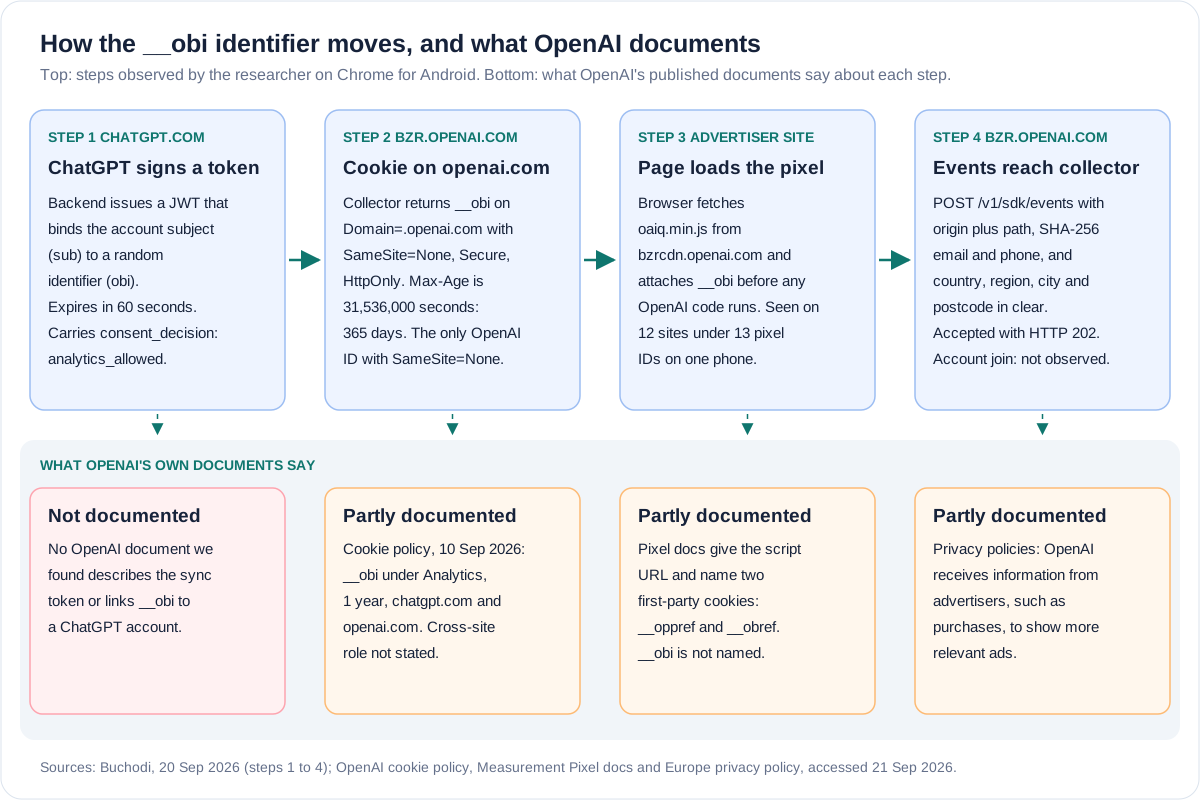
The Buchodi post describes four steps, drawn below. The researcher says the mechanism was reproduced on the author's own phone and confirmed with two separate capture methods. It was then checked against several months of traffic covering 936 distinct advertiser pixels across 1,029 hostnames.
- ChatGPT signs a token. On chatgpt.com, the client generates 16 random bytes and asks the backend for a signed token (a JWT). The token links the account's subject identifier (
sub) to a new identifier (obi), is addressed tobzr.openai.com, carriesconsent_decision: analytics_allowed, and expires 60 seconds after issue. The researcher says "bzr" stands for bazaar, which he reports is OpenAI's internal name for its ads platform. - The identifier becomes a cookie. The browser posts the token to
bzr.openai.com/v1/obi/sync, which returns__obiwithDomain=.openai.com,HttpOnly,Secure,SameSite=noneand a one-year lifetime. The value in the cookie matches theobivalue in the token. - An advertiser's page loads the pixel. The browser fetches
oaiq.min.jsfrombzrcdn.openai.comand attaches__obito that request. This happens before any OpenAI code runs. - Events reach the collector. Event posts to
bzr.openai.com/v1/sdk/eventsalso carried the cookie, including requests from the pixel's code path that is meant to send no credentials.
What travels with the cookie. The researcher says the pixel payload tags each identity value with its source. in means the advertiser passed the value on purpose. fm, ht and js mean the pixel scraped it from form fields, from page text or from the tag-manager data layer. In the observed traffic, scraped identity outnumbered identity the advertiser supplied by 685 events to 255. That means 72.9 per cent of identity events came from scraping (685 of 940). Email, phone and first and last names are hashed with SHA-256 before sending. Country, region, city and postcode are sent in the clear. Postcode was the form field harvested most often: 100 events across 28 sites.
The researcher says URLs are cut down to origin plus path, and none of 23,929 observed URLs carried a query string. Paths are enough to reveal a lot, though. The ones reaching the collector included a medical condition, a debt-solutions funnel and a litigation intake form. Automatic matching was switched on for 638 of 881 pixels where the setting could be seen (72.4 per cent), including every credit and lending advertiser in the sample.
Reach and logged-out users. On one device, a single __obi value was sent from 12 commercial websites under 13 pixel IDs, and every request was accepted. Across the wider traffic, 12 of 30 distinct __obi values (40 per cent) appeared under more than one advertiser. Of 932 decoded sync tokens, 736 (79.0 per cent) carried subject_type: account_user and 196 (21.0 per cent) were anonymous. The researcher says an anonymous subject stays stable for at least 27 days on a device.
The pixel's other cookie behaves differently. __obref is set on each advertiser's own domain. Of 2,860 values observed, 2,828 (98.9 per cent) appeared under exactly one advertiser. That is the separation you would expect from a first-party cookie. The researcher's point is that __obi bypasses it.
What OpenAI's own documents say
The table checks each part of the mechanism against OpenAI documents fetched on 21 September 2026. The right-hand column matters most: it shows what the documents leave out.
Buchodi's findings against OpenAI's published documents. Sources: OpenAI cookie policy (10 Sep 2026), Europe and US privacy policies, Measurement Pixel docs, Conversion Terms (12 Jun 2026), Ads help centre.
| Finding | What OpenAI's documents say | Not stated anywhere we found |
|---|---|---|
| A cookie called __obi exists | Cookie policy lists __obi under Analytics: 1 year, chatgpt.com and openai.com. It is the only entry in that section. | That it is sent from third-party sites, or that it is SameSite=None |
| Advertisers install OpenAI code | Pixel docs give the loader for bzrcdn.openai.com/sdk/oaiq.min.js and ask for it near the top of the head on every page that measures conversions | That loading the script sends an OpenAI cookie |
| The pixel's cookies | Pixel docs list two first-party cookies: __oppref (30 days) and __obref (365 days) | __obi is not named in the pixel docs |
| OpenAI receives off-site activity | Europe and US privacy policies: information from advertisers, for example purchases, to show more relevant ads | Which identifier is used to match it to a person |
| It is tied to a ChatGPT account | Nothing found | Any link between __obi and an account |
| Identity is scraped from pages | Pixel and help docs: automatic advanced matching detects customer information from forms and other sources and hashes it with SHA-256 | That tag-manager data layers are read, or which fields are taken |
| URL paths are sent | Pixel docs: the SDK adds the current page origin as source_url | That paths are sent. The researcher saw paths; the docs say origin |
| Consent is analytics consent | Cookie policy: analytics cookies help OpenAI understand how its services perform and are used | Why an advertising identifier sits under analytics |
The privacy policy that covers UK users. OpenAI's Europe privacy policy applies to people in the EEA, the UK and Switzerland. The current version is dated 24 August 2026. It says: "We receive information from advertisers and other data partners", to help "show more relevant ads to Free and Go users", and "we could receive information about purchases you make from these advertisers." In its legal-basis table, "Using information provided by advertisers to serve more relevant ads" appears under ad personalisation, where the stated basis is consent. The same table gives legitimate interests as the basis for "measurement and reporting services to advertisers". That row describes ad content viewed inside ChatGPT, not events collected on other sites.
Note what the policy does not do. It does not name __obi. It does not say that off-site events are keyed to a cookie set while you are logged in. And for UK residents the controller is not the Irish entity. Section 12 says OpenAI Ireland Limited is controller for the EEA and Switzerland, and "If you live anywhere else, OpenAI OpCo, LLC" in San Francisco is the controller.
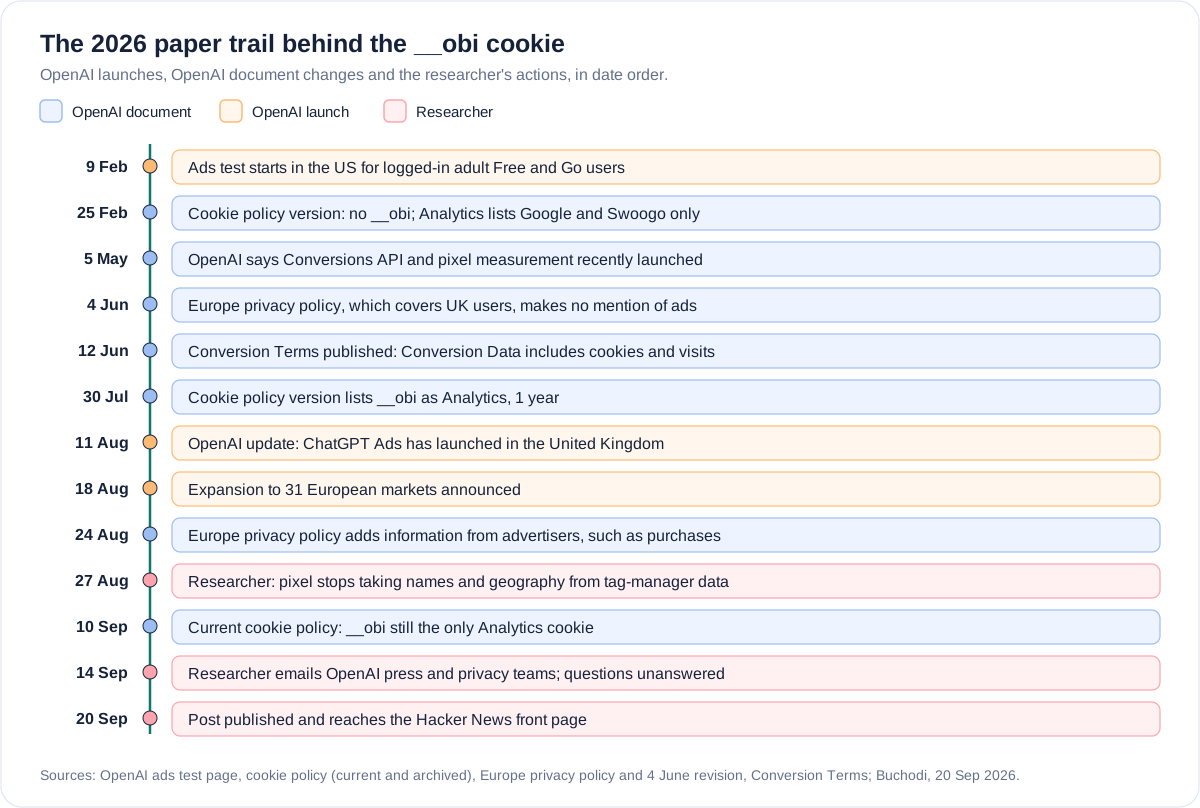
The version before it said nothing about ads. The previous Europe policy, dated 4 June 2026, has no reference to ads or advertiser data. OpenAI's ads test page carries an update dated 11 August 2026 saying ChatGPT Ads "has now launched in the United Kingdom". So for at least the 13 days between 11 August and 24 August, the privacy notice for UK users said nothing about advertising. OpenAI's primary pages do not give the exact UK launch date. Secondary coverage puts it in June, which would make the gap longer. We have not confirmed that date from OpenAI.
The cookie policy history. An archived copy of the cookie policy dated 25 February 2026 lists only Google Analytics and Swoogo cookies under Analytics, and no __obi. A copy dated 30 July 2026 lists __obi as the only Analytics entry. So the cookie reached the policy at some point in that window. OpenAI had already said on 5 May 2026 that it had "recently launched Conversions API and pixel-based measurement" (New ways to buy ChatGPT ads).
The advertiser contracts are more direct. OpenAI's Conversion Terms, published 12 June 2026, define Conversion Data to include "cookies" and "website visits" and "purchases". Advertisers provide it for the "Access Purpose", which means OpenAI's and its affiliates' "development, provision, and improvement of their products or services". That explicitly includes letting OpenAI "improve, optimize, measure, and deliver the Services". The advertiser and OpenAI are independent controllers. Under the Ad Tools DPA, effective 19 August 2026, "OpenAI OpCo, LLC will Process UK Data", and the UK version of the standard contractual clauses (Module One) applies. The advertiser is the data exporter.
Supported, partly supported, or not
Each element of the headline against the evidence. Sources: Buchodi post; OpenAI policies and developer docs.
| Headline element | Verdict | Why |
|---|---|---|
| ChatGPT sets an identifier that reaches other websites' OpenAI requests | Supported by observation | Two capture methods, 12 sites on one device; OpenAI lists the cookie itself |
| It is tied to your ChatGPT account | Supported by observation, not by OpenAI documents | The signed token binds sub and obi; no OpenAI document says so |
| OpenAI receives what you do on those sites | Partly supported | Privacy policies and Conversion Terms confirm advertiser data, such as purchases and visits, comes in |
| ChatGPT knows it | Not established | The server-side join was not observed; use for ad targeting is stated only in general terms |
| On other websites, in general | Overstated | Only pixel-carrying sites, only in browsers that allow third-party cookies, and about one session in five syncs |
The fair summary: an independent researcher has shown a working plumbing path from a ChatGPT account to OpenAI's ad collector on third-party sites. OpenAI's documents confirm that off-site advertiser data flows in and is used for ads. The link between the two, an account-bound cross-site cookie, is documented only by the researcher. OpenAI has not answered his questions.
An analytics label is not a control
Several comforting names attach to this system. None of them works as a control.
"Analytics". OpenAI's cookie policy files __obi under Analytics, and the researcher reports every decoded token carried consent_decision: analytics_allowed. OpenAI's own cookie table shows it runs analytics and marketing as separate choices (oai_consent_analytics and oai_consent_marketing). The researcher infers that someone who allows analytics and refuses marketing still gets __obi. He asked OpenAI to confirm or deny this and got no answer. UK law is clear about where this sits. The ICO's exceptions guidance says the analytics exception "is about how your service is used, not about who uses it", and that it "doesn't apply to things like online advertising". An identifier that follows one person across advertisers is not statistics about how chatgpt.com is used, whatever the table calls it.
"Privacy-preserving identifier". OpenAI's pixel docs use this phrase for oppref, the click reference. That is a different value from __obi, and a label is not a design property either way.
"Securely hashes". The pixel docs say automatic matching hashes customer information "using SHA-256" and that "Raw customer information is not sent". That is true as far as it goes. But a SHA-256 digest of a normalised email address is a fixed value. The same address gives the same digest on every site, which is exactly why advertisers are asked to send it. It is a matching key. Postcode, city and region travel unhashed.
"No credentials". The researcher found that the SDK's code path meant to send no credentials still delivered the cookie, because the browser had already attached it to the script download.
oaiq("consent", false). The pixel docs say that when consent is false, the pixel does not send measurement-event pings. That flag runs inside a script the browser has already fetched. If the researcher is right that the fetch itself carries __obi, a site that loads the script and then sets consent to false has already disclosed the identifier. Also, according to the docs the pixel "initializes consent to true by default".
Who is in scope: plans, regions and opt-outs
ChatGPT plans against ads and the __obi mechanism. Sources: OpenAI Ads help centre, ads test page, enterprise privacy page, Buchodi post.
| Plan | Shows ads (OpenAI) | __obi sync |
|---|---|---|
| Logged out | Yes, all-audience ads only | Observed: 196 of 932 tokens were anonymous |
| Free | Yes, unless the user picks Ads-Free with lower limits | Observed on account tokens; plan not recorded |
| Go | Yes | Not separately stated |
| Plus, Pro | No | Not stated |
| Business, Enterprise, Edu | No | Not stated and not tested; enterprise privacy page does not mention ads or cookies |
Regions. OpenAI's help centre says personalised ads "are not initially available in the European Economic Area (EEA) or Switzerland". The UK is not on that list. OpenAI's advertiser docs say custom audiences are not supported for campaigns targeting the EEA or Switzerland, and again the UK is not excluded. The Ads Manager availability page lists the United Kingdom as available for self-service advertisers. OpenAI's 18 August announcement of 31 European markets fits the 30 EEA states plus Switzerland, but that count is our inference: OpenAI names only nine of them.
When it began. Ads testing started in the US on 9 February 2026 for "logged-in adult users on the Free and Go subscription tiers" (OpenAI). The pixel launched shortly before 5 May 2026. __obi appears in the cookie policy by 30 July 2026. The researcher dates a narrowing of the pixel's data-layer scope to 27 August. None of the sources gives a start date for the __obi sync itself.
Opt-outs, and what each one is documented to do.
- Cookie choices on chatgpt.com and openai.com. The token's
consent_decisionfield suggests the sync is gated on analytics consent. If so, refusing analytics cookies should stop it. That is our inference from the researcher's data; OpenAI does not document it. - Settings, then Ads controls. Free and Go users can turn off ad personalisation, turn off the use of past chats and memory, and delete ads data. OpenAI says deleted data is retained for up to 30 days. OpenAI does not say whether any of these settings stops
__obibeing set or read. - Ads-Free or a paid plan. Both remove ads. Whether either stops the sync is not stated.
- Browser. The researcher says Safari's tracking prevention blocks the mechanism. Blocking third-party cookies in any browser should have the same effect on the cross-site step. That follows from how
SameSite=Noneworks; it is not something OpenAI documents. - Advertiser side. The pixel docs offer a per-event
opt_outflag that removes the event "from future user-level personalization". That wording confirms user-level personalisation from pixel events exists.
The UK position: PECR first, then UK GDPR
PECR regulation 6 as it now reads. The Data (Use and Access) Act 2025 replaced regulation 6 from 5 February 2026. It now says a person "must not store information, or gain access to information stored, in the terminal equipment of a subscriber or user", subject to Schedule A1. Two details decide who is responsible here. First, the rule covers "instigating the storage or access". A UK website that embeds OpenAI's script makes the visitor's browser send OpenAI's cookie, so the site is instigating access to it. Second, the Schedule A1 exceptions are narrow. The statistical exception needs the "sole purpose" to be statistics about the provider's own service, with information shared only to help improve that service. Ad measurement for a third-party platform that uses the data to deliver ads does not fit.
What the ICO says about ads. The ICO's final guidance on storage and access technologies was published on 29 April 2026. It is direct: "The use of storage and access technologies for online advertising purposes requires consent" (ICO). Measurement can share that consent, because it is "intrinsically linked" to advertising. But the ICO adds that separate consent is needed where "third parties are processing information on a user's interaction with the advert for tracking or profiling people". OpenAI's Conversion Terms let it use conversion data to "improve, optimize, measure, and deliver the Services", and its privacy policies describe using advertiser data to make ads more relevant. Our reading, which is inference rather than a regulator's finding: a UK site's consent request must name OpenAI and cover profiling for ad delivery on ChatGPT, not just "measuring our campaigns".
Lawful basis under UK GDPR. Where PECR consent is required, the ICO says that for later processing "you should use consent as your lawful basis", and that falling back on legitimate interests "may also render your original consent request invalid" (ICO). OpenAI's Europe policy gives consent as its basis for ad personalisation using advertiser data. It gives legitimate interests for measurement reporting, but only for activity inside ChatGPT. Which basis covers off-site events matched through __obi is not stated.
Roles and transfers. Under the Conversion Terms and Ad Tools DPA, a UK advertiser and OpenAI OpCo, LLC are independent controllers. Data leaves the UK under the UK SCCs, and the advertiser is the exporter. The advertiser warrants that it has "all required notices" and consents, and must not send "Prohibited Data", a category that covers health and financial distress. The DPA also bars event names or parameters that "reveal or imply" sensitive categories. The researcher found URL paths naming a medical condition and a debt-solutions funnel reaching the collector. A path is a parameter a site owner controls.
Penalties. Since 5 February 2026 the ICO can issue PECR fines "of up to £17.5 million or 4% of global turnover" (ICO). The ICO's 18 May 2026 advice proposes future exceptions for low-risk, contextual advertising. It keeps consent for "intrusive tracking and profiling people over time and across services", and it stresses "nothing has changed at this stage".
If you have deployed ChatGPT for staff
Workplace plans do not show ads. OpenAI's help centre says Plus, Pro, Business, Enterprise and Edu "will not have ads". But the enterprise privacy commitments cover business data, meaning inputs and outputs. They say nothing about advertising or about cookies set in a browser. The researcher did not test workspace accounts. The realistic exposure is not your Enterprise tenant. It is a staff member signed into a personal Free account in the same browser profile they use for work research.
Take this with you
For a UK organisation using ChatGPT, in order
- Confirm which plan every user is on, and find personal Free or Go accounts registered with work email addresses, which OpenAI's privacy policy says it may report to the organisation for adding to a business account.
- Enforce single sign-on to your workspace and block personal ChatGPT sign-in on managed browser profiles where your identity provider and browser management allow it.
- Ask your OpenAI account team in writing whether the __obi sync token is ever issued to Business, Enterprise or Edu sessions, and whether your contract excludes workspace users from any advertising use.
- Check your managed browser settings: blocking third-party cookies stops a SameSite=None cookie from being sent from other sites, and Safari and iOS already do this according to the researcher.
- Update staff guidance: personal ChatGPT accounts in work browsers can link ad-pixel activity on retailer and service sites to that personal account.
- Record the decision in your DPIA or AI use register, noting that the enterprise privacy page is silent on advertising and cookies.
If you run a UK website with third-party tags
Your marketing team may have installed OpenAI's pixel since Ads Manager opened to UK advertisers. OpenAI's pixel documentation gives these hosts in its Content Security Policy advice. Search your tag manager, templates and CSP for them:
bzrcdn.openai.com   script-src   SDK loader oaiq.min.js and pixel config
bzr.openai.com      connect-src  event posts to /v1/sdk/events
bzr.openai.com      img-src      image tag and noscript fallback
oaiq(               in page code: the command queue the snippet creates
Take this with you
For a UK website owner, in order
- Inventory: search tag manager containers, page templates and CSP headers for bzrcdn.openai.com, bzr.openai.com and oaiq, including any Shopify or HubSpot integration that manages ChatGPT Ads for you.
- Block the script until consent: gate the loader itself in your consent platform rather than relying on oaiq consent false, because the researcher reports the script download carries the __obi cookie.
- Rewrite the consent text to name OpenAI, say that OpenAI may use the data to deliver and personalise ads on ChatGPT, and give the retention periods, including 365 days for __obref.
- Decide on automatic advanced matching in Ads Manager: switch it off unless you can justify OpenAI scraping and hashing form, page and data-layer values.
- Remove the pixel from pages whose paths reveal health, debt, legal or other sensitive matters, as the Ad Tools DPA forbids fields that imply Prohibited Data.
- Wire withdrawal through: when a visitor withdraws consent, stop the script, call oaiq consent false to delete __oppref and __obref, and stop forwarding obref to the Conversions API.
- Record the independent controller relationship and the UK SCCs transfer to OpenAI OpCo, LLC in your records of processing and privacy notice.
- Test from a clean device outside your network, as the ICO suggests, and confirm no request goes to an openai.com host before consent is given.
Method, motive and what is still missing
Treat the method and the accusation separately. The method is reproducible and clearly bounded. The researcher publishes counts, names the browser, gives the rate at which syncing happened, and says plainly what was not observed. The strongest wording, "knows", sits in the headline, not in the findings. Buchodi publishes a threat intelligence newsletter with paid members-only issues, so attention helps it commercially. That is a reason to check the work, which we have done against OpenAI's documents. It is not a reason to discount it.
OpenAI's interest is plain too. Ads fund the Free and Go tiers, and OpenAI says it wants "stronger signals" so it can "show more relevant ads". Its documents are careful to say advertisers see only aggregated reports, and that is consistent with the researcher's findings. The researcher's claim concerns what OpenAI itself receives, which is a different question.
The researcher emailed OpenAI's press and privacy teams on 14 September, six days before publishing. He asked why __obi is an analytics cookie and whether it is set when a user accepts analytics but refuses marketing. OpenAI Support acknowledged the email and answered neither question. We found no OpenAI statement on the finding as of 21 September 2026.
The question that exposes the gap
OpenAI's promise to users is about conversations: advertisers never see your chats. The researcher's finding is about the other direction: what advertisers' websites tell OpenAI, keyed to an identifier created while you were logged in. For UK readers, both groups should ask OpenAI the same question in writing. Staff-tool owners are asking about their users; website owners are asking about their visitors.
If a person refuses marketing cookies on chatgpt.com, will OpenAI still set __obi and accept it from advertiser sites, and if it does, what UK lawful basis does OpenAI OpCo, LLC rely on to link those events to that person?
Key facts
Sources
- PrimaryThe original analysis, 20 September 2026: sync token, __obi cookie attributes, request classes, payload sources, counts, limits and OpenAI's non-answerBuchodi's Threat Intelaccessed 2026-09-21
- PrimaryCookie policy dated 10 September 2026: __obi listed as an Analytics cookie, one year, chatgpt.com and openai.com; consent cookie namesOpenAIaccessed 2026-09-21
- PrimaryArchived cookie policy dated 30 July 2026 listing __obi; and the 27 February 2026 capture of the 25 February version without itInternet Archiveaccessed 2026-09-21
- PrimaryEurope privacy policy dated 24 August 2026 covering EEA, UK and Switzerland: advertiser data, legal bases, controller for UK residentsOpenAIaccessed 2026-09-21
- PrimaryPrevious Europe privacy policy dated 4 June 2026, which makes no mention of ads or advertiser dataOpenAIaccessed 2026-09-21
- PrimaryUS privacy policy dated 10 September 2026: information received from advertisers, such as purchasesOpenAIaccessed 2026-09-21
- PrimaryMeasurement Pixel documentation: loader URL, consent default, CSP hosts, automatic advanced matching, __oppref and __obref cookies, opt_out flagOpenAI Developersaccessed 2026-09-21
- PrimaryFull Ads documentation export: Conversions API obref field, custom audiences EEA and Swiss exclusion, image tag, changelogOpenAI Developersaccessed 2026-09-21
- PrimaryConversion Terms published 12 June 2026: Conversion Data definition, Access Purpose, independent controllers, advertiser warrantiesOpenAIaccessed 2026-09-21
- PrimaryAd Tools Terms published 24 August 2026: Prohibited Data definition and audience restrictionsOpenAIaccessed 2026-09-21
- PrimaryAd Tools Data Processing Addendum effective 19 August 2026: UK data processed by OpenAI OpCo, LLC under UK SCCs Module OneOpenAIaccessed 2026-09-21
- PrimaryAds in ChatGPT FAQ: plans with and without ads, ad controls, personalised ads not in EEA or Switzerland, 30-day deletionOpenAI Help Centeraccessed 2026-09-21
- PrimaryConversion Measurement: oppref, automatic advanced matching, modelled measurement, consent obligations on advertisersOpenAI Help Centeraccessed 2026-09-21
- PrimaryAds Manager availability by country, including the United Kingdom as available for self-serviceOpenAI Help Centeraccessed 2026-09-21
- PrimaryAds test announcement of 9 February 2026 with updates, including the 11 August 2026 UK launch updateOpenAIaccessed 2026-09-21
- Primary5 May 2026 announcement: pixel and Conversions API recently launched; stronger signals help show more relevant adsOpenAIaccessed 2026-09-21
- Primary18 August 2026 announcement of expansion to 31 European marketsOpenAIaccessed 2026-09-21
- PrimaryEnterprise privacy commitments, updated 8 January 2026, covering business data and silent on advertising and cookiesOpenAIaccessed 2026-09-21
- PrimaryPECR regulation 6 as substituted from 5 February 2026 by the Data (Use and Access) Act 2025, including instigating storage or accesslegislation.gov.ukaccessed 2026-09-21
- PrimaryPECR Schedule A1 exceptions, including consent and the statistical purposes exceptionlegislation.gov.ukaccessed 2026-09-21
- PrimaryStorage and access technologies guidance: online advertising and ad measurement require consentICOaccessed 2026-09-21
- PrimaryExceptions chapter: the statistical purposes exception does not cover online advertising or tracking peopleICOaccessed 2026-09-21
- PrimaryPECR and UK GDPR: use consent as the lawful basis for subsequent processing where PECR consent is requiredICOaccessed 2026-09-21
- PrimaryCompliance chapter: service provider responsibility for third-party technologies, no pre-enabling, auditsICOaccessed 2026-09-21
- Primary29 April 2026 news release publishing the final guidanceICOaccessed 2026-09-21
- Primary5 February 2026 DUAA commencement statement: PECR fines up to 17.5 million pounds or 4 per cent of global turnoverICOaccessed 2026-09-21
- Primary18 May 2026 advice to government on possible low-risk advertising exceptions; nothing has changed yetICOaccessed 2026-09-21
- Reported bySubmission of the Buchodi post on 20 September 2026 at 15:18 UTCHacker Newsaccessed 2026-09-21