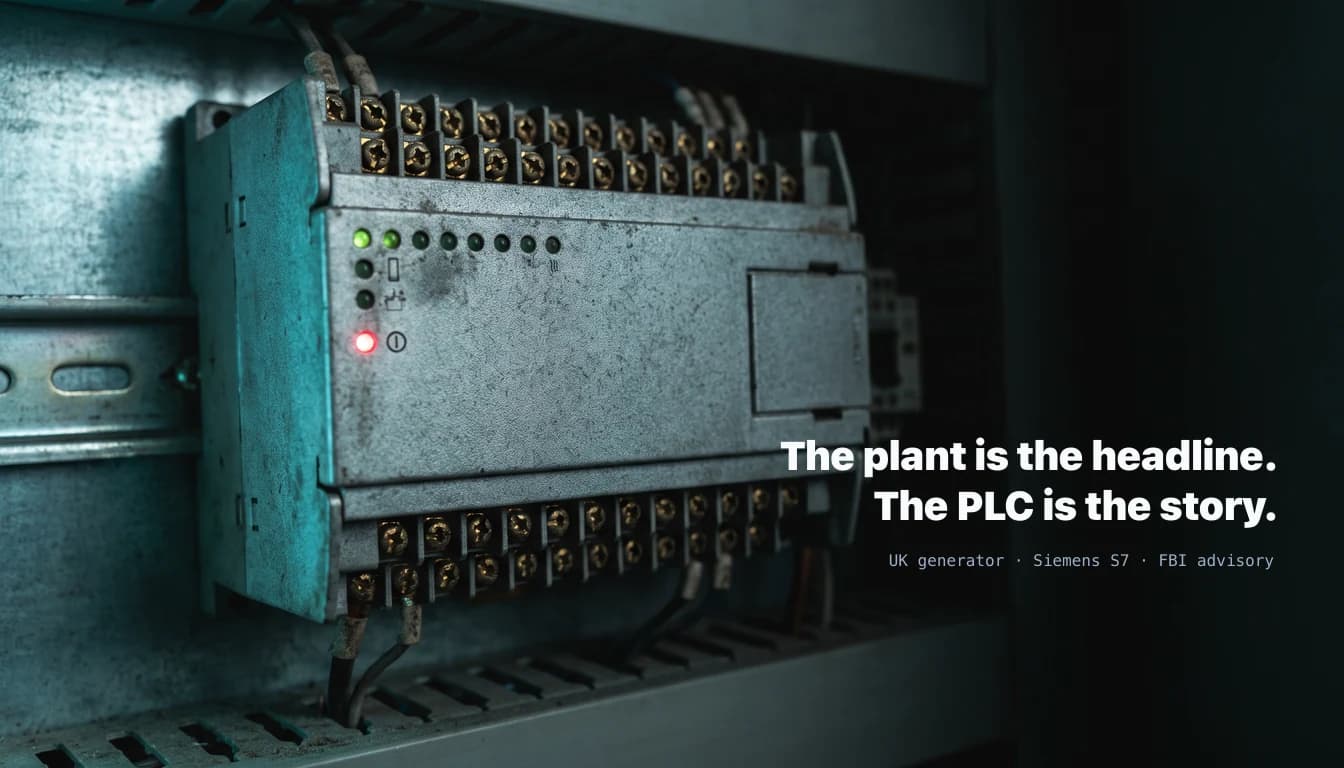
Iran shut a UK power plant, said the headlines. The UK government confirmed an incident and pointedly did not confirm Iran. The real story is exposed PLCs
A UK small-scale generator was down four days after a cyber incident the government confirmed but has not attributed. Around it sits a firmer pattern: 30-plus US water sites hit via internet-facing PLCs, and a federal warning of AI-generated exploits against Siemens S7 controllers.
By Parminder Kumar Sharma · · 6 min read
What was reported, and what was confirmed
The headline moved fast: an Iran-linked cyberattack shut down a UK power plant. The verified facts are thinner than the headline, and the gap is the first thing worth stating.
A UK government spokesperson confirmed to The Register that a security incident affected a "small-scale energy generator", that at no point was there a risk to the wider energy system, and that the government briefed energy chief executives afterwards. The Telegraph, which broke it, reported the plant was down for four days. That is the confirmed core.
What is not confirmed is the attribution. The UK has not formally blamed Iran, or anyone. No technical detail, no named plant, no method has been released. "Iran-linked" is an inference, a reasonable one given timing, but an inference, and the government pointedly has not made it.
The real story is the pattern, not the plant
Taken alone, this incident is too thin to build on. Taken with what surrounds it, it is a clear data point in a pattern that does have substance.
In late July, suspected Iranian operatives disrupted more than 30 water facilities in Minnesota, with similar intrusions across at least eleven other US states. Those did not need an AI assist; they abused internet-connected programmable logic controllers directly. Then, last week, the FBI and four other federal agencies warned that attackers are now using AI-generated exploitation scripts to break into internet-exposed Siemens S7 series PLCs at water, energy and manufacturing sites. Their words: "This is not a theoretical risk, it is an active threat."
The through-line is not a clever exploit. It is that the controllers running physical processes answer the internet, and the reconnaissance and exploitation of them is being automated. The control that fails is network exposure, not PLC firmware. A generator, a water plant and a factory share the same weakness, which is why one thin incident and thirty confirmed ones belong in the same picture.
The sequence this UK incident sits inside
Late Jul
US water facilities hit
More than 30 facilities in Minnesota disrupted via internet-connected PLCs, later reported across 11 more states.
Mid Aug
Federal advisory
FBI and four agencies warn of AI-generated exploit scripts targeting internet-exposed Siemens S7 PLCs. Active threat.
24 Aug
UK generator down
UK government confirms a small-scale energy generator was hit and down four days. Not attributed to Iran.
Why the exposure keeps happening
It is tempting to ask how, in 2026, controllers running turbines and water treatment are still reachable from the internet. The answer is mundane and is the reason the problem persists. Operational technology was built for reliability and long life, not for a hostile network, and much of it predates the assumption that everything is connected. Remote access was then bolted on for maintenance, often through a cellular link or a vendor's remote-support channel, because sending an engineer to a substation is expensive and a modem is cheap. Each of those decisions was locally reasonable and collectively created a fleet of safety-critical devices that answer strangers. The controllers themselves are frequently robust; what is fragile is the network path that was added around them, and that path is invisible on the architecture diagram that says IT and OT are separated.
The AI element does not change the target, it changes the economics of finding it. Scanning the entire internet for exposed controllers and matching each to a working exploit used to take skill and time. Automated, script-generating tooling collapses both, which turns a niche capability into a commodity one. That is the shift the federal advisory is warning about, and it is why "we are too small and obscure to be found" has stopped being a defence.
What to do
Take this with you
For anyone running operational technology
- Find your internet-exposed PLCs before someone else does. The consistent weakness across every incident here is a controller reachable from the internet, not a novel exploit. Inventory and remove that exposure first.
- Assume the reconnaissance is automated now. AI-generated scripts scale scanning and exploitation, so obscurity and low profile are no longer protection. If it answers the internet, it will be found.
- Segregate IT from OT for real, not on a diagram. The boundary in most estates is thinner than the architecture claims, and it is the control that actually failed in these cases.
- Treat attribution as secondary to exposure. Whether or not Iran is behind the UK incident changes nothing about the fix, which is the same either way.
- Read the FBI advisory and check specifically for exposed Siemens S7 devices, which the advisory names as the current target.
The position
Two things are true and worth holding together. The specific claim, that Iran shut a UK power plant, runs ahead of the public evidence, and a careful reader should note that the government confirmed an incident and declined to confirm the actor. Reporting the inference as fact is the smaller version of the same problem this site keeps finding: a confident sentence with its uncertainty stripped off.
And the pattern underneath is real and does not depend on the attribution at all. Critical-infrastructure controllers are exposed to the internet, and the work of finding and exploiting them is being automated. That is the threat to plan against, whoever is behind any single incident. The plant makes the headline; the exposed PLC is the story.
Sources
- PrimaryIran-linked cyberattack shut down a UK power plantThe Registeraccessed 2026-08-24
- Reported byRelated OT intrusions against power infrastructure, August 2026The Hacker Newsaccessed 2026-08-24