The catalogue calls it path traversal. Its own CWE, and both sources it cites, say authentication bypass
CVE-2026-5430 entered the exploited catalogue on 24 September with a three day deadline. The name and description describe a file upload flaw. The structured field in the same record, and the WSO2 and NVD pages it links to, describe a JWT signature check that accepts the wrong algorithm.
By Parminder Kumar Sharma · · 8 min read
One record, two descriptions of different things
CISA added CVE-2026-5430, affecting several WSO2 products, to the Known Exploited Vulnerabilities catalogue on 24 September 2026, with a deadline of 27 September. Three days.
Here is what the record says about itself, quoted from the catalogue JSON:
vulnerabilityName: "WSO2 Multiple Products Path Traversal Vulnerability"shortDescription: "contain a path traversal vulnerability that could allow for unrestricted file upload and lead to remote code execution"cwes:["CWE-347"]
CWE-347 is Improper Verification of Cryptographic Signature. It is not path traversal, which is CWE-22, and it is not unrestricted file upload, which is CWE-434.
Now the two sources the same record links to in its notes field. WSO2's own advisory, published 3 May 2026: "JWT authentication can be bypassed when a token is signed using an unsupported algorithm, allowing unauthorized access." NVD's record, published 6 August: "The JWT authentication mechanism accepts tokens signed with algorithms other than those explicitly configured or supported", leading to unauthorized access and potential full account takeover.
Neither mentions path traversal. Neither mentions file upload. The structured field is right, and the sentence a human reads first is describing a different class of vulnerability.
What that does not establish. It does not establish that the entry is wrong to act on: the CVE is correct, the products are correct, the exploitation assessment is correct, and the deadline stands. It does not establish that WSO2's products have no path traversal flaw, only that this identifier is not one. It does not establish how the wording came about, and CISA has not been asked. And it does not establish that anyone has been harmed by it.
What it establishes is that a defender who triages on the name is looking for the wrong thing in the wrong place, and that nothing in their tooling will tell them.
Why the wrong name is worse than no name
Consider what each reading produces in practice, because the two vulnerability classes lead to opposite work.
If you believe this is a path traversal leading to file upload, you go looking at upload endpoints, at write permissions on directories, at web server configuration, at file type validation. You ask whether your deployment exposes an upload path at all, and if it does not, you may reasonably conclude your exposure is limited.
What the flaw actually is: the JWT authentication mechanism accepts a token signed with an algorithm it was never configured to accept, and validates it anyway. So an attacker mints a token, the gateway believes it, and they are authenticated. WSO2's own wording is that successful exploitation may lead to compromise of administrative accounts and full account takeover.
The defensive questions are entirely different. Which algorithms does the deployment accept, and is that list enforced rather than advertised. What has been authenticated recently that should not have been. Are there sessions or tokens to invalidate. Is there anything in the logs that looks like a valid session with no corresponding login.
And this is the part that turns a labelling error into an operational one: the record carries forensicTriage: Yes, which asks agencies to go and look for evidence of compromise. Looking for evidence of a file upload that never happened produces a clean result and a closed ticket.
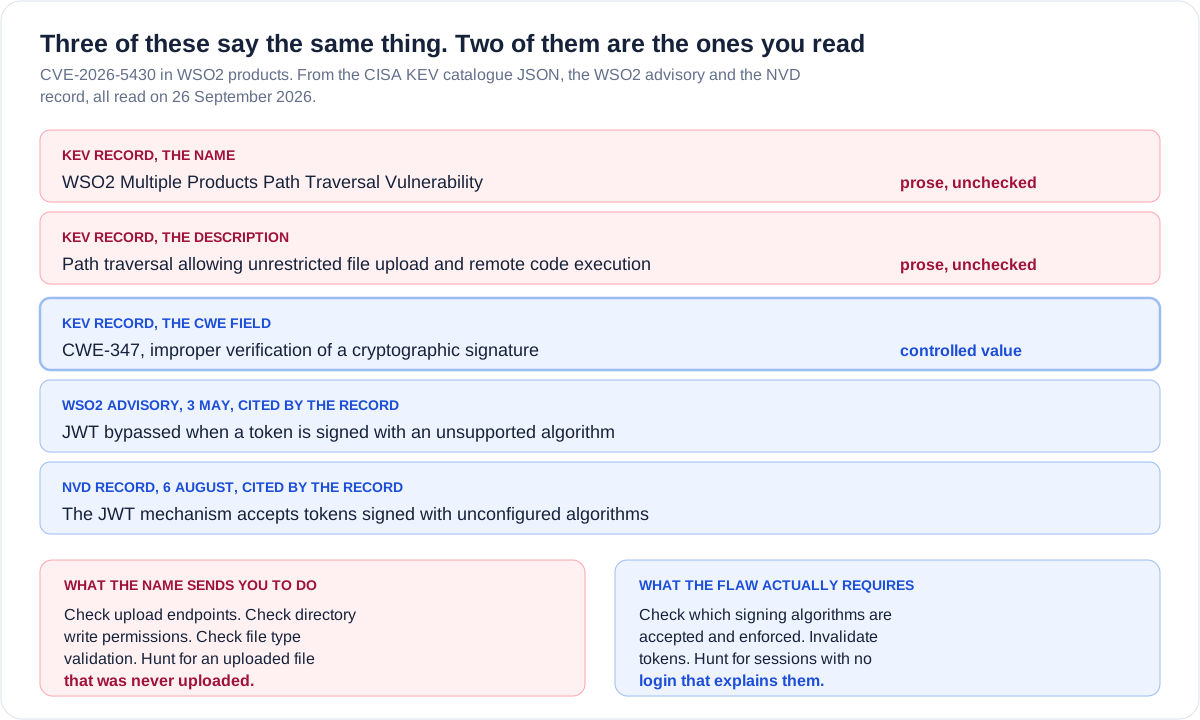
The same identifier as described by the catalogue's free text, by the catalogue's own structured field, and by the two sources the catalogue cites. All read on 26 September 2026.
| Where it is written | What it says the flaw is | Class |
|---|---|---|
| KEV vulnerabilityName | Path traversal | CWE-22, if it were true |
| KEV shortDescription | Path traversal to unrestricted file upload to remote code execution | CWE-434, if it were true |
| KEV cwes field | Improper verification of cryptographic signature | CWE-347 |
| WSO2 advisory, 3 May | JWT bypassed when a token is signed with an unsupported algorithm | CWE-347 |
| NVD record, 6 August | JWT mechanism accepts tokens signed with unconfigured algorithms | CWE-347 |
The dates, which are their own story
WSO2 published its advisory on 3 May 2026. The CVE reached NVD on 6 August. The catalogue entry appeared on 24 September, with a due date of 27 September.
That is 144 days from the vendor advisory to the catalogue, and 49 days from the NVD record. Then three days to remediate.
The scoring is worth a line too, because it is unusually careful and almost nobody will see it. WSO2 assigned 10.0, with a scope change, and then published a second figure in the same breath: 9.8 for single tenant deployments, on the reasoning that the impact is contained within one security authority boundary. A vendor publishing its own downward adjustment, with the reason attached, is better practice than the round number it started from, and it is carried in the NVD description rather than in a score field, so most tooling will only ever show the 10.0.
CISA's own SSVC assessment on the same NVD record reads exploitation: active, automatable: yes, technicalImpact: total. That is consistent with the catalogue entry and it is the answer to anyone who suspects the addition itself was hasty. The decision is well evidenced. It is the sentence wrapped around it that is wrong.
The general shape, because this is not one bad record
Every catalogue, feed and dashboard in this field mixes two kinds of content. There are controlled values, drawn from fixed lists, copied between systems and validated on the way: the identifier, the CWE, the dates, the product names, the flags. And there is prose, written once by a person to make the record legible, never validated against anything, and read first by everybody.
The prose is the part that reaches a human, and it is the only part with no integrity check. That is the structural problem, and it produces the same failure in several places this site has already looked at: a field that changes with nothing recording that it changed, a version string that cannot represent a second release, a console that reports what an agent once said rather than what the device does.
The common feature is not carelessness. It is that the human-readable layer and the machine-readable layer are maintained by different processes, and only one of them is checked.
What to do about it
Take this with you
In the order worth doing
- If you run WSO2 API Manager, API Control Plane, Traffic Manager or Universal Gateway, treat this as an authentication bypass and not as a file upload flaw. Patch per the vendor advisory of 3 May, which is nearly five months old.
- Check which JWT signing algorithms your deployment accepts, and confirm the list is enforced rather than configured. The flaw is that an unsupported algorithm was accepted anyway.
- Because the record asks for forensic triage, look for authenticated activity with no corresponding authentication: sessions, administrative actions or API calls that exist without a login that would explain them. Looking for uploaded files will not find this.
- Invalidate existing tokens and sessions after patching, on the assumption that a forged one may already be in circulation. A patch stops new forgeries and does nothing about an accepted token still in use.
- In your own triage process, key on the CWE rather than the title wherever both are present. That single change would have caught this record automatically.
- If you maintain any internal catalogue or risk register, check whether anything validates its free text against its structured fields. Almost nothing does, including the ones this piece is about.
The question this leaves
It would be easy and wrong to write this as an attack on the catalogue. The catalogue is the single most useful public artefact in vulnerability management, the entry is correct in every field that a machine reads, and the decision behind it is supported by CISA's own published assessment. One sentence in it is wrong.
But that sentence is the product. Almost nobody reads a CWE. They read a name in a ticket, and the name here sends them looking for a file that was never uploaded, on a record that explicitly asks them to go looking for evidence of compromise.
So the question for your own process: when the prose and the structured fields in a record disagree, which one does your organisation act on, and do you know the answer because you decided it, or because of how your tooling happens to render a row?
Sources
- PrimaryThe KEV catalogue JSON read on 26 September 2026, used for the record's name, description, CWE, dates and forensic triage flag, quoted verbatimCISAaccessed 2026-09-26
- PrimaryAdvisory WSO2-2026-5328 of 3 May 2026, one of the two sources the catalogue record cites, used for the vulnerability description, the scores and the affected versionsWSO2accessed 2026-09-26
- PrimaryThe NVD record, the other source the catalogue cites, used for the description, the CWE, the CNA score and the CISA SSVC decision pointsNVDaccessed 2026-09-26