TerminalFix chains eight stages from a fake CAPTCHA to a reverse tunnel, and never touches a CVE. There is nothing to patch
Microsoft published the chain on 28 August 2026: a fake Cloudflare Turnstile writes a PowerShell command to your clipboard, you paste it into Windows Terminal, and eight stages later a signed Python runtime is tunnelling to an attacker over WebSocket. No software flaw is exploited at any point, which we verified against the NVD API and the CISA KEV catalogue. Microsoft also states plainly that it did not observe the ransomware the coverage attributes to this campaign.
By Parminder Kumar Sharma · · 7 min read
What Microsoft actually described
On 28 August 2026 Microsoft published an analysis of a campaign it calls TerminalFix. A compromised website serves a fake Cloudflare Turnstile overlay, the familiar "verify you are human" checkbox. Interacting with it silently writes a PowerShell command to the visitor's clipboard, and the page then instructs them to paste it into Windows Terminal or PowerShell rather than the Run box.
What follows is eight stages long, and the interesting property is what it never does.
The command downloads an archive to C:\ProgramData\f47f2a8c21c9df4e containing exactly two files: LockScreenContentServer.exe, a legitimate signed Windows binary, and dui70.dll, unsigned, masquerading as the Windows DirectUI Engine and carrying a forged compile timestamp in the year 2104. The signed executable has a static import dependency on that DLL, and the Windows loader resolves the application directory before System32. Execution therefore begins inside a trusted, signed process.
From there the payload is decoded in memory from the DLL's resource section, and the next stage arrives inside three PNG images: the first eight bytes of the pixel data are the payload length as a 64-bit integer, and the remainder is the file. One image yields an executable, two yield halves of a DLL that are concatenated. The source images are deleted afterwards.
Persistence is set twice, through an HKCU Run key and a scheduled task re-running every 60 minutes, both named LockScreenContentServer_MuODG5yBM to sit alongside the legitimate Lock Screen component. Reconnaissance then enumerates domain trusts, domain administrators, and Active Directory users including their description fields, which is where administrators still leave passwords.
The last stage is the one worth dwelling on. The implant downloads an unmodified, signed, embeddable Python 3.14.5 from python.org over TLS, then runs client.py under pythonw.exe. The attacker brings their own interpreter, inheriting the trust of a legitimate open-source runtime. The tunnel reaches gitnow[.]dev:443 and upgrades to a WebSocket, with certificate verification explicitly disabled, SOCKS5-style address parsing that lets the operator reach any host the victim can see, and four rotating browser user-agent strings. On the wire it is an ordinary encrypted session to one destination.
There is no CVE, and that is the finding
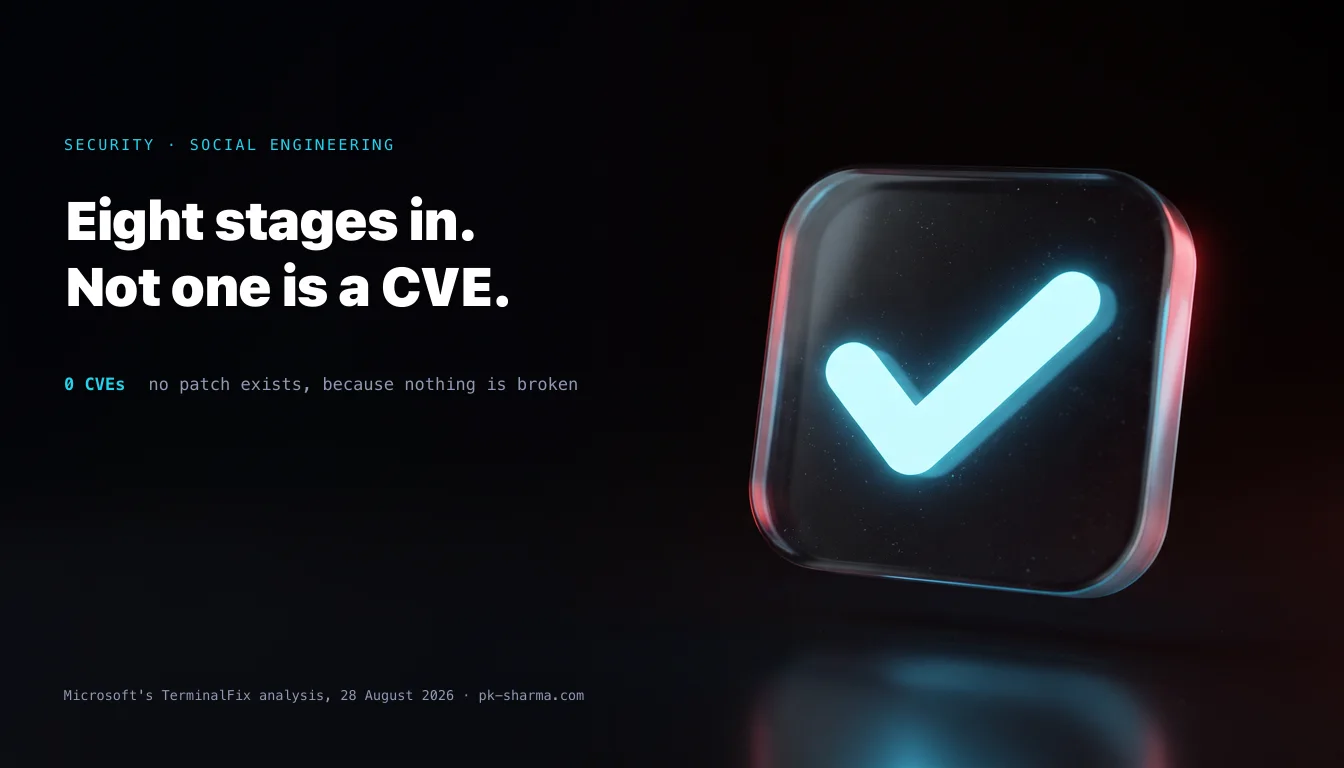
We checked rather than assumed. The NVD API returns totalResults: 0 for ClickFix, for TerminalFix and for dui70. The CISA KEV catalogue, version 2026.08.27 with 1,685 entries, contains nothing related. Microsoft's own post names no CVE anywhere in its text.
That is not an oversight. No software flaw is exploited at any point in this chain. The clipboard, the terminal, the loader's directory search order, Run keys, Task Scheduler, ADSI and a signed Python runtime are all working exactly as designed. The only thing that goes wrong is that somebody pastes a command.
The practical consequence is uncomfortable for the way most organisations are wired. There is no patch to deploy, no KEV deadline to work to, and no vulnerability scanner finding to close. Every control that touches this is a policy or configuration decision that had to be made before the lure arrived.
The Terminal framing needs qualifying
Microsoft's own words are that directing victims to Terminal rather than Run "increas[es] the likelihood that complex, multi-line scripts execute successfully". The reasoning is sound and the numbers are real: the Run dialog passes its input to ShellExecute and is bounded by MAX_PATH, giving a practical maximum of 259 characters, while a cmd.exe command line is documented at 8,191. That is roughly thirty times the headroom, and it removes the need for the aggressive Base64 and concatenation tricks actors have used to squeeze a loader into 259 characters.
But "TerminalFix moves ClickFix to the terminal" is not the new part, and Microsoft's own earlier research says so.
The delivery surface has been round this loop before
Mar to Jun 2024
ClickFix first observed
Microsoft attributes early activity to Storm-1607 delivering DarkGate. One May 2024 campaign ran to tens of thousands of emails.
Aug 2025
Actors move away from Terminal
Microsoft: early lures ran commands in Terminal or PowerShell, but multiple line warnings might have deterred potential victims, leading to the threat actors changing their tactics. The direction of travel was Terminal to Run.
Feb to Mar 2026
Terminal-based ClickFix returns
Microsoft Threat Intelligence discloses a campaign using Win+X then I to launch Windows Terminal directly, delivering Lumma Stealer.
28 Aug 2026
TerminalFix published
The delivery surface is prior art. What is new is the post-execution chain: sideloading into a signed process, steganographic staging, AD description harvesting and a bring-your-own-Python tunnel.
There is a further wrinkle that cuts against the multi-line framing. Windows Terminal ships with multiLinePasteWarning set to true by default, and Microsoft Learn justifies it in exactly these terms: it is "useful if you often copy and paste commands from untrusted websites". On default settings a genuinely multi-line paste raises a dialog.
What Microsoft did not observe
This is the sentence that matters most, and it is the one the coverage drops. Microsoft writes:
Microsoft did not observe the downstream actions described below in the analyzed chain.
The downstream actions are privilege escalation, disabling security controls, data exfiltration and ransomware, which Microsoft frames conditionally as what "typically follows". The Hacker News reports it as: "The tech giant has warned that such access can be abused further to escalate privileges, disarm security controls, exfiltrate sensitive data, and deploy ransomware." That is a fair paraphrase of the conditional sentence, and it omits the disclaimer standing next to it. A reader of the coverage alone would reasonably conclude ransomware was part of this campaign. It was not observed in it.
The absence runs deeper than one sentence.
What Microsoft quantified, and what it did not
| Quantified | Not quantified anywhere |
|---|---|
| Scheduled task interval, 60 minutes | Victim or device count |
| Python 3.14.5 over TLS 1.2 | Number of organisations affected |
| 7-byte protocol header, 8 message types | Sectors, named only as multiple industries |
| 3 PNGs, 8-byte length prefix | Geographies, none at all |
| 12 file hashes, 10 of them dui70.dll variants | Date of first observation, or campaign duration |
| 4 rotating user-agent strings | Threat actor or cluster ID, no Storm number |
Ten distinct dui70.dll hashes are the only implicit hint at breadth, and Microsoft draws no conclusion from them. The honest summary is that this is a well-documented technique report, not an incident report with a measured footprint. Nobody has inflated the numbers, because there are no numbers to inflate.
Microsoft's own hunting query will not run
A small thing, and the kind that costs an analyst twenty minutes on a Monday. One of the four KQL hunting queries in the post contains Unicode curly quotes around its last two literals, which Defender advanced hunting will not parse.
$ | where ProcessCommandLine has_all ("client.py", "--server", "--uuid", “cert.pem”, “gitnow.dev”)Syntax error: unexpected characterAs published. The first three literals use straight ASCII quotes and the last two use U+201C and U+201D. Replace the smart quotes with straight ones before running it.
Worth checking the other three queries in your own tenant before trusting a clean result.
What to check this week
Take this with you
Controls that actually reach this chain
- Set Windows Terminal multiLinePasteWarning and largePasteWarning to true, and confirm they are not disabled by your own profile management. These are the only controls that meet the user at the moment of the paste.
- Enforce PowerShell Constrained Language Mode and an AllSigned or RemoteSigned execution policy. With App Control, these are the two measures that break stage 2 itself rather than cleaning up after it.
- Alert on LockScreenContentServer.exe running from any path other than C:\\Windows\\SystemApps. Microsoft names this specifically, and it is a cheap, high-signal detection.
- Enable PowerShell script block logging if it is not already on, because every stage after the paste is scripted and none of it is visible without it.
- Fix the smart quotes in Microsoft’s reverse-tunnel hunting query before you run it, and sanity-check the other three.
- Treat any hit as network-level access and rotate credentials, including domain administrator accounts, because the reconnaissance stage reads AD user description fields.
Note what is missing from that list. None of these stop the paste, they constrain what happens afterwards. Microsoft also recommends an ASR rule blocking JavaScript or VBScript from launching downloaded executable content, which appears to be boilerplate: no JavaScript or VBScript launches anything anywhere in the described chain, and that rule would not have interrupted this intrusion.
The position
The uncomfortable part is not the tunnel or the steganography, both of which are competent but unremarkable. It is that a chain this long, ending in a persistent network pivot with credential-harvesting reconnaissance, requires no vulnerability at all. This site keeps arriving at the same place from different directions: the Gitea flaw whose severity was really a configuration setting, the advisory that omitted everything a defender needed. Vulnerability management is a well-funded, well-tooled discipline pointed at the part of the problem that has a number attached to it.
The second thing worth carrying away is smaller and more immediate. Microsoft said plainly that it did not observe ransomware here, and within two days that sentence had fallen out of the retelling. When you brief this internally, brief the caveat with it.
Sources
- PrimaryTerminalFix campaign deploys a reverse tunnel through multistage intrusion, 28 August 2026Microsoftaccessed 2026-08-30
- PrimaryThink before you Click(Fix): analyzing the ClickFix social engineering technique, 21 August 2025Microsoftaccessed 2026-08-30
- PrimaryWindows Terminal interaction settings: multiLinePasteWarning defaults to trueMicrosoft Learnaccessed 2026-08-30
- PrimaryCommand prompt line string limitation: 8,191 charactersMicrosoft Learnaccessed 2026-08-30
- PrimaryAttack surface reduction rules reference, updated 14 August 2026Microsoft Learnaccessed 2026-08-30
- PrimaryNVD API 2.0 keyword queries for ClickFix, TerminalFix and dui70: totalResults 0NIST National Vulnerability Databaseaccessed 2026-08-30
- PrimaryKnown Exploited Vulnerabilities catalogue, version 2026.08.27, 1,685 entries, no related recordCISAaccessed 2026-08-30
- Primary#StopRansomware: Interlock (AA25-203A), documenting ClickFix via the Run dialogCISA, FBI, HHS and MS-ISACaccessed 2026-08-30
- Reported byTerminalFix Uses Fake Cloudflare CAPTCHAs to Deploy Reverse-Tunnel Backdoor, 30 August 2026The Hacker Newsaccessed 2026-08-30
- Reported byESET Threat Report H1 2026, ClickFix detection trendESETaccessed 2026-08-30