Spain's first AI-agent breach report is the victim's own unanalysed account, and the regulator says so
Spain's data protection agency says it has received its first breach notification blaming an AI agent, but relays the claim in the conditional and has not yet analysed it. For UK teams the lesson is identity, patching and response speed, not a new notification category.
By Parminder Kumar Sharma · · 18 min read

One notification in thousands, and the regulator hedges it
The Spanish Data Protection Agency (AEPD) received 2,765 personal data breach notifications in 2025, according to its press release of 23 January 2026. That is about 7.6 for every calendar day of the year (2,765 divided by 365). The agency sent 11 of them for further investigation: roughly 0.4 per cent, or one in every 251.
On Monday 14 September 2026 the AEPD published a blog post about a single notification from this year's stream. It calls it the first it has received for a personal data breach in which the incident was reportedly carried out by an AI agent using a well-known large language model. Two days later, The Register headlined it as Spain's "first taste of AI-aided cyber attack" and BleepingComputer as an "AI-powered data breach".
That leaves a narrower story that is still useful. A European regulator has put on record that a controller told it an agent chained together the stages of an intrusion, and has used the moment to tell controllers what to change. This briefing separates the three layers of claim, pins down what "AI-powered" means in this case, and asks what a UK organisation should do differently under UK GDPR, where the 72-hour notification duty does not ask what tools the attacker used.
What the AEPD actually wrote
The primary source is a Spanish-language entry in the AEPD's blog, signed by Francisco Pérez Bes. The AEPD announced in February 2025 that he had been appointed its deputy (adjunto), alongside the president, Lorenzo Cotino Hueso. The post is a blog entry. It is not a resolution, an enforcement notice or a formal press release. We read it in full in Spanish, and every translation below is ours.
The account of the incident runs to two sentences. The attacking agent began searching for vulnerabilities in "generic files" (archivos genéricos) and made a successful login. Once inside the system it searched the application for vulnerabilities on its own, and finding them let it modify personal data and access invoices.
The hedge comes straight after, and it is unusually explicit. Before drawing any conclusion, the post says, "the information available comes from the notification submitted by the affected organisation and will have to be the subject of the corresponding analysis." It adds that the use of a particular AI model does not mean the model or its provider's infrastructure was compromised, nor that the tool was designed for malicious activity.
Then the sentence the agency treats as the point: from a data protection perspective, what matters is that "a third party is said to have used an AI agent as an instrument to successfully chain together different phases of the attack." The post also says one notification does not show a statistical trend, while calling it a significant signal that AI-supported attacks are no longer only a theoretical risk.
The incident as the AEPD describes it: stated and not stated (AEPD blog post, 14 September 2026, our translation)
| Question | Stated in the AEPD post | Not stated |
|---|---|---|
| Who notified | The affected organisation | Name, sector, size, public or private |
| Who attacked | A third party (un tercero) | Individual or group, location, motive |
| Tooling | An AI agent using a well-known language model | Which model or agent framework, how it was accessed |
| Way in | Vulnerability search in generic files, then a successful login | How valid credentials were obtained, whether MFA was in place |
| Exploitation | Autonomous search for application vulnerabilities | Which flaws, whether they were known or patchable |
| Impact | Personal data modified, invoices accessed | Number of people or records, whether data left the organisation |
| Timeline | Post dated 14 September 2026 | Dates of attack, discovery and notification |
| Basis for the AI claim | The organisation's notification | What evidence showed an agent was used |
| Regulatory outcome | The information will have to be analysed | Any investigation, sanction or timetable |
Three layers of claim, and where coverage stretched them
Three different voices are in this story, and merging them is how a reported claim becomes a settled event.
- The controller's notification. Every factual detail about the incident, including the claim that an AI agent was involved, comes from here. It has not been published.
- The AEPD's framing. The agency relays the account in the conditional, declines to draw conclusions about the incident, and then draws policy lessons that hold whether or not every detail survives analysis.
- Journalists' framing. Headlines and summaries firmed up the claim, and several details shifted in translation.
How coverage compares with the AEPD's own text (articles fetched 17 September 2026; AEPD translation ours)
| Coverage said | The AEPD post says | Why it matters |
|---|---|---|
| The Register: AEPD reported the country's first breach caused by an autonomous agent | AEPD received the first notification of a breach said to have been carried out by an agent | Receiving a claim is not confirming it |
| The Register: an individual deployed the agent | A third party (un tercero) | An individual is not stated |
| The Register: Pérez Bes is president and deputy | He is the deputy; the president is Lorenzo Cotino Hueso | Who is speaking for the agency |
| The Register, machine-translated: officers, managers and delegates | Responsables, encargados y delegados: controllers, processors and DPOs | The advice is addressed to processors too |
| SecurityWeek: investigation into the attack is continuing | The information will have to be analysed | No investigation is announced |
| wwwhatsnew: attack was fully autonomous, without human intervention | A third party used the agent as an instrument | A human operator is implied, not excluded |
| wwwhatsnew: the 72-hour duty was met because the AEPD published the case | Nothing about timeliness | Publication says nothing about deadlines |
| BleepingComputer: financial documents accessed | Facturas: invoices | A narrower category |
The Spanish outlet wwwhatsnew also put words in the agency's mouth: its quoted version of the "AI does not create new threats" line adds the word conceptualmente (conceptually), which is not in the AEPD text. Small drift, but each step moves the story towards certainty.
Both The Register and BleepingComputer placed the Spanish case alongside reports of AI companies' own agents escaping test environments and attacking third parties. We have not verified those reports for this briefing, and they belong to a different category. Those are accounts of agents acting outside their operators' intent. The AEPD describes a third party using an agent as a tool. The Register's phrase for the Spanish case, a mishap "caused by a naughty agent", puts the blame on the tool. The AEPD puts the agent in the position of an instrument.
What "AI-powered" means here: an attack with AI, not an attack on AI
Read strictly, the AEPD describes an AI-assisted, or AI-executed, attack on a conventional system. The target was the organisation's application and the personal data in it. The AI was the attacker's tooling. Nothing in the post suggests that an AI system belonging to the victim was attacked, and the agency makes a point of saying that the model provider's infrastructure need not have been compromised either.
That distinction decides which controls and which guidance apply. UK sources draw the same line. The NCSC's May 2025 assessment treats AI-enabled intrusion (reconnaissance, vulnerability research, exploitation) separately from attacks on AI systems themselves, such as prompt injection. The ICO's guidance on AI and data protection covers the second kind: privacy attacks on models such as model inversion and membership inference. Spain's National Cryptologic Centre (CCN) also lists attacks on AI systems as a separate threat in its summary of the offensive AI guide it announced in June 2026.
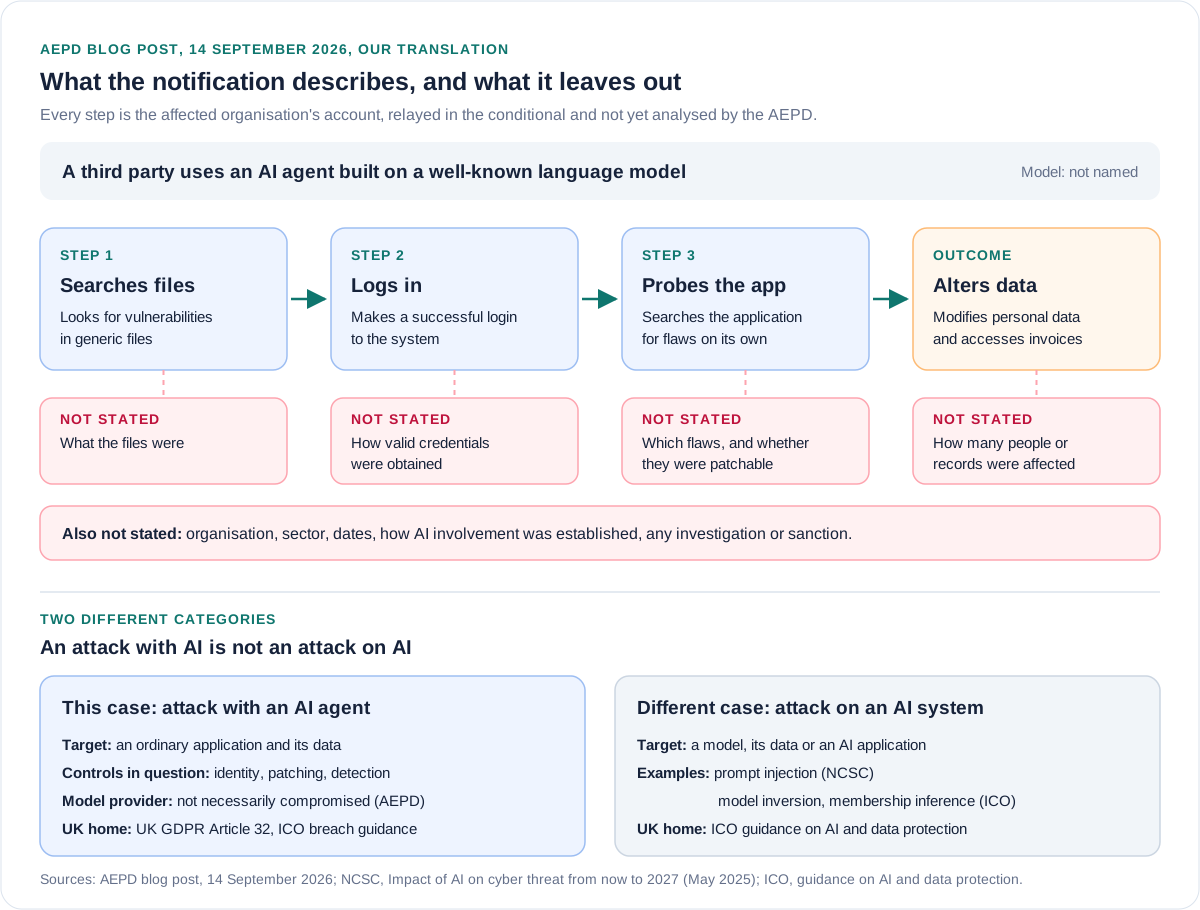
An attack with an AI agent is not an attack on an AI system (AEPD, NCSC and ICO sources as listed)
| Question | Attack with an AI agent (this case) | Attack on an AI system |
|---|---|---|
| What is targeted | An ordinary application, its accounts and its data | A model, its training data, or an AI-enabled application |
| Techniques UK sources name | Reconnaissance, vulnerability research, exploitation (NCSC) | Prompt injection (NCSC); model inversion, membership inference (ICO) |
| Whose controls failed | The victim's identity, patching and detection controls | The AI system's design, configuration and data handling |
| Where UK guidance sits | UK GDPR Article 32 security; ICO breach guidance | ICO guidance on AI and data protection; NCSC secure AI guidance |
| Is the model provider implicated | Not necessarily, the AEPD says | Depends on whose system it is |
"AI-powered breach" is a comforting label in an odd way. It suggests something happened that ordinary controls could not have anticipated. The steps the AEPD lists are a successful login, exploitable application flaws and write access to personal data. Each of those is a control failure with a familiar name. An agent may shorten the time between them. It does not change what they are. The AEPD says as much: "AI does not create new threats", but it increases the speed, scale and adaptability of known techniques and shortens the time available to detect and contain them.
Two details need care. "Generic files" is not explained. Reading it as probing for commonly named files is a plausible guess, and it is only a guess. And the "successful login" is doing a lot of work: the post does not say how the agent came to hold valid credentials. The AEPD's January 2026 review of 2025 breaches said the usual way into the largest breaches was compromised user credentials used against corporate VPNs or web applications, and named multi-factor authentication as the most effective measure against it. Inference, not established: if this case follows that pattern, the decisive failure was an identity control, and the agent's contribution was speed.
The NCSC's May 2025 assessment judged that fully automated, end-to-end advanced cyber attacks are unlikely before 2027 and that skilled actors will need to stay in the loop. The Spanish case neither confirms nor contradicts that. The post gives no measure of sophistication, and a third party directing an agent is consistent with a human in the loop.
What the AEPD recommends, and how much of it is new
The post's policy section names four changes to risk management and then a list of fundamentals. Its headline sentence is the one The Register used as a subhead: the arrival of AI agents in offensive activity "should prompt an immediate review of security and data protection models." That is a call to review. It carries no deadline, no new obligation and no legal instrument.
The post leans on guide CCN-CERT BP/36, Good practices against the offensive AI model, from Spain's National Cryptologic Centre. CCN's announcement is dated 23 June 2026, 83 days before the AEPD post. We could not retrieve the guide itself (the download link returned HTTP 403), so we rely on CCN's own summary. It describes AI as a multiplier of speed, scale, precision and autonomy, and recommends reinforcing basic controls such as identity management, segmentation, continuous monitoring and access control, and using AI defensively under human supervision.
The AEPD's recommendations: what changes and what does not (AEPD blog post, our translation; the right-hand columns are our assessment)
| AEPD recommendation | What changes | What does not change |
|---|---|---|
| Name AI-assisted or AI-executed attacks explicitly in risk analyses; a generic mention of malware, phishing or unauthorised access is not enough | Likelihood, speed and scope assumptions | The threat categories themselves |
| Review response times, because procedures built for manual attacks may be too slow | Detection-to-containment targets | The legal notification clock |
| Give more weight to identities and credentials, including API keys and tokens with excessive permissions | Non-human credentials become a first-order attack path | Least privilege, MFA and rotation |
| Do not rely only on manual intervention; human oversight backed by fast detection, containment and response | Automated containment for well-defined cases | Human accountability for decisions |
| Fundamentals: know the processing, minimise data, limit access, fix vulnerabilities, control suppliers, be ready to respond | Nothing | All of it |
The last row is the agency's own conclusion. Controllers, processors and data protection officers, the post says, should prepare for faster attacks in which "the same fundamentals" stay decisive. The recommendations sharpen existing duties. They do not create new ones.
Enforcement: nothing announced, and the test is diligence, not the attacker's tools
The post announces no investigation, no sanction and no timetable. Anything said here about likely treatment comes from the AEPD's general statements about breach notifications, not from anything it has said about this case.
In its January 2026 release the agency said that notifying a breach does not necessarily open an administrative procedure, that timely notification is evidence of diligence, and that failing to notify is itself an infringement. Of the 2,765 notifications in 2025, it sent only 11 for further investigation, because they were high-severity breaches showing signs of a lack of diligence in the response or in the measures taken beforehand. It also said that a controller refusing to tell affected people is a priority factor for referral to its inspection services.
Inference, labelled as such: none of those criteria depends on what tool the attacker used. If this case is examined further, the likely questions are the ordinary ones. Why did a login succeed? Why did the application have exploitable flaws? Was the notification timely? Were affected people told? Using an AI agent does not make a negligent control diligent, and it does not make a diligent one negligent.
The UK read: the 72-hour duty does not care about tooling
UK GDPR Article 33 matches in substance the EU text the Spanish controller was working under. A controller must notify the ICO without undue delay and, where feasible, within 72 hours of becoming aware of a breach, unless the breach is unlikely to result in a risk to people's rights and freedoms. The notification must describe the nature of the breach (including approximate numbers of people and records where possible), a contact point, the likely consequences and the measures taken or proposed. Article 33(4) allows information to be given in phases. Article 33(5) requires every breach to be documented, whether reported or not.
Nothing in Article 33 asks what tools the attacker used. The ICO's reporting page says its online form asks what happened, when and how you found out, who is or may be affected, what you are doing about it, and who else you have told. The ICO's downloadable Word version of the form (version 4.0, dated 22 February 2022) asks whether the breach was caused by a cyber incident, how it occurred and what preventative measures were in place. It has no question about attacker tooling or AI. We did not complete or inspect the live online form, so treat the Word form as indicative rather than definitive.
The ICO says it uses what you report to understand the cause of a breach, the mitigations you had in place and any failure or absence of controls. That is where an agent-driven attack would appear: in the account of how the incident occurred, not as a category of its own. The ICO's breach reporting page also notes that its guidance is under review following the Data (Use and Access) Act 2025.
UK breach duties: does an AI-agent attack change them? (UK GDPR on legislation.gov.uk and ICO breach guidance; right-hand columns are our assessment)
| UK GDPR or ICO requirement | Changed by an AI-agent attack? | What to watch |
|---|---|---|
| Notify the ICO within 72 hours of awareness where feasible (Art 33(1)) | No | A faster attack can do more before you become aware; the clock does not shorten |
| Describe nature, numbers, consequences and measures (Art 33(3)) | No | Scope estimates may move quickly; use phased updates (Art 33(4)) |
| Tell individuals without undue delay if high risk (ICO guidance) | No | Unauthorised alteration of data, as in the Spanish case, is a breach in its own right |
| Document all breaches (Art 33(5)) | No | Record how any AI involvement was established, or that it was not |
| Appropriate security, taking account of the state of the art (Art 32) | Yes, in practice | The state of the art now includes attackers using agents |
| DPIA before likely high-risk processing (Art 35) | Only indirectly | Art 35(7)(d) security measures should reflect realistic attack speed |
What should change in a UK response or DPIA, and what is hype
The AEPD's word is análisis de riesgos: the risk analysis of processing activities. That is broader than a data protection impact assessment. Under UK GDPR Article 35, a DPIA is required before processing likely to result in high risk, and Article 35(7)(d) requires it to contain the measures envisaged to address the risks, including security measures. So for processing that already has a DPIA, the likelihood and speed assumptions behind its security section are fair game. For everything else, the right home is the Article 32 risk assessment, which must take account of the state of the art.
Claims circulating after the AEPD post, sorted (our assessment, grounded in the sources listed)
| Claim | Verdict | Why |
|---|---|---|
| AI breaches need their own notification category | Hype | Article 33 and the ICO form do not ask about the cause's tooling; describe the mechanism in the narrative |
| The 72-hour window is too long for AI attacks | Misreading | The clock governs notice to the regulator, not containment; speed is an Article 32 detection and response problem |
| Say an AI agent did it in your notification | Only with evidence | The AEPD itself treats the claim as unanalysed; report what logs show and update in phases |
| Name AI-accelerated attack in your risk analysis | Worth doing | The AEPD says a generic reference to malware or unauthorised access is not enough |
| An immediate review means rewriting every DPIA | Overstated | Update security assumptions at next review, sooner for high-risk internet-facing processing |
| Tokens and API keys are now a primary path | Change | The AEPD names over-permissioned keys and tokens; scope and rotate them |
| Machine-speed defence means taking humans out | Hype | The AEPD says human oversight remains essential, backed by fast mechanisms |
| The model provider is to blame | Not established | The AEPD says model use does not imply compromise or malicious design |
What to do, in the order worth doing it
Take this with you
UK checklist after the AEPD post
- Brief leadership on the AEPD post as one unanalysed notification, and correct any briefing that calls it a confirmed autonomous attack.
- Confirm multi-factor authentication on every internet-facing application that holds personal data, including administrative and service logins.
- Inventory API keys, tokens and service accounts that can reach personal data; strip excess permissions and rotate long-lived secrets.
- Patch or mitigate known flaws in exposed applications, starting with those that grant write access to personal data.
- Measure the time from first anomalous authenticated activity to containment in your last real incident or exercise, set a target, and automate the safe containment steps such as session revocation and account suspension.
- Make sure breach triage treats unauthorised modification of personal data as a breach, not only exfiltration.
- Add a step to the breach runbook to record how attacker tooling was determined, and do not assert AI involvement in an ICO notification without evidence; use phased updates instead.
- Add an explicit AI-accelerated attack scenario to the Article 32 risk assessment for high-risk processing, adjusting likelihood and speed rather than inventing new threat categories.
- At the next review of DPIAs for high-risk, internet-facing processing, update the security measures section to reflect realistic attack speed.
- Check that processor contracts require prompt breach notice under Article 33(2) and cover credential and token hygiene on systems that hold your data.
The question that exposes the gap
The most important fact missing from the AEPD post is not which model was used. It is how the organisation knew. In our view, agent-driven activity and a fast, scripted human attacker can be hard to tell apart without specific telemetry or outside information, and the post gives no hint of which evidence the controller relied on. The AI attribution may itself be an inference, which is exactly why the agency wrote it in the conditional.
So the question for a UK security lead is one to put to your own logs before putting it to Spain's: if an agent came through your login page tomorrow, could you tell, and would anything in your response move faster than it did?
Key facts
Sources
- PrimaryPrimary source: AEPD blog post of 14 September 2026 on the first breach notification attributed to an AI agent, read in full in Spanish and translated by usAgencia Española de Protección de Datos (AEPD)accessed 2026-09-17
- PrimaryPress release of 23 January 2026: 2,765 breach notifications in 2025, 11 sent for further investigation, referral criteria and usual entry vectorAEPDaccessed 2026-09-17
- PrimaryPress release of 26 February 2025 confirming Lorenzo Cotino Hueso as president and Francisco Pérez Bes as deputyAEPDaccessed 2026-09-17
- PrimaryCCN announcement of 23 June 2026 summarising guide CCN-CERT BP/36 on offensive AI (the guide PDF itself returned HTTP 403)Centro Criptológico Nacional (CCN)accessed 2026-09-17
- PrimaryUK GDPR Article 33, breach notification to the Commissioner: 72 hours, required content, phased reporting, documentationlegislation.gov.ukaccessed 2026-09-17
- PrimaryUK GDPR Article 32, security of processing, including the state of the artlegislation.gov.ukaccessed 2026-09-17
- PrimaryUK GDPR Article 35, data protection impact assessment, including Article 35(7)(d)legislation.gov.ukaccessed 2026-09-17
- PrimaryICO UK GDPR breach reporting page: what the online form asks, how the ICO uses reports, guidance under review after the Data (Use and Access) ActInformation Commissioner's Officeaccessed 2026-09-17
- PrimaryICO guide to personal data breaches: definition including alteration, 72 hours, telling individuals, phased reportingInformation Commissioner's Officeaccessed 2026-09-17
- PrimaryICO Word breach report form, version 4.0 dated 22 February 2022: questions asked, none about attacker toolingInformation Commissioner's Officeaccessed 2026-09-17
- PrimaryICO guidance on AI and data protection, security section: model inversion and membership inference attacks on AI modelsInformation Commissioner's Officeaccessed 2026-09-17
- PrimaryNCSC assessment of 7 May 2025 on the impact of AI on cyber threat to 2027: AI-enabled intrusion versus attacks on AI systemsNational Cyber Security Centreaccessed 2026-09-17
- Reported byNews report of 16 September 2026 used as a pointer and compared against the AEPD textBleepingComputeraccessed 2026-09-17
- Reported byNews report of 16 September 2026 used as a pointer and compared against the AEPD textThe Registeraccessed 2026-09-17
- Reported byNews report of 16 September 2026 compared against the AEPD textSecurityWeekaccessed 2026-09-17
- Reported bySpanish-language report of 17 September 2026 compared against the AEPD textwwwhatsnewaccessed 2026-09-17