Fake interviews target Rust maintainers' publishing rights, and arrayref showed what one stolen account does
The Rust project warns that fake job and contract video calls are being used to compromise maintainers' devices and accounts in order to publish malware. August's arrayref compromise shows the downstream half: a build script that ran on cargo build.
By Parminder Kumar Sharma · · 15 min read

2,285 downloads, and not one bad line in arrayref
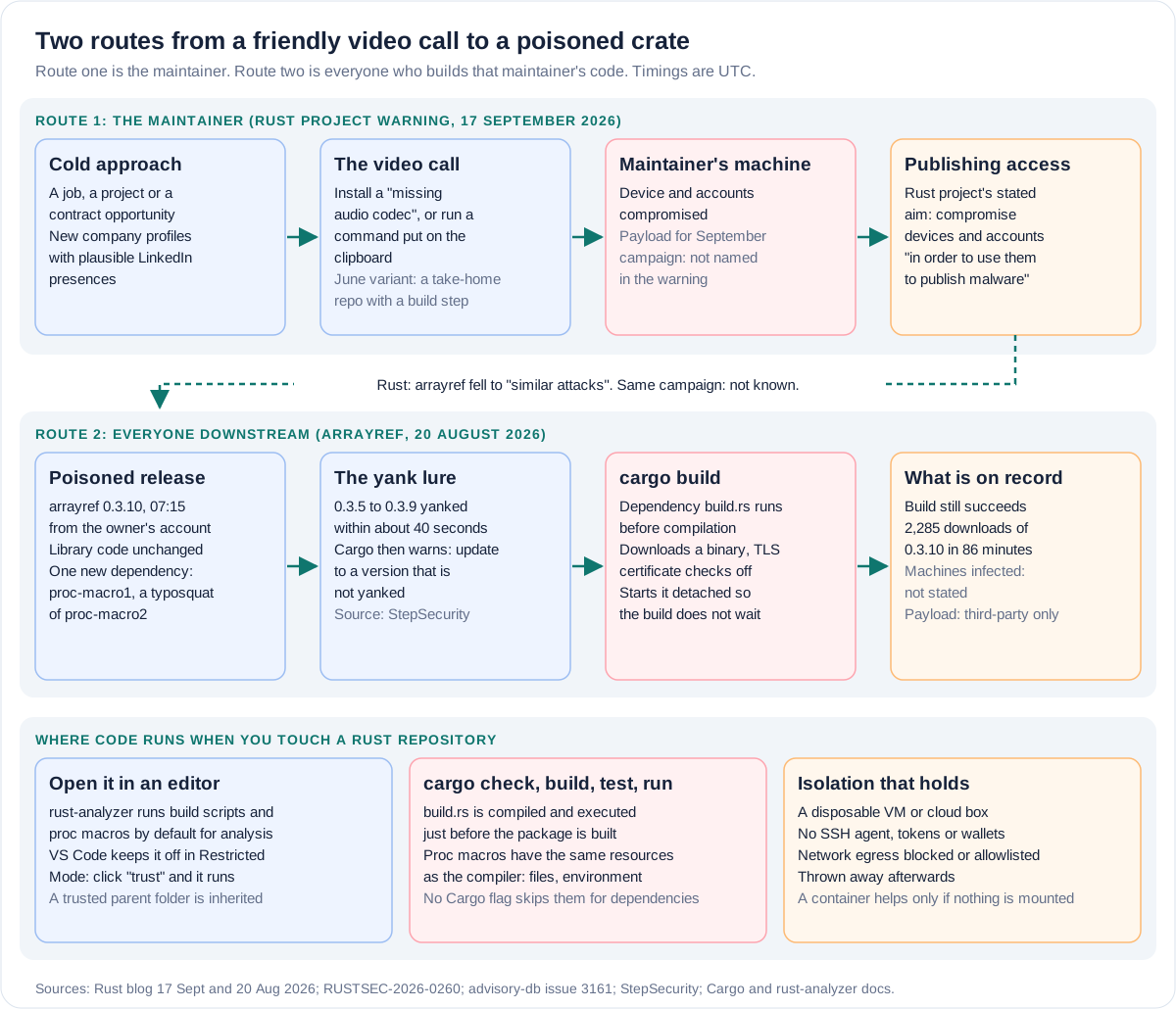
On 20 August 2026 a new release of arrayref, a small Rust crate with more than 266 million lifetime downloads, sat on crates.io for 86 minutes. According to the RustSec advisory, it was downloaded 2,285 times before it was removed. That is about 27 downloads a minute. The library code in that release was not the problem. The release added one dependency, proc-macro1, whose build script downloaded a malicious payload, and Cargo runs a dependency's build script automatically as part of cargo build.
Four weeks later, on 17 September, the Rust project warned that an ongoing campaign is targeting rust-lang members and owners of popular crates with fake job, project and contract video calls. Its stated aim is to compromise devices and accounts "in order to use them to publish malware". The Register reported the warning on 21 September, four days later.
The arithmetic is worth doing before reading anything into the 2,285. At arrayref's current rate of about 57.5 million downloads per 90 days, 86 minutes of normal traffic across all versions is roughly 38,000 downloads. The poisoned version took about 6 per cent of that, which fits RustSec's own statement that it was "less than 10%" of the crate's traffic because most users already had older versions locked. Lockfiles did most of the defending that morning.
Here is what those figures do not establish. A download is not a build, and a build is not a confirmed infection: no source I read gives a count of compromised machines. The Rust project does not say that arrayref fell to a fake interview specifically. It says the crate was compromised "through similar attacks", and adds that it does not know whether the June incident, the arrayref compromise and the current campaign are the same operation. And it does not attribute the campaign to North Korea. It says the attack style is known to be used by the DPRK, which is a statement about technique, not about who is behind these calls.
What the Rust project actually said, and what it left out
The primary warning is a short post by Adam Harvey on the Rust blog, written on behalf of the crates.io team and the security response working group. It is worth reading in full because it is careful about what it claims. I found no separate statement from the Rust Foundation. The table sets out the post against the questions a defender will ask.
The Rust project's warning of 17 September 2026, claim by claim. Source: Rust blog, Be alert: targeted attacks on prominent Rustaceans.
| Question | Stated | Not stated |
|---|---|---|
| Who is targeted | rust-lang members and owners of popular crates | How many people were approached |
| The lure | A video call about a job, project or contract | Which platforms or company names |
| The ask | Install something, such as a supposedly missing audio codec, or run a command put on the clipboard | The payload, its name or its hashes |
| The goal | Compromise devices and accounts to publish malware | Whether any account was compromised in September |
| Cover story | New but legitimate seeming company profiles, plausible LinkedIn presences | Any indicators of compromise |
| Link to earlier incidents | June attack on prominent Rust developers; arrayref compromised through similar attacks | Whether they are one campaign (it says this is not known) |
| Attribution | Attack style known to be used by the DPRK | That this campaign is DPRK |
The advice in the post is equally modest: be suspicious of cold outreach, hold calls on platforms you trust and ideally set them up yourself, and check that accounts look normal with MFA on and no unexpected logins. Concerns go to help@crates.io or security@rust-lang.org. There is nothing wrong with that advice. The point is that it is aimed at the maintainer's judgement, and it leaves the downstream consumer, which is most UK organisations, with no action of their own. The rest of this briefing is about that consumer.
Three incidents, one pattern
The warning links two earlier events. Read together with a third, they show a pattern that moves from the individual to the registry.
The incidents the Rust warning links to, with days counted to the warning of 17 September 2026. Sources: grack.com, Rust blog, RustSec, ashishb.net.
| Date | Event | Days before warning |
|---|---|---|
| 16 May 2026 | A developer publishes two fake technical adviser approaches, each asking him to run an npm project | 124 |
| 25 June 2026 | Matt Mastracci publishes his near miss: a fake venture capital approach and a booby-trapped take-home repo | 84 |
| 20 August 2026 | arrayref, internment and append-only-vec republished with a malicious build-time dependency | 28 |
| 17 September 2026 | Rust project warns of an ongoing campaign against maintainers | 0 |
June: the take-home test. Matt Mastracci, who publishes crates on crates.io, describes an approach from a persona claiming to be from a defunct Singapore venture capital firm, a video call with the camera off, and then a "test" repository. His instructions ended by asking him to run the typecheck, test suite and build commands before submitting. The repository was TypeScript, and the trap was a patch file that injected a loader into the TypeScript compiler, so the first typecheck or build would start a remote access trojan. He calls it PinpinRAT; the name comes from its internal strings and he found no other references to it. Its commands included dumping the environment, uploading any file, and spawning processes. He caught it because a TypeScript task made no sense for a Rust maintainer. His closing line is the reason this briefing exists: had it been a Rust repository with a booby-trapped build.rs, he writes, "I might have even fallen for it".
August: the poisoned release. The Rust security response team says a report arrived that proc-macro1 was malicious and carried a build script downloading a payload. It then found that arrayref had been republished to depend on it, with recent versions yanked. It removed the malicious versions, reversed the yanks, locked the owner's account, and said it did not believe the author was acting maliciously: their computer or credentials were likely compromised.
September: the warning. The call, the codec and the clipboard. No payload is named.
Why cargo build runs a stranger's code
Rust developers often assume that compiling is safe and running is dangerous. The Cargo documentation says otherwise. A file named build.rs in a package root makes Cargo compile that script and execute it just before building the package, and the script "may perform any number of tasks". It runs as you, with your files, your environment variables and your network. Procedural macros are the second route: the Rust reference says they run during compilation and have the same resources as the compiler, and "have the same security concerns" as build scripts.
Three details from the arrayref records show how little an attacker needs from that design.
- The dependency was the weapon, not the crate. The original report to RustSec, filed at 07:54 UTC, says
proc-macro1shipped the genuineproc-macro2source so that builds succeeded, with abuild.rsthat pieced together a download address from base64 fragments, fetched a binary over TLS with certificate checks switched off, and ran it. The same report says the child process was deliberately abandoned, with an in-source comment about escaping Cargo's job object, so the build did not wait for it. - The registry's safety signal became the lure. According to StepSecurity, which says it checked the crates.io audit log, versions 0.3.5 to 0.3.9 were yanked in a burst between 07:15:24 and 07:15:40. The reporter says that is how he was hit: Cargo's advice to move off a yanked version resolved to the one release that was not yanked, which was the poisoned one.
- It was quick. From the malicious
proc-macro1release at 07:11:15 to the last deletion at 09:25:24 is 2 hours 14 minutes. The three legitimate crates were poisoned between 07:15:00 and 07:37:49, a span of 22 minutes 49 seconds.
Merely opening the project can be enough. The rust-analyzer configuration lists cargo.buildScripts.enable and procMacro.enable as true by default, so an editor running rust-analyzer will run build scripts and proc macros to analyse the code. The VS Code extension declares that it does not support untrusted workspaces, warning that a malicious actor could use it "to run arbitrary code on your machine". So in VS Code the only thing between opening a hostile Rust repository and running its build script is the Workspace Trust prompt, and VS Code's documentation notes that trusting a parent folder trusts every subfolder under it. By the same documented life cycle, cargo check has to run build scripts before it can check a package; that is my reading of the Cargo book rather than a separate statement in it.
The friendly name is not a control
Most of the protection developers believe they have here comes from reassuring words. Each one describes an intention, not a boundary.
Comforting labels in this story and what they actually do. Sources: Cargo book, Rust reference, rust-analyzer and VS Code documentation, RustSec issue 3161, StepSecurity.
| Label | What it suggests | What it does |
|---|---|---|
| cargo build, cargo check | Compiling, not running | Runs every dependency's build script and proc macros as you |
| Yanked | This version is bad, move on | Only a signal; in August it herded users to the poisoned release |
| Audio codec, driver, fix | A harmless install to make the call work | Software from a stranger, run with your privileges |
| Take-home test | A coding exercise | In June, a build command that started a RAT |
| Trusted folder | I checked this repo | Trust extends to every subfolder, including the next clone |
| cargo audit clean | We were not affected | Advisories for deleted malware arrived hours later; check lockfiles and caches |
| It is Rust | Memory safe, so safe | Memory safety says nothing about what a build script is allowed to do |
The cargo audit row deserves a note. On the day, a commenter in the RustSec issue pointed out that deleted malicious versions produced no audit signal. Advisories were then added, and the OSV record for RUSTSEC-2026-0260 is dated 20 August. A clean audit today will catch arrayref 0.3.10. It will not catch the next one in the hours before an advisory exists, and a warm ~/.cargo/registry cache or a vendored copy keeps building a version the registry has deleted.
Attribution: separate the method from the accusation
The Rust post links to Kudelski Security research on the Contagious Interview campaign as evidence that the style is DPRK tradecraft. That research describes fake interviews run over LinkedIn, WhatsApp and Discord, repositories that trigger a backdoor on npm install or when opened in VS Code, and theft of the whole process environment. The joint advisory of 18 September from Japanese, US, Australian and German agencies describes the same technique at scale, at least 30,000 PCs in more than 100 countries between December 2025 and July 2026, and we covered it here. That advisory talks about npm and VS Code projects. It does not mention Rust, Cargo or crates.io.
So the honest position is this. The technique matches a documented North Korean campaign. No primary source I read says these Rust approaches were made by North Korea, and Mastracci himself writes that who was behind his attempt is for the agencies to decide. The defender does not need the attribution to act, because the controls are the same whoever is calling.
Some interests are worth declaring. StepSecurity, whose timeline I rely on for the yank sequence, sells the runtime monitoring product it uses to demonstrate detection. Kudelski sells detection and response services. None of that makes their evidence wrong; the registry timestamps they cite match the Rust project's own. It is a reason to take their product conclusions as sales material and their data as data.
What isolation actually works
The Rust project's advice is to be suspicious. That is necessary but it is not a control, because the whole technique is built to pass cursory inspection. What stops a build script is where it runs and what it can reach.
Isolation options for running unfamiliar Rust code, judged against what a hostile build script does. Mechanism sources: Cargo book, Rust reference, rust-analyzer and VS Code documentation; judgements are the author's.
| Option | What it stops | What it does not stop |
|---|---|---|
| Reading the code first | Obvious payloads in the top-level build.rs | Payloads in a dependency, a proc macro or a patch file |
| VS Code Restricted Mode | rust-analyzer and tasks running on open | Anything you run once you click trust or open a terminal |
| Container with nothing mounted and no network | Credential theft and payload download | Container escape, and it fails the moment you mount your home or SSH agent |
| Disposable VM or cloud machine, no secrets | Theft from your real machine; destroyed afterwards | Anything you type into it, such as a token or password |
| Egress allowlist in CI | Payload download and callback to a bare IP | A payload embedded inside the crate itself |
| Committed Cargo.lock and --locked builds | Silent resolution to a brand new release | A poisoned version you deliberately update to |
| Trusted publishing for releases | Long-lived crates.io tokens in CI secrets | A maintainer's stolen browser session or local token |
For maintainers specifically, crates.io has supported trusted publishing since July 2025, which lets GitHub Actions request a short-lived publishing token through OpenID Connect instead of storing an API token. The arrayref publishes came from the owner's own account without a matching commit in the project repository, according to StepSecurity, which is exactly the path trusted publishing is designed to make unnecessary. Whether the account used a token or a session is not stated in the Rust project's post.
What this means for a UK organisation
Most UK organisations are not maintainers. They are consumers of crates, through their own Rust services, through tools their engineers install with cargo install, and through vendor software built on these libraries. Three exposures follow.
- Your builds. Any build that resolved
arrayref0.3.10,internment0.8.7,append-only-vec0.1.9 or any version of the attacker crates during the window ran the payload on that machine or runner, with whatever secrets it held. - Your engineers as targets. Anyone on your team who maintains a popular crate is exactly who this campaign wants, and the approach arrives on their personal LinkedIn and personal laptop, outside your EDR and SSO logging.
- Your hiring. If your own interview process asks candidates to clone and build a repository, you have taught them the behaviour the attacker relies on.
No UK agency is named in the Rust warning, and no UK victim is recorded in any source I read.
# Check a developer machine or CI cache for the deleted malicious crates
# (command published by the Rust security response team, 20 August 2026)
find ~/.cargo/registry/cache -type f \( \
  -name 'append-only-vec-0.1.9.crate' -o \
  -name 'arrayref-0.3.10.crate' -o \
  -name 'internment-0.8.7.crate' -o \
  -name 'proc-macro1-*.crate' -o \
  -name 'proc-macro-en-*.crate' -o \
  -name 'aovine-*.crate' -o \
  -name 'arone-*.crate' -o \
  -name 'aronenao-*.crate' -o \
  -name 'tinymember-*.crate' \
\) -print

# Check committed lockfiles across your repositories
grep -rEn 'proc-macro1|proc-macro-en|aovine|arone|aronenao|tinymember' --include=Cargo.lock .
grep -rEn -A1 'name = "(arrayref|internment|append-only-vec)"' --include=Cargo.lock . | grep -E '0\.3\.10|0\.8\.7|0\.1\.9'
What to do, in the order worth doing it
Take this with you
This week
- Run the Rust project's cache check on developer machines, self-hosted runners and any CI cache or container image with a warm Cargo registry.
- Search every committed Cargo.lock for the six attacker crates and the three affected versions. Treat any hit as a compromised build host and rotate every credential it could reach.
- Tell anyone in your organisation who owns a crate on crates.io about the warning, and ask them to check MFA and recent logins as the Rust project advises.
- Set a plain rule for everyone: no installing codecs, drivers or fixes during a call with someone you have not met, and no pasting commands a stranger supplies.
Take this with you
This month
- Build Rust in CI with a committed Cargo.lock and the --locked flag, and review lockfile changes in pull requests like code.
- Put an egress allowlist on build runners so a build script cannot fetch a payload from a bare IP address.
- Keep VS Code Workspace Trust on, clone unfamiliar code outside any trusted parent folder, and do not click trust on a repository you are evaluating.
- Give engineers a disposable VM or cloud workspace with no credentials for anything they are asked to build by a stranger.
- Ask maintainers on your staff to move releases to crates.io trusted publishing and remove long-lived publishing tokens.
Take this with you
This quarter
- Consider a cooling-off period before new crate versions enter your builds; the August releases were live for 86 to 107 minutes.
- Remove any step in your own hiring that asks a candidate to clone, install or build code on their own machine.
- Ask software vendors who ship Rust how they would know if a build in the August window had pulled the poisoned versions.
The question that exposes the gap
The Rust project's advice relies on a maintainer noticing that a pleasant video call is a trap. Mastracci noticed only because the language was wrong. So the question for any organisation that builds Rust is not whether your developers are careful. It is this: if a trusted maintainer's account published a poisoned release tomorrow morning, which of your machines would run its build script before anyone in the Rust project had written a word about it, and what secrets would be sitting on them?
Sources
- PrimaryBe alert: targeted attacks on prominent Rustaceans, by Adam Harvey. The primary warning, read in full: targets, lure, stated aim, links to earlier incidents, DPRK wording and advice.Rust project (crates.io team and security response working group)accessed 2026-09-21
- PrimarySupply chain attack on arrayref. Official incident notice: build script payload, deleted crates, per-crate publish and deletion times, account lock, cache check command.Rust Security Response Teamaccessed 2026-09-21
- PrimaryRUSTSEC-2026-0260, arrayref 0.3.10 removed due to a malicious dependency. Source of the 2,285 downloads and the less than 10 per cent of traffic statement (read via the OSV API, with sibling advisories 0259, 0261, 0262, 0263, 0264, 0265 and 0266).RustSec advisory databaseaccessed 2026-09-21
- PrimaryOriginal malware report by jhobern, filed 07:54 UTC on 20 August 2026, and the comment thread. Used for the build script behaviour, the yank lure, the audit gap and the third-party payload reports.RustSec advisory-db on GitHubaccessed 2026-09-21
- PrimaryAnatomy of a Failed (Nation-State?) Attack. First-hand account of the June approach linked by the Rust warning: the persona, the take-home repo, the build step trap and the RAT capabilities.Matt Mastracci, grack.comaccessed 2026-09-21
- PrimaryI was asked to install malware during a fake interview. First-hand account linked by the Rust warning as evidence the style is seen outside Rust. Used for the date and the npm install trigger only.Ashish Bhatia, ashishb.netaccessed 2026-09-21
- PrimaryHow DPRK's Contagious Interview campaign targets developers. Vendor research the Rust warning cites for the DPRK technique link.Kudelski Securityaccessed 2026-09-21
- PrimaryJoint advisory of 18 September 2026 on WaterPlum, commonly referred to as Contagious Interview. Used for scale and to confirm it does not mention Rust, Cargo or crates.io.FBI IC3 and partner agenciesaccessed 2026-09-21
- PrimaryVendor write-up of the arrayref attack. Used for the yank timestamps from the crates.io audit log, the minute-by-minute timeline and the absence of a matching repository commit.StepSecurityaccessed 2026-09-21
- PrimaryBuild scripts. Documents that Cargo compiles and executes build.rs just before building a package.The Cargo Bookaccessed 2026-09-21
- PrimaryProcedural macros. States they run during compilation with the compiler's resources and share build scripts' security concerns.The Rust Referenceaccessed 2026-09-21
- PrimaryConfiguration reference. Shows cargo.buildScripts.enable and procMacro.enable default to true.rust-analyzeraccessed 2026-09-21
- PrimaryVS Code extension manifest. Declares untrusted workspaces unsupported, with the arbitrary code warning quoted.rust-analyzer on GitHubaccessed 2026-09-21
- PrimaryWorkspace Trust. Restricted Mode behaviour and parent folder trust inheritance.Microsoft, Visual Studio Code documentationaccessed 2026-09-21
- Primarycrates.io development update, July 2025. Announcement of trusted publishing via OIDC from GitHub Actions.Rust blog, crates.io teamaccessed 2026-09-21
- Primaryarrayref crate record. Lifetime and 90-day download counts used for the arithmetic.crates.io APIaccessed 2026-09-21
- Reported byNews report that pointed to the Rust warning, published 21 September 2026.The Registeraccessed 2026-09-21
- Reported byEarlier briefing on the 18 September joint advisory.pk-sharma.comaccessed 2026-09-21