OpenAI is cutting model supply to Cursor after SpaceX bought it. The lesson is not the feud, it is that your AI tooling has a contract clause you never saw
A change-of-control clause fired two weeks after the acquisition closed, and 12 November is now a date on a lot of developers tooling. The impact is narrower than the headlines: about 5% of Cursor traffic by its own account, with bring-your-own-key access reportedly intact. And the sharpest line in OpenAI post, about an admission under oath, is a characterisation of testimony rather than a quote of it.
By Parminder Kumar Sharma · · 9 min read
What OpenAI announced
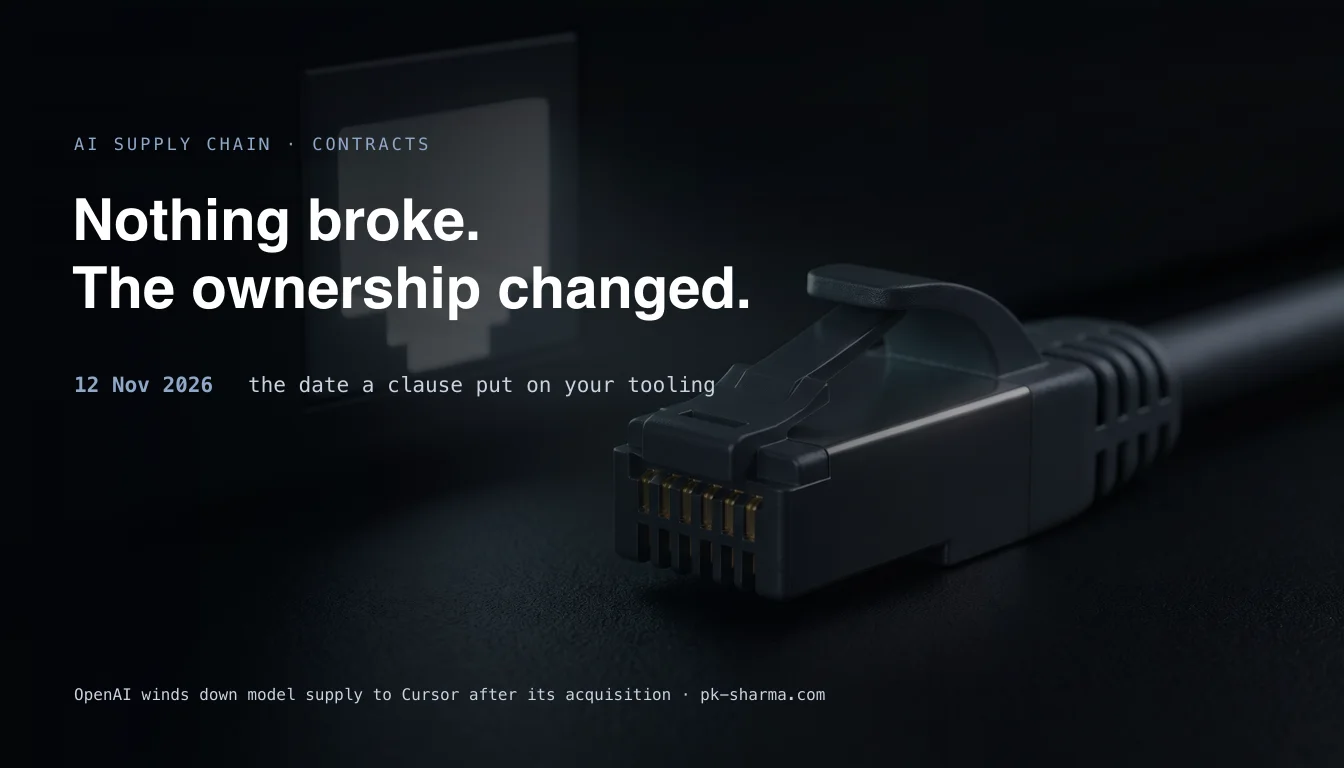
On 28 August 2026, OpenAI published a short post stating it had notified SpaceX that it intends to wind down the contract supplying OpenAI models to Cursor, with a proposed shutoff date of 12 November 2026. OpenAI says that is "the maximum notice provided by our contract."
The stated reason is trust: OpenAI writes that it "cannot be confident that SpaceX will use our technology within our terms of service, based on our experience with Elon Musk’s companies violating contracts." The mechanism is contractual: OpenAI says its agreement with Cursor "gives us a limited time window to cancel it after a change of control."
Two things are ending, on different clocks. Existing models stop on 12 November. Future models have already stopped: OpenAI says it is "not providing future models to Cursor, including its coming Astra model."
The part practitioners should take from this
Every AI supply-chain story this site has run has been technical: reseller hops nobody disclosed, shared backends, a cache that answers by timing. This one is contractual, and it is the layer with the least visibility of all.
Nobody using Cursor chose SpaceX. They chose an editor, and the ownership underneath it changed in a transaction they had no part in. A clause they have never read, in a contract they never signed, then put a date on their tools. There is no technical fault to debug and no configuration to fix.
What actually changes, and what does not
The headlines say OpenAI is cutting Cursor off. The detail is more precise, and more interesting, because the paths that survive are the ones that run through OpenAI’s own surface.
What ends on 12 November, and what does not
| Path to an OpenAI model | Status |
|---|---|
| OpenAI models bundled through Cursor | Ends on 12 November 2026 |
| Future OpenAI models, including Astra | Already withdrawn, not provided at all |
| Using your own OpenAI API key inside Cursor | Reported to continue working |
| OpenAI’s own IDE extensions running inside Cursor | Reported to remain available |
| Anthropic, Google, Moonshot and Z.ai models in Cursor | Unaffected |
| Grok and Cursor’s Composer | Unaffected, and now listed as Cursor’s own models |
That distinction matters. This is not "OpenAI models cannot be used in Cursor". It is the bundled commercial relationship ending, while the routes that keep OpenAI as the direct counterparty stay open. A developer who wants GPT in Cursor after November can reportedly still have it, by holding their own OpenAI account.
Cursor’s co-founder Michael Truell put a number on the impact, posting that "OpenAI models serve about 5% of Cursor user traffic" and that the company is "speaking with the OpenAI team to resolve this." He added that Cursor had "trusted their platform to be neutral infrastructure for our business."
If that 5% is right, this is less a catastrophe for Cursor than a signal about the model layer generally.
The corporate chain, which OpenAI compresses
OpenAI’s post says Twitter is "now part of SpaceX" and xAI is "now also part of SpaceX." Both are true, but they arrived by two separate transactions a year apart, and the sequence is worth having straight.
How a code editor ended up inside a rocket company
Mar 2025
xAI acquires X
Announced 28 March 2025, an all-stock deal valuing X at $33bn and xAI at $80bn.
Feb 2026
SpaceX acquires xAI
Announced 2 February 2026, bringing both xAI and X inside SpaceX, with orbital data centres given as the rationale.
12 Jun 2026
SpaceX lists on Nasdaq
The IPO gives SpaceX publicly traded stock, which becomes the currency for what follows four days later.
16 Jun 2026
Cursor deal announced
SpaceX agrees to acquire Anysphere, the company behind Cursor, in an all-stock merger.
14 Aug 2026
The acquisition closes
Per the SEC filing, at an implied equity value of $60.0bn, paid in about 389 million SpaceX Class A shares.
28 Aug 2026
OpenAI gives notice
Two weeks after closing, OpenAI exercises its change-of-control window and proposes a 12 November shutoff.
Note what the acquisition already did to the model line-up. Cursor’s own documentation now lists Grok alongside its in-house Composer model, described as jointly trained by Cursor and SpaceXAI. The substitution for a departing OpenAI was staged before OpenAI departed.
Handle the "under oath" claim carefully
OpenAI supports its trust argument with two prior incidents. Both deserve precision, and one of them is being repeated in a form stronger than the record supports.
The Twitter claim needs the same care. The underlying reporting is that OpenAI paid Twitter a reported sum for data access, and that Musk cut that access off in December 2022 having judged the price too low. No court has found a breach. "Broke the terms of our contract" is OpenAI’s characterisation of a unilateral termination, and X has never publicly conceded or contested it.
None of this makes OpenAI wrong. A supplier is entitled to decide who it trusts, and it does not need a judgment to do so. But a company describing a counterparty’s conduct is an interested party, and "admitted under oath" reads as settled fact when the underlying admission was about something adjacent.
The commercial reading, stated plainly
OpenAI gives a compliance reason and does not mention the obvious commercial one. Both can be true, and the honest thing is to say so rather than pick.
OpenAI sells Codex, a competing coding product. Cursor is now owned by the company that also owns xAI, whose Grok models Cursor now ships as its own. So OpenAI is ending a bundled supply relationship with a rival coding tool owned by a rival model lab, and the paths it has left open are the ones where OpenAI remains the direct counterparty and keeps the customer relationship.
There is precedent in both directions, which argues against treating this as unprecedented. Anthropic cut Windsurf off from Claude in June 2025, and revoked OpenAI’s own API access in August 2025. Within hours of OpenAI’s announcement, Anthropic co-founder Tom Brown said Anthropic would "continue to increase compute to support Claude models in Cursor." The suppliers are all playing the same game.
Musk’s response, reported by Reuters, was "I couldn’t care less." SpaceX has issued no statement, and Cursor has published no migration guidance.
What to do
Take this with you
For teams whose tooling depends on somebody else’s model
- Write down which of your tools resell a model you do not contract for directly. That is your exposure list. If the answer is a bundled subscription rather than your own API key, a change of ownership at either end can move your access without your involvement.
- Prefer holding your own model credentials where the tool supports it. In this case the reported survival of bring-your-own-key access is exactly the difference between a tool decision and a supplier decision, and it is the cheapest form of insurance available.
- Treat vendor ownership as a monitored risk, not background news. Change-of-control clauses are standard and invisible to end users, so the trigger for losing a dependency can be an acquisition you read about in the press.
- Keep a tested second model path in any workflow that matters. Cursor users still have Anthropic, Google and others, which is why this is disruptive rather than fatal. A workflow pinned to one provider through one reseller has no such cushion.
- Do not assume regulation covers this. Analysis of the EU Data Act switching rules makes the point neatly: they protect a customer who chooses to leave a provider, not a customer whose provider decides to leave them.
The position
The interesting thing here is not the feud. It is that a large number of developers have just discovered they had a dependency with a termination clause in it, and that neither end of that clause was theirs.
This site keeps writing about the AI supply chain as a technical problem, because that is where the measurable failures have been. This is the same argument one level up. The question "who serves my prompt" has a corporate answer as well as a technical one, and the corporate answer can change in a single transaction. Nobody using Cursor in June chose to depend on the outcome of a merger, and by August that is what their tooling depended on.
Two closing cautions, both about precision, which is the only thing this story is short of. The impact is smaller than the headlines imply: around 5% of traffic by Cursor’s own account, with the bring-your-own-key path reportedly intact. And the sharpest sentence in OpenAI’s post, the one about an admission under oath, is a characterisation of testimony rather than a quotation of it. When a dispute is this public, the details are exactly what gets flattened, and the flattened version is what everyone remembers.
Sources
- PrimaryOur decision on Cursor following its acquisition by SpaceX, 28 August 2026OpenAIaccessed 2026-08-29
- PrimarySpace Exploration Technologies Corp. Form 8-K, completion of the Anysphere merger, 14 August 2026US Securities and Exchange Commissionaccessed 2026-08-29
- PrimaryCursor is now a part of SpaceX, 14 August 2026Cursor (Anysphere)accessed 2026-08-29
- Reported byElon Musk testifies that xAI trained Grok on OpenAI models, 30 April 2026TechCrunchaccessed 2026-08-29