Nscale's IPO filing: two customers hold 85 per cent of a 103 billion dollar order book
Nscale's Form S-1, filed on 18 September 2026, puts 88.4bn dollars of its 103.4bn dollar contracted book with Microsoft and Anthropic. For UK buyers of sovereign compute, the filing is a supplier due diligence pack that reads very differently from the press release.
By Parminder Kumar Sharma · · 17 min read

Add the two contracts up: 85 per cent of the book
Nscale Limited, a London company that calls itself a full stack AI hyperscaler, filed a Form S-1 registration statement with the U.S. Securities and Exchange Commission on 18 September 2026. Two numbers sit a few pages apart in it. Statements of work with Microsoft entered into between September 2025 and April 2026 provide for payments of up to approximately 43.8bn dollars through December 2033. Services agreements with Anthropic, signed on 25 August 2026, provide for aggregate payments of up to approximately 44.6bn dollars. Add them: 88.4bn dollars. The filing separately reports 103.4bn dollars of active and contracted total contract value as of 31 August 2026. The two named contracts are 85 per cent of that figure.
That arithmetic is ours, and it comes with a caveat the filing itself does not remove. The two customer figures are stated as amounts payable up to a maximum and subject to delivery; total contract value is defined in the filing as revenue contracted across the committed term, measured at signature and excluding optional extensions. Nobody reconciles the two presentations. So the honest version of the number is this: on the filing's own figures, the two largest disclosed contracts are of the same order as the whole contracted book, and the space left for everyone else is about 15bn dollars.
Here is what that does not establish. It does not establish that Nscale will fail, or succeed, or that its shares will do anything at all. This briefing carries no view on the offering as an investment, and P.K. Sharma is not a financial adviser. It does not establish that either contract will be performed: the filing says the Anthropic financing is not yet committed. And it does not establish current revenue concentration, because in the six months to 30 June 2026 Nscale recognised 140.6m dollars of revenue in total, and the Anthropic agreements did not exist for any of it. The reason this matters to a UK security lead or head of infrastructure is narrower and more useful than a share price: if you are buying sovereign AI compute in Britain, this document is the most detailed supplier due diligence pack you will ever be handed for free.
What the filing states, and what it leaves blank
A registration statement in this form is a preliminary prospectus. The number of shares and the price range are printed as blanks, and they were still blank on 22 September 2026, four days after filing. Nscale intends to list ordinary shares on the New York Stock Exchange under the symbol NSCL, and to re-register as Nscale plc before completion. There is a retail tranche for UK investors, structured through depositary interests issued by Computershare or Euroclear UK and International, but the shares themselves will be listed solely on the NYSE and not on the London Stock Exchange.
Stated and not stated in Nscale's Form S-1 of 18 September 2026
| Question | Stated in the filing | Not stated in the filing |
|---|---|---|
| Where and at what price | NYSE, symbol NSCL, ordinary shares, UK retail tranche via depositary interests | Number of shares, price range, valuation and proceeds are all blank in this version |
| Microsoft | Up to approximately 43.8bn dollars through December 2033, terms of five to six years per tranche | How much of that sits inside the 103.4bn dollar contracted total |
| Anthropic | Up to approximately 44.6bn dollars across four agreements, at the Monarch Compute Campus | Any binding financing commitment for the required GPUs and data centre infrastructure |
| Largest customer identity | 52 per cent of revenue in the first half of 2026, 73 per cent in 2025, one customer for substantially all of 2024 | The customer is not named in any of the three periods |
| UK capacity | Two sites, 20 IT MW colocation and 50 IT MW owned, both contracted | Which customers hold them, and when either goes live |
| Security certifications | In the process of obtaining ISO 27001, SOC 2 and ISO 22237 aligned standards | Which certifications, if any, are held today, and for which sites |
The financial shape is the one the sector has taught us to expect. Revenue of 140.6m dollars in the six months to 30 June 2026, against 10.4m dollars in the same period of 2025. A net loss of 1,020.1m dollars in those six months, which is 7.3 times revenue. An accumulated deficit of 1,860.9m dollars. Cash and cash equivalents of 1.5bn dollars at 30 June 2026. Remaining performance obligations of 56.4bn dollars at that date, before the Anthropic agreements were signed. Two material weaknesses in internal control over financial reporting, covering entity level and business process controls, information technology general controls, and a shortage of finance staff, with remediation running through 2026 and 2027.
Concentration is not one risk, it is four
The word concentration appears in the filing in several places, and each one is a different exposure. Reading them together is the point, because a customer buying capacity inherits all four at once.
Four concentrations disclosed in the Form S-1
| Concentration | What the filing discloses |
|---|---|
| Customers | Largest customer was 52 per cent of revenue in the first half of 2026, 73 per cent in 2025 and substantially all revenue in 2024. The 2025 customer is expected to fall below 20 per cent of 2026 revenue. |
| Contract value | Microsoft up to 43.8bn dollars and Anthropic up to 44.6bn dollars, against 103.4bn dollars of active and contracted total contract value. Active value is 2.6bn dollars, 2.5 per cent of the total. |
| Suppliers | Three suppliers accounted for 53, 37 and 10 per cent of purchases in the first half of 2026. NVIDIA is the primary manufacturer, orders are placed just in time, and there are no long term contracts guaranteeing capacity. |
| Geography | In the first half of 2026, 52 per cent of revenue came from deployments in Portugal and 45 per cent from Norway. Of 1,370 contracted IT MW across 17 sites, 770 are in the United States. |
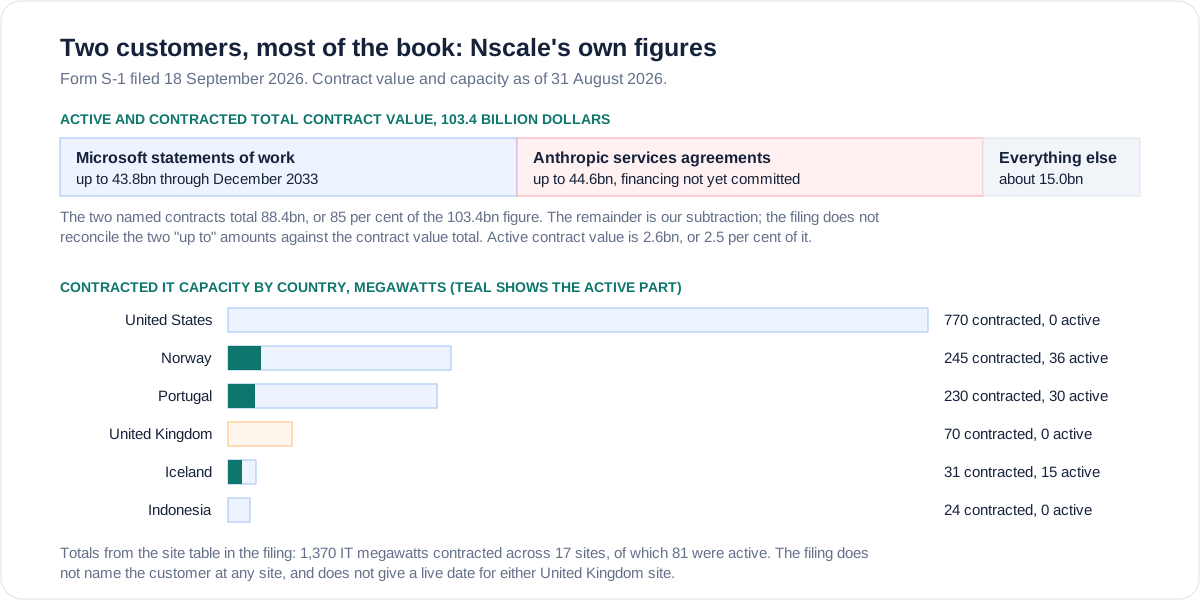
The capacity panel is the one procurement people should sit with. As of 31 August 2026 Nscale reported approximately 25,000 active GPUs and 461,000 active and contracted GPUs. Five sites were active and twelve contracted. Of 1,370 contracted IT megawatts, 81 were live, which is 5.9 per cent. Almost everything in this company is a promise about a building that is not finished, funded by contracts whose cash arrives when the buildings are.
The largest contract is conditional, and the filing says so
The Anthropic arrangement is four separate agreements, each between Anthropic and a wholly owned Nscale subsidiary, for dedicated GPU infrastructure at the Monarch Compute Campus in Mason County, West Virginia, deploying NVIDIA Vera Rubin NVL72 systems across four tranches. Nscale is required to use best efforts to obtain qualifying financing for the GPUs and the data centre infrastructure within a specified period. The filing then says, plainly, that as of its date no binding commitments have been obtained for any of the financings required to perform, and that all of them remain in process.
The performance terms run the other way too. Delays are excused only where they are caused by industry wide supply constraints affecting the specified GPU systems, and only if Nscale placed binding orders with its supplier within a set period. If an excused delay runs past a threshold, or if a tranche is late past a specified period, Anthropic may terminate that tranche without liability. Anthropic may terminate the agreement if monthly uptime falls below specified thresholds for sustained periods. The filing describes these service levels as more stringent than those in its other customer agreements.
Alongside this sits a going concern note that most readers will skip. Management identified that its forecast funding requirements relied on uncommitted debt and equity financing, which initially raised substantial doubt about the ability to continue as a going concern. The doubt is treated as alleviated, and the stated mitigation is the sentence to underline: management evaluated its ability to defer, reduce or cancel capital expenditure if that financing is not obtained as forecast, and concluded that plan is probable of being effectively implemented. That is prudent accounting. It is also, read from the other side of the table, a description of what happens to a build that somebody else is waiting on.
The UK footprint, as disclosed
Nscale is a British company: incorporated in England and Wales, headquartered in about 7,677 square feet of office space in London, and it markets its UK domicile as a competitive advantage in sovereign compute. The site table tells a more careful story. Of 17 data centre sites, two are in the United Kingdom: a 20 IT MW colocation site and a 50 IT MW owned site. Both are listed as operating data centre sites with contracted customer status, which in the filing's own vocabulary means under development pursuant to signed contracts, not serving customers today. Together they are 70 IT MW, or 5.1 per cent of contracted capacity. None of the five active sites is in Britain.
The filing also records what happened to the project that put Nscale on the front pages here. Stargate UK was announced on 16 September 2025 as a platform across a number of UK sites in partnership with NVIDIA, Microsoft and OpenAI, with a particular focus on sovereign workloads. The UK government's announcement the same week said OpenAI would take up to 8,000 GPUs in the first phase, with the possibility of scaling to approximately 31,000, at sites including Cobalt Park inside the new North East AI Growth Zone. Nscale's own release that week promised up to 58,640 GPUs in the UK, including 23,040 NVIDIA GB300 units for Microsoft at Loughton in what it called the country's largest AI supercomputer, at 50 MW scalable to 90 MW. The S-1 records the sequel in one sentence: in April 2026 OpenAI withdrew from the Stargate Norway and Stargate UK partnerships, and Microsoft then expanded its agreement to take the extra compute capacity at Stargate Norway.
Two observations follow, one of which is inference and labelled as such. The observation of fact: the extra capacity released by OpenAI's withdrawal was taken up in Norway, not in Britain, and the UK government's most recent update on the North East AI Growth Zone, published on 12 May 2026, does not mention Stargate UK, Nscale, OpenAI or Cobalt Park at all. The inference: the 50 IT MW owned UK site in the table is the same size as the Loughton facility announced for Microsoft in September 2025, which makes it likely to be that site, but the filing names no site and no customer, so this is our reading and not a disclosed fact.
For anyone assembling a UK sovereign compute strategy, the practical content of all this is that national announcements and signed capacity are different objects with different failure modes. We made a similar point about disclosure theatre in a different jurisdiction when reviewing California's data centre laws and their reporting gaps: a headline commitment, a designation, and an operating megawatt are three separate things, and only the last one runs a workload.
Three comforting labels, checked against the document
Procurement runs on labels because labels are what fit in a slide. Each of the three below appears in Nscale's own materials or in the market's shorthand for this sector, and each means something narrower in the filing than it does in a pitch.
Label against disclosure, from the Form S-1 definitions and risk factors
| Label | What a buyer may assume | What the filing actually says |
|---|---|---|
| Tier 1 data centre | A resilience classification, with redundant power and cooling paths | The filing defines Tier 1, 2 and 3 as classifications for data centre markets and locations, meaning primary, secondary and emerging. Both UK sites are Tier 1 in that sense, which is about the market, not about redundancy. |
| Sovereign compute | Your data, your law, your operator, end to end | The filing's own definition includes control over who operates the infrastructure and who can access it. It also discloses that nine of 17 sites are colocation where Nscale in some cases does not control the third party facility, and that US export control duties and end use checks follow the hardware to facilities outside the United States. |
| Take or pay backlog | Contracted revenue that is as good as banked | Total contract value is measured at signature, excludes extensions, and is 97.5 per cent not yet active. Contracts commence on successful delivery of clusters, carry delivery milestones and penalties, and in the largest case depend on financing that has not been committed. |
The certification position deserves its own line, because UK buyers tend to treat it as a gate. The filing says the company is, in its words, "in the process of obtaining industry standard certifications and qualifications, including ISO 27001, SOC 2" and data centre standards aligned to ISO 22237, and is developing NIS2 readiness. It does not say which are held today, or for which sites. Nscale also records that it is subject to the UK Network and Information Systems Regulations, which is a statement about obligation, not about assurance.
What concentration means when you are the small customer
Concentration risk is usually explained from the investor's chair: if a big customer leaves, revenue falls. The supply chain version is the mirror image, and it is the one that belongs in a UK risk register. When one or two counterparties carry most of the contracted value, they also carry most of the negotiating power, most of the penalty exposure, and most of the delivery priority. Everyone else is served from the remainder.
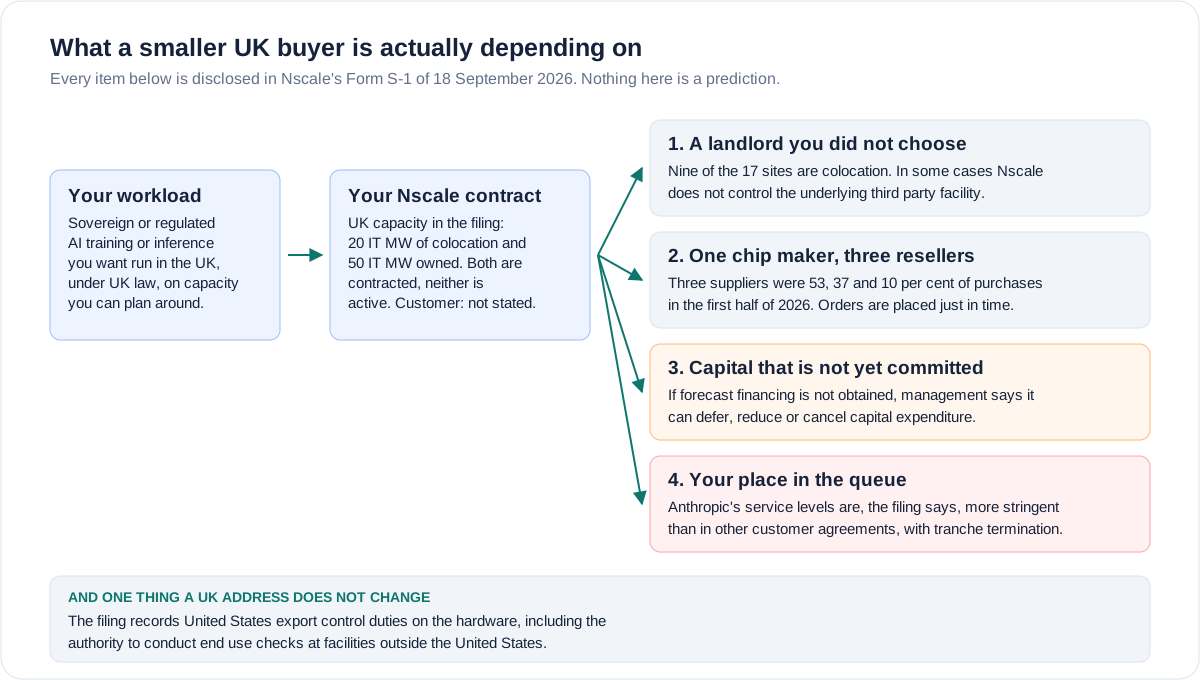
Two further disclosures cut the other way, in the customer's favour, and it would be unfair to leave them out. First, the filing admits that because Nscale sells dedicated bare metal rather than a proprietary platform, customers face relatively low switching costs at the end of a term and its offering may be less differentiated than competitors. Read as a buyer, that is portability, and it is worth writing into the contract while it is still true. Second, an SEC registration turns a private supplier into a quarterly reporting one. If this listing completes, the concentration figures above stop being a one off disclosure and become a series you can track.
Method, and whose interests are in play
A risk factors section is written to be exhaustive, by lawyers, under liability. It is not a prediction, and treating a list of disclosed risks as a forecast of failure is a category error. Everything in this briefing is drawn from what the company itself chose to state, with our arithmetic shown so you can redo it. Where the filing is silent, we say so rather than filling the gap.
The interests are worth naming without sneering at anyone. Nscale and its underwriters, led by Goldman Sachs, J.P. Morgan and Morgan Stanley, have an interest in a successful offering. NVIDIA is both a supplier and, through a subscription agreement of 15 September 2026 for at least 3.1bn dollars of convertible loan notes and non voting shares, an investor. News coverage has an interest in a sharp framing: TechCrunch's piece that pointed us to the filing describes roughly 85 per cent of revenue coming from the two customers, where the filing's number is a share of contracted value, not of revenue. The reported 35bn dollar valuation and 3bn dollar raise are attributed there to other outlets and do not appear in the registration statement at all. And, again, Anthropic is a named customer in the document and the maker of the model used to research this piece.
What to do, in order
Take this with you
If you are buying, or already using, AI cloud capacity in the UK
- Find out whether your capacity sits at an owned site or a colocation site, and who the landlord is. The filing states that in some cases the provider does not control the third party facility.
- Ask for your position in the delivery queue in writing, and ask whether any other customer holds service levels or termination rights stronger than yours.
- Check whether your contract commences on signature or on acceptance of delivered clusters, and what happens to your programme if acceptance slips two quarters.
- Ask which security certifications are held today for the specific site that will run your workload, with certificate numbers and scope statements, rather than at company level.
- Price the exit. Dedicated bare metal is portable by the provider's own admission, so negotiate data egress, image portability and a wind down period while that is an advantage you hold.
- Map the export control exposure of your workload, including which hardware is subject to United States controls and who may conduct end use checks at the facility.
- If sovereignty is the reason you chose the supplier, write the sovereignty test into the contract: location, operating entity, access control, governing law, and notice on any change to any of the four.
- Once quarterly reporting starts, track customer concentration, active versus contracted capacity and committed financing as supplier health metrics, not as investor trivia.
The question that exposes the gap
Britain's sovereign compute story has been told in gigawatts announced, growth zones designated and partnerships unveiled on state visit week. Nscale's filing is the first time one of the central companies has had to write down, under American securities law, how much of that is signed, how much is live, who it is for and what has to happen for the rest to exist. On its own figures, 81 megawatts are running, none of them here, and 85 per cent of the contracted book belongs to two American customers, one of whose contracts is waiting on financing that has not been committed.
So the question to put to any provider selling you sovereign AI compute, including this one, is not how many gigawatts they have announced. It is this: when capital, chips or switchgear are short, which customer's contract makes the decision for you, and have you ever seen that contract?
Sources
- PrimaryNscale Limited, Form S-1 registration statement filed 18 September 2026. Primary source for every figure in this briefing: revenue, losses, customer and supplier concentration, contract terms, the site table and the risk factorsU.S. Securities and Exchange Commissionaccessed 2026-09-22
- PrimaryEDGAR filing index for accession 0001193125-26-395475, used to confirm the filing date, the filer identity and the exhibit listU.S. Securities and Exchange Commissionaccessed 2026-09-22
- PrimaryNscale's own announcement of the registration statement, used for the listing venue, ticker and the underwriting syndicateNscaleaccessed 2026-09-22
- PrimaryNscale's UK AI infrastructure announcement of 16 September 2025, used for the original Stargate UK and Loughton GPU and megawatt claimsNscaleaccessed 2026-09-22
- PrimaryUK government announcement of the North East AI Growth Zone and Stargate UK, 16 September 2025, used for the GPU offtake and investment claims made at the timeDepartment for Science, Innovation and Technologyaccessed 2026-09-22
- PrimaryUK government update on the North East AI Growth Zone, 12 May 2026, checked for any mention of Stargate UK or NscaleDepartment for Science, Innovation and Technologyaccessed 2026-09-22
- Reported byNews coverage that pointed to the filing, and the source of the reported 35bn dollar valuation and 3bn dollar raise that the filing itself does not stateTechCrunchaccessed 2026-09-22