NCSC says AI-powered malware in a ransomware attack on UK CNI is 'highly likely' by 2028, a range of 80 to 90%
The NCSC assessment says AI-powered malware will highly likely have been used in a ransomware attack on UK critical infrastructure between now and 2028. On its own yardstick that is 80 to 90 per cent, for one attack, with no sector, victim or definition of the malware given.
By Parminder Kumar Sharma · LinkedIn · · 17 min read
Highly likely is a range of 80 to 90 per cent, and the judgement is about one attack
The NCSC's probability yardstick has seven terms, and the one it attaches to AI-powered malware being used in a ransomware attack on UK critical national infrastructure (CNI), "highly likely", is printed as a range of 80 to 90 per cent. Read as the NCSC's own scale reads it, that leaves 10 to 20 per cent for the event not happening (derived: this site subtracts the printed range from 100, and the NCSC does not state that reading). The judgement sits in an NCSC assessment titled "Artificial intelligence and cyber intrusion", published on 3 November 2026 alongside the NCSC's annual State of the Cyber Nation report. This briefing reads the assessment, the news release and nine pages of the annual review on 3 November 2026, from 15:51 UTC.
The wording is narrower than the headlines around it. The key judgement says "between now and 2028" AI-powered malware "will have been used in a ransomware attack on UK CNI": one kind of event, at least once, anywhere in UK CNI, at some point in a window whose length depends on how "2028" is read. From 3 November 2026 that window is 424 days if it ends before 1 January 2028 and 789 days if it runs to the end of 2028 (derived). The news release headline says UK CNI faces AI-powered attacks "within two years", which is 731 days (derived). The assessment does not say which of these it means.
What the pages do not establish matters as much as what they say. They do not say that such an attack has happened. They name no sector inside CNI, no victim and no attacker for the ransomware judgement. They give no probability for any of the three scenarios, which the assessment itself says "are not predictions". And "AI-powered malware" is not defined in the assessment's glossary.
One thing to hold in mind throughout: the assessment and the news release are the NCSC's own. The NCSC is a government body assessing a threat, and the news release also lists government spending and schemes that the NCSC runs or supports. That gives it an interest in being heard, which is not a charge of bad faith. The assessment says it combines classified intelligence, industry knowledge, academic material and open source; this site can see none of the classified part.
What the NCSC yardstick says each word means
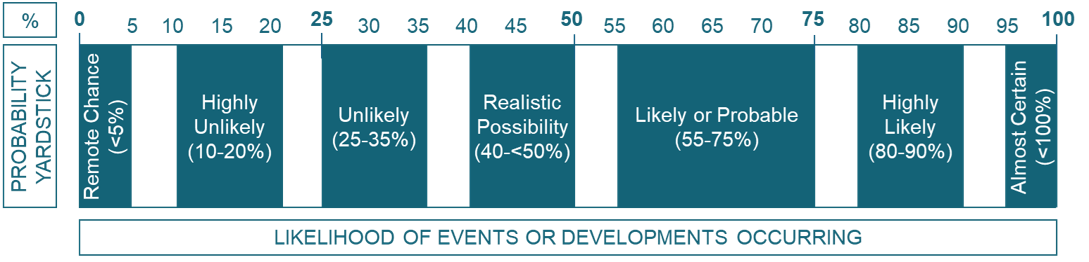
The assessment says it uses "the PHIA probability yardstick every time we make an assessment, judgement or prediction", and that the terms "correspond to these likelihood ranges". PHIA is the Professional Heads of Intelligence Assessment, the cross government body the NCSC names. The ranges themselves are printed as a graphic, not as text, so a text extraction of the page drops them. This briefing read them from the saved image of the NCSC graphic and checked each against the picture.
The seven terms on the NCSC probability yardstick, with the range printed in the NCSC's graphic and the key judgement (numbered as on this page) that uses the term
| Term | Range as printed | Used by key judgement |
|---|---|---|
| Remote Chance | below 5% | none |
| Highly Unlikely | 10 to 20% | none |
| Unlikely | 25 to 35% | none |
| Realistic Possibility | 40 to below 50% | none |
| Likely or Probable | 55 to 75% | 3 (written as "likely") |
| Highly Likely | 80 to 90% | 1 and 4 |
| Almost Certain | below 100% | 2 (written as "almost certain") |
Two points follow from the graphic. First, the terms do not tile the scale: the gaps between the bars, from 5 to 10, 20 to 25, 35 to 40, 50 to 55, 75 to 80, 90 to 95, have no word. A judgement of, say, 77 per cent has no label on this yardstick. Second, "likely" in an NCSC assessment means 55 to 75 per cent, not the 80 to 90 per cent of "highly likely". Coverage can blur the two. SecurityWeek's republished Associated Press report says the UK "will likely face" AI cyberattacks on critical infrastructure by 2028, which uses the lower term, while the assessment's ransomware judgement uses the higher one. Infosecurity Magazine headlines the same story with the word "Imminent" and says AI-powered malware is "strongly expected" in attacks on "power stations, airports and hospitals". Imminent is not a term on the yardstick, and on the pages read for this briefing the assessment names no sector inside CNI. Where coverage and the NCSC differ, the NCSC's pages govern.
The four key judgements, in full and with their terms
The assessment lists four key judgements. Three begin "By 2028" and the fourth, the ransomware one, begins "It is highly likely that between now and 2028". The table keeps the printed wording of each in shortened form and adds the range from the yardstick.
The four key judgements in the NCSC assessment, with term, range and time frame as printed (the claim column paraphrases; the full wording is in the diagram above)
| Judgement, in brief | Term and range | Time frame as printed |
|---|---|---|
| 1. Russia, China and other nation states will routinely use AI-cyber to achieve geopolitical goals; the UK faces more scale and speed of sophisticated attacks | Highly likely, 80 to 90% | By 2028 |
| 2. Many systems will remain vulnerable to AI-cyber tools that find and exploit weaknesses; attackers can be less cautious about losing an access because replacing it costs little | Almost certain, below 100% | By 2028 |
| 3. Attackers will apply AI-cyber capability against known vulnerabilities in CNI legacy technology, and the new attack surface from AI tools deployed inside CNI | Likely, 55 to 75% | By 2028 |
| 4. AI-powered malware will have been used in a ransomware attack on UK CNI | Highly likely, 80 to 90% | Between now and 2028 |
Look at judgement 3 beside judgement 4. The assessment is less confident, 55 to 75 per cent, that attackers will apply AI-cyber capability against known vulnerabilities in CNI legacy technology as a pattern, than it is, 80 to 90 per cent, that AI-powered malware will have been used in a ransomware attack on UK CNI at least once. A plausible reading, which is this site's inference and not the NCSC's stated reasoning, is that one occurrence is easier to be confident about than a sustained pattern. The two judgements also ask different questions: one is a count of at least one, the other is about behaviour across the sector.
Judgement 4 also has no actor. Judgement 1 names Russia, China and other nation states as ones that will routinely use AI-cyber; the ransomware judgement names nobody. The annual review's page on the cyber threat to the UK repeats both in nearly the same words, and its page on the impact of AI states the ransomware one in a shorter form with no date: "It is highly likely AI malware will be used in a ransomware attack on UK CNI." That page then says cyber criminal adoption of AI "will highly likely increase the scale and efficiency of ransomware operations". It is a separate judgement about criminals generally, about operations and not about CNI, with no time frame beside it on that page. The news release attaches "within the next two years" to it.
Three scenarios, five drivers and an explicit caveat
The assessment builds three scenarios for 2028 and says they are "plausible possibilities in the medium-term but are not predictions", designed to "provide insights" and "inform the development of proactive security strategies". It adds that "the prospect for surprise is high". Five drivers shape them: geopolitical tensions, UK CNI cyber defence, the pace of development for AI technologies, availability of AI-cyber capability, and AI and a cyber-literate workforce. The wording within each scenario does use probability terms, for example the baseline says threat "has almost certainly increased", but those terms describe the scenario if it happened. They are not a likelihood that the scenario happens, and the assessment gives none.
In the baseline, the assessment says widely available AI-cyber tools have "almost certainly" led to a significant rise in the discovery of zero day vulnerabilities, while defensive tools shorten the window from zero day to n day and make patching quicker. But "without correct and widespread configuring of this technology, many systems are still vulnerable", and an organisation's "internal patching and testing processes will need to evolve to meet the pace of accelerating vulnerability discovery". For CNI it says implementation of defensive capabilities "lags behind offensive ones".
In the pessimistic scenario frontier AI reaches "all actors, from state-level threat actors to independent neophyte hackers", attribution gets harder, and an automated cyber actor "no longer under its operator's control" appears. The assessment calls it "a realistic possibility" that such an entity could self replicate. The yardstick puts a realistic possibility at 40 to below 50 per cent, but this sentence sits inside a scenario that is itself not a prediction, so no likelihood of that event in the real world follows. In the optimistic scenario CNI sectors replace "ageing legacy systems" with modern ones "less vulnerable to AI-cyber attack", a workforce educated in AI and cyber security deploys AI securely, and fewer AI models are released under a robust regulatory framework.
What "AI-powered malware" means is not stated, and the headline says more than the judgement
The assessment's glossary defines AI, generative AI, AI-cyber, frontier AI, large language model, AI system, AI design and vulnerability. "AI-cyber" is "the application of AI developments in cyber intrusion capability". It does not define "AI-powered malware", "malware" or "ransomware". A defender cannot tell from the page whether malware that calls a model while it runs counts, or malware merely written with a model's help, or a ransomware crew using an AI tool during an intrusion. Because the term is open, the same real event could meet the judgement under one reading and not under another. Neither the news release nor the review pages read for this briefing fill the gap.
The news release headline reads "Cyber chief: UK facing AI-powered attacks on critical infrastructure within two years". Its lead says AI-powered malware is "highly likely to be used in ransomware attack on Britain's critical national infrastructure by 2028". The judgement it summarises says one event will have happened at least once. "Facing AI-powered attacks" in the plural is the release's framing, and the judgement does not say how many attacks or against whom. The release also says the annual review warns that within the next two years AI adoption by hostile actors is "highly likely" to increase the scale and efficiency of operations "including ransomware attacks, social engineering, and vulnerability exploitation".
The release also quotes lines the NCSC chief executive is "set to say" and "expected to say" in a speech launching the report. This briefing did not see the speech and treats those lines as the NCSC's pre release text, not as a delivered speech. One of them is the framing the NCSC leans on: the coming rise in incidents is "not because AI has invented new ways to attack us" but because "vulnerabilities that have been tolerated for far too long can now be discovered and exploited at a scale that was once unimaginable". Another line reads "For decades, we have collectively got away with doing tech on the cheap." The phrase belongs to the chief executive's draft remarks, not to the assessment.
What the State of the Cyber Nation review adds, including a sentence that cuts the other way
The news release links its "State of the Cyber Nation" to the NCSC Annual Review 2026, a 29 page web report that covers 1 September 2025 to 31 August 2026 and is titled in its PDF download "NCSC Annual Review 2026 - The State of the Cyber Nation". This briefing read nine of its pages and the landing page; it did not read the other pages or the 11.8 MB PDF. On its incident management page, the NCSC says its team received 1,831 reports of cyber attacks, that after triage 337 needed the team's support, and that 80 of those were "nationally significant". The Early Warning service notified 8,500 organisations of events that indicated a suspected compromise. Of the 337, 80 is 23.7 per cent, and 337 of 1,831 is 18.4 per cent (both derived). The page warns that incident reporting "does not follow a simple year-on-year trend" and prints no earlier year's figure, so no rise or fall can be read from it.
The same page carries the sentence most relevant to the ransomware judgement. "The IM team has also begun to see threat actors incorporating AI tools into their attacks. None of the observed uses of AI enabled a novel class of attack." That is a statement about observed incidents handled by the NCSC, with no count, no sector and no mention of ransomware or CNI in those two sentences. It does not say an AI-powered ransomware attack on UK CNI has occurred, and it does not say one has not.
What the NCSC Annual Review 2026 pages read say about AI and the threat, with the page and the wording used
| Page | What it says | Qualifier on the page |
|---|---|---|
| Incident management | Threat actors incorporating AI tools into attacks; none enabled a novel class of attack | Observed uses, no count given |
| Impact of AI on cyber threat | AI "highly likely" to speed up and scale existing methods "rather than autonomously conducting end-to-end attacks" | Human operators "highly likely" remain essential |
| Impact of AI on cyber threat | AI assisted vulnerability discovery and exploit development "highly likely" a significant threat; defenders face a "race to shorten patch deployment timelines" | Not all AI found flaws are exploitable |
| Impact of AI on cyber threat | A widening digital divide between organisations able to adopt AI for defence and those unable "almost certain" | Stated as a judgement, no count |
| A decade of cyber threat | For large organisations 88% of incidents came from four initial access vectors; recent state backed incidents were not an "autonomous end-to-end AI attack" but simpler exploitation of known flaws | "Autonomous end-to-end AI capability is coming into view" |
The review's decade page lists the four vectors as exploiting external public facing applications, phishing, misuse of valid accounts and exploiting external remote services. Its page on autonomous attack repeats the pessimistic scenario in near identical words and says its purpose "is not to predict the future, but to illustrate the consequences of inaction". The pattern across these pages is consistent with the chief executive's framing: the NCSC says it sees AI speeding up known attack methods, and it warns of capability coming into view, which is a different claim from AI having already changed who is breached. That is this site's reading of the pages, and the NCSC does not draw it in those words.
Stated and not stated
What the NCSC pages read on 3 November 2026 state and do not state about AI-powered ransomware on UK CNI
| Question | Stated | Not stated |
|---|---|---|
| Has an AI-powered ransomware attack on UK CNI happened? | It "will have been used" between now and 2028, "highly likely" | Any such attack as having occurred |
| How likely, in numbers? | Highly likely is 80 to 90% on the NCSC yardstick | Any number in the assessment text itself |
| How many attacks? | At least one is the judgement's reach | A count, a rate or a routine of attacks |
| Which part of CNI, which attacker? | UK CNI; nation states named only for judgement 1 | Any sector, victim or ransomware group |
| Which scenario will happen? | Three are "plausible" and "not predictions" | A likelihood for any scenario |
| What counts as AI-powered malware? | AI-cyber is defined in the glossary | Any definition of AI-powered malware |
| How many AI related incidents? | NCSC has "begun to see" AI tools in attacks, none a novel class | A count of them, or the share of 337 |
| A date more precise than 2028? | "By 2028" and "between now and 2028" | Which day, month or year inside that window |
What this means for UK organisations, from what the NCSC says
The whole story is about the UK, so the NCSC's own advice is the guide, and only what its pages state is repeated here. The news release says the chief executive will urge organisations to address "the failure to adequately invest in their technology", to avoid "having technology unnecessarily connected to the internet" and to make Cyber Essentials "the starting point for cyber security, not the end goal", building resilience "according to their size, complexity and risk". The review's foundations page describes Cyber Essentials as the minimum standard the government recommends for UK organisations of all sizes.
For operators of critical services, the review's moment of choice page says organisations "with ageing technology, limited visibility of their technology estates and slow remediation processes will find it harder to maintain resilience". It points to the Cyber Security and Resilience Bill, which it says will bring "important new sectors" into scope, and to the NCSC's CAF Core Profile as its "recommended minimum benchmark for cyber resilience" for essential services. It also tells organisations to "make plans to deploy software security updates quickly, more frequently, and at scale" in preparation for a "patch wave", and refers to updated NCSC vulnerability management guidance. The news release adds that the forthcoming National Cyber Action Plan is part of the government's response. The pages give no deadline for any of these, and this briefing adds none.
For related reading on this site, the NCSC's AI chapter in its research problem book, which sets out where it says more work is needed, is in an earlier briefing.
A ranked checklist
Items 1, 3, 4 and 5 follow the NCSC's own words on the pages above. Items 2 and 6 are this site's suggestions and are marked as such.
Take this with you
In the order worth doing
- Quote the range, not the adjective (this site's suggestion). In any board paper or risk register that relies on an NCSC judgement, write "highly likely (80 to 90%)" and name the yardstick, so nobody reads it as "probably".
- Ask what you run that is old, internet connected and unpatched (this site's suggestion, built on judgement 3). The assessment says attackers are likely to apply AI-cyber capability against known vulnerabilities in CNI legacy technology; list those systems first.
- Fix the foundations the NCSC names: invest in technology across its life, do not connect it to the internet unnecessarily, and treat Cyber Essentials as the starting point, not the end goal.
- Shorten and rehearse your patching and testing, because the assessment says internal patching and testing processes "will need to evolve", and the review says plans should cover deploying updates quickly, more frequently and at scale.
- Use the conditions of the optimistic scenario as a design target: replace ageing legacy systems, educate the workforce on AI and cyber security, and make defensive AI-cyber tools correctly and widely configured, since the baseline says unconfigured tools leave systems vulnerable.
- Write down what you would count as AI-powered malware in your own register (this site's suggestion), since the assessment does not, and test that your detection and recovery plans work whichever definition applies.
The question the range exposes
A word like "highly likely" lets a reader feel informed while committing to nothing. The NCSC attached a range to it, 80 to 90 per cent, and attached a window to the event, now to 2028. The harder question sits on the other side of the page: if your board accepted a one in five to one in ten chance that nothing of the kind happens, what has it decided to do about the rest? When a risk register at your organisation says "highly likely", does anyone in the room know it means 80 to 90 per cent, and was the budget set against that number or against the adjective?
Key facts
Sources
- PrimaryNCSC Assessment 'Artificial intelligence and cyber intrusion', published 3 November 2026: the yardstick, three scenarios, four key judgements, five drivers, glossary. Read in fullNational Cyber Security Centreaccessed 2026-11-03
- PrimaryThe assessment's own five page PDF, read to confirm the page text, the judgements and the glossaryNational Cyber Security Centreaccessed 2026-11-03
- PrimaryThe PHIA probability yardstick graphic printed in the assessment, the only place the likelihood ranges appearNational Cyber Security Centreaccessed 2026-11-03
- PrimaryNews release 'Cyber chief: UK facing AI-powered attacks on critical infrastructure within two years', 3 November 2026: headline, lead, speech lines 'set to' be said, government investment. Read in fullNational Cyber Security Centreaccessed 2026-11-03
- PrimaryNCSC Annual Review 2026 (The State of the Cyber Nation), 29 page web report for 1 September 2025 to 31 August 2026: landing page, downloads and contentsNational Cyber Security Centreaccessed 2026-11-03
- PrimaryAnnual review page 'The cyber threat to the UK': the dated AI and ransomware judgementsNational Cyber Security Centreaccessed 2026-11-03
- PrimaryAnnual review page 'The impact of AI on cyber threat': the AI key judgements, the undated ransomware variantNational Cyber Security Centreaccessed 2026-11-03
- PrimaryAnnual review page 'The age of autonomous attack': the pessimistic scenario and its stated purposeNational Cyber Security Centreaccessed 2026-11-03
- PrimaryAnnual review page 'Incident management': 1,831 reports, 337, 80, 8,500 and the sentence on observed AI useNational Cyber Security Centreaccessed 2026-11-03
- PrimaryAnnual review page 'Continuity and change: A decade of cyber threat': the 88% initial access figure and the end to end AI sentenceNational Cyber Security Centreaccessed 2026-11-03
- PrimaryAnnual review page 'A moment of choice': CAF Core Profile, patch wave advice, Cyber Security and Resilience Bill, frontier AI board messagesNational Cyber Security Centreaccessed 2026-11-03
- PrimaryAnnual review page 'Why building strong foundations has never mattered more': Cyber Essentials described as the minimum standardNational Cyber Security Centreaccessed 2026-11-03
- Reported byRepublished AP report, 3 November 2026, read only to compare wording ('will likely face') with the NCSC pagesSecurityWeek (Associated Press)accessed 2026-11-03
- Reported byReport of 3 November 2026, read only to compare wording ('Imminent', 'strongly expected', sectors named) with the NCSC pagesInfosecurity Magazineaccessed 2026-11-03