A fully patched Ivanti VPN gave an attacker root through a three-flaw chain; two flaws are fixed, one is not
Volexity says a fully patched Ivanti Connect Secure appliance gave an attacker unauthenticated root access from 3 October. It counts three chained flaws; the fixed builds cover two, and the third has no fix and is absent from Ivanti's advisory.
By Parminder Kumar Sharma · · 29 min read
A fully patched appliance, three chained flaws, two fixes
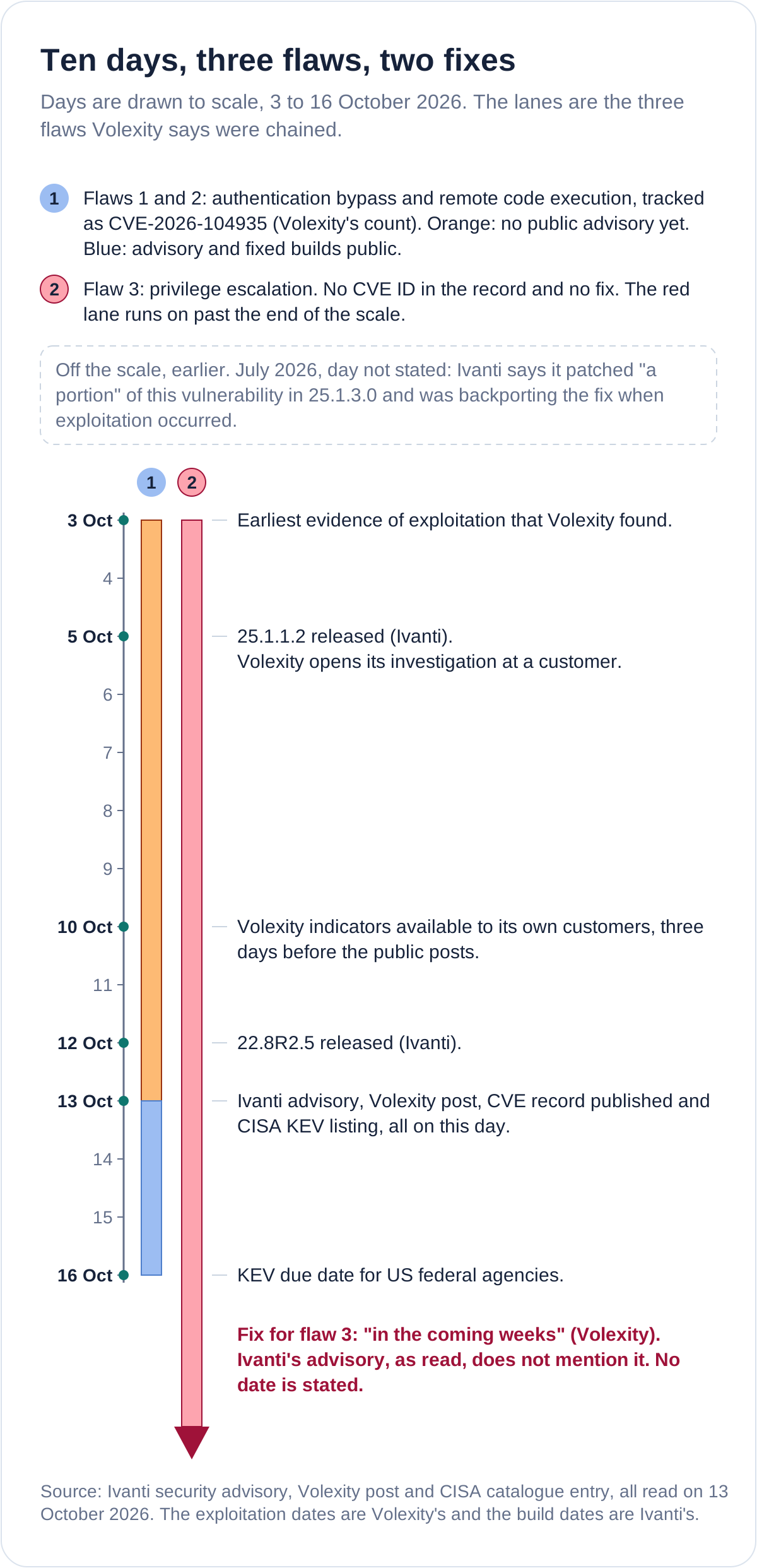
Volexity says the Ivanti Connect Secure (ICS) VPN appliance it investigated was "fully patched (at the time, version 22.8R2.4)", and that an attacker it tracks as UTA0576 still gained "unauthenticated root-level code execution" on it by chaining three zero-day flaws. Volexity found exploitation starting on 3 October 2026. Ivanti's advisory, Volexity's post, the CVE record and CISA's Known Exploited Vulnerabilities (KEV) listing all appeared on 13 October.
The arithmetic of the fix is short (all derived from the sources read for this briefing). Three flaws were chained. Two of them, an authentication bypass and a remote code execution bug, are tracked under CVE-2026-104935 on Volexity's account. Ivanti lists four fixed builds for the CVE, 22.8R2.5, 25.1.1.2, 25.1.3.0 and 25.1.3.1, across two release lines. The third, a privilege escalation, has no CVE ID in the record, no fix, and no mention in Ivanti's advisory as read. Ten days passed between the first exploitation Volexity found and the public advisory and KEV listing, and the KEV due date for US federal agencies is three days after the listing.
That is not quite the story the headlines tell. "Fully patched" was true of the appliance only in the sense that it ran the newest build of its line. Ivanti dates 22.8R2.5, the first fixed 22.8 build, to 12 October, nine days after the first exploitation Volexity found (derived), so the first two flaws had no fix on that line either when it was exploited. The third flaw is the one that will still have no fix after an organisation installs a fixed build today. On Ivanti's own account a fix for "a portion" of the vulnerability had already shipped in July, in a release Ivanti says needs a new platform. The label "patched" described a build's place in a release list, not the state of the flaws inside it.
What the record does not establish is most of what an operator wants to know: how many appliances were affected (Ivanti says "a limited number of customers at the time of disclosure"), who UTA0576 is, which builds contain the third flaw and when it will be fixed, whether the fixed builds alone stop this chain, whether working exploit code is public, and what the attacker actually obtained from the directory. The sections below set each out with who said it, then the UK clocks and duties, then an ordered checklist. Defender level only: this briefing reproduces no indicator, request pattern, path or file name from Volexity's post.
How this was read. Ivanti's advisory needs scripts to display, so it was read in a browser at about 19:56 BST on Tuesday 13 October 2026 and its version table and FAQ re-read at about 20:02. Volexity's post, the NVD and CVE.org records, CISA's KEV catalogue file, and the NCSC, ICO, Microsoft and Cyber Essentials pages were read directly, from 19:54 BST. Ivanti's recovery-steps article sits behind a customer sign-in and was not read: no account was created and nothing was submitted. SecurityWeek's report was used as a pointer, and every figure in it was checked against the primaries.
Where the primary sources differ
The four primary records were each read in full. They do not describe the event in the same words, and where they differ this briefing follows the vendor's own page and says so.
Points on which Ivanti's advisory, Volexity's post, the CVE record and the KEV entry differ, read on 13 October 2026, and how this briefing treats each.
| Point | What the sources say | How this briefing treats it |
|---|---|---|
| How many vulnerabilities | Ivanti: "one high severity vulnerability". Volexity: three zero-day flaws, two of them tracked under CVE-2026-104935. CVE record: one weakness class (CWE-290), an authentication bypass by spoofing that allows arbitrary commands. | Three flaws is Volexity's count and is attributed to it. Ivanti's advisory does not say how many flaws sit under the CVE. |
| Build dates | Ivanti: 25.1.1.2 released 5 October, 22.8R2.5 released 12 October, 25.1.3.0 released July 2026. Volexity: the vulnerability "was fixed in patches released on October 13, 2026". | Follows Ivanti's page. Neither source explains the difference. |
| The newest build | Volexity: 22.8R2.4 "at the time of writing is the latest version". Ivanti: 22.8R2.5 (12 October), 25.1.1.2 (5 October) and the 25.1.3 builds (from July) exist. | 22.8R2.4 was the newest build of its line when exploited, not the newest Ivanti release. |
| Affected builds | Ivanti: 25.1.1.1 and prior, 25.1.2.2 and prior, 22.8R2.4 and prior. CVE record: "before version 25.1.3.0", with 25.1.3.0, 25.1.3.1, 22.8R2.5 and 22.7R2.14 listed unaffected and no mention of 25.1.1.2. Volexity: upgrade 25.1.1 and prior, 25.1.2 and 22.8R2.4. | Follows Ivanti's table. A scanner keyed to the CVE record's wording could flag a patched 25.1.1.2 appliance (inference). |
| The third flaw | Volexity: a privilege escalation, with a fix in "a future release in the coming weeks". Ivanti's advisory, the CVE record, the NVD page and the KEV entry do not mention it. SecurityWeek: "the vendor plans to fix it". | The plan is Volexity's report of Ivanti's work. No Ivanti page read says it. |
The chain at the level a defender needs
Volexity describes three flaws. This briefing says what each gave the attacker and does not reproduce how.
The three chained flaws as Volexity describes them in its post of 13 October 2026, with their status as read on the same day.
| Flaw, in Volexity's order | What it gave the attacker | Status as read on 13 October |
|---|---|---|
| 1. Authentication bypass | Requests could reach scripts that normally need a sign-in, because the part of a request that is checked for permission is not the part that decides which script runs. | Under CVE-2026-104935. Fixed in the four builds. |
| 2. File write leading to remote code execution | A flaw in an upload handler that Volexity says becomes code execution through a timing window, running as the web-facing service user. | Under CVE-2026-104935 (Volexity's count). Fixed in the four builds. |
| 3. Privilege escalation | A privileged maintenance service trusts a shared configuration store that the web-facing process could alter in memory, giving root. | No CVE ID in the record. No fix. Not in Ivanti's advisory. Volexity: a future release in the coming weeks. |
After the chain, Volexity says the attacker acted like an operator reading results, not a script running (high confidence). It extracted credentials stored on the appliance, including domain credentials used for directory lookups. It exported limited Active Directory metadata. It used a custom tool to test credentials against Kerberos and a custom tool to query the directory, through the appliance's own directory service account, for LAPS local administrator passwords, BitLocker recovery information and password-bearing attributes. It ran local DNS and host reconnaissance, collected the appliance's configuration including its authentication methods, and ran password spraying against directory accounts. It captured traffic on the appliance and inspected the directory-lookup part of it for credentials, and read the appliance's authentication logs to find valid usernames. It also removed entries from two of the appliance's logs.
Two properties matter for hunting. First, there was no implant. Volexity says commands and results travelled inside the exploit chain's own web requests, the whole chain ran again for every command, and there was "no backdoor or web shell". Anything that looks for a planted file will find none. Second, the chain left little to find on disk. Volexity says the privilege escalation altered library code in memory only and put the configuration store back as it was, and the attacker trimmed the appliance's logs. Volexity reconstructed the chain from memory images and crash dumps of the appliance, collected with Ivanti's help. It also says the extent to which each cleanup step worked on the victim "has not been fully established".
One distinction the summaries blur: a search is not a result. Volexity says the directory tool searched for LAPS passwords, BitLocker recovery information and password-bearing attributes through the appliance's service account, and that the results were written out and taken through the exploit channel. It does not say what the results contained. Whether any LAPS password or recovery key came back depends on what that account was permitted to read, and the post does not state it. The safe reading for planning is that anything the account could read is exposed. The factual reading is that the record shows the search, not the haul.
What "fully patched" meant, build by build
Ivanti's advisory has a version table that maps three groups of affected builds to fixed builds, read here by row, and solution text that adds dates and platform notes. The table below combines them. "Not stated" means the advisory gives no date.
Builds named in Ivanti's advisory for CVE-2026-104935, read on 13 October 2026. Status and dates are Ivanti's wording; the version table was checked against a rendered view of the page.
| Build or range | Ivanti's status | Date and notes as Ivanti states them |
|---|---|---|
| 22.7R2.14 and prior | Not affected | The advisory says "22.7.14 and lower" in one place and 22.7R2.14 in another. 22.7 reaches end of life on 31 January 2027. |
| 22.8R2.4 and prior | Affected | 22.8R2.4 is the build in Volexity's case (build 19097). 22.8 is called a temporary bridge and reaches end of life on 31 January 2027. |
| 22.8R2.5 | Fixed | Released 12 October 2026. For customers who cannot move at once to 25.1.1.2. |
| 25.1.1.1 and prior | Affected | Listed for ISA6000 or ISA8000 appliances. |
| 25.1.1.2 | Fixed | Released 5 October 2026. Ivanti's recommended target for 22.8 customers. |
| 25.1.2.2 and prior | Affected | No 25.1.2 build is listed as fixed. The table row points to 25.1.3.0 or 25.1.3.1. |
| 25.1.3.0 | Fixed ("do not contain this vulnerability") | Released July 2026, day not stated. Needs the new platform: ISA4500, ISA6500 or ISA8500 hardware, or a new virtual or cloud build from the 25.1.3.0 template. |
| 25.1.3.1 | Fixed | Not stated. No release date on the advisory. |
Counted from that table (derived): four fixed builds, across two release lines (22.8 and 25.1) and three trains (22.8R2, 25.1.1 and 25.1.3). Three of the four are dated before the 13 October advisory: July, 5 October and 12 October. The fourth, 25.1.3.1, has no date on the page. Ivanti's FAQ explains why fixes arrived out of order: it "initially discovered a portion of this vulnerability" itself, "patched it in the July release 25.1.3.0", and "had been working to backport the fix to the remaining supported versions when exploitation occurred". Which portion it found, and when it learned of the exploitation, are not stated. The July release is between 74 and 104 days before the advisory, and 64 to 94 days before the first exploitation Volexity found (derived; the day of the month is not stated).
Do the fixed builds break the chain, or is the third flaw required? On Volexity's account the first two flaws gave code execution as the web-facing service user and the third turned that into root, so root needed all three. Ivanti says updating to a resolved version resolves the CVE. Read together, that suggests (inference) that a fixed build closes the unauthenticated way in that Volexity saw, so this chain no longer reaches root from the network by that route. It does not remove the third flaw. The record does not say whether the 25.1.3 builds contain the third flaw, whether another route to code execution on the appliance exists, or whether variants of the first flaw's technique exist; Volexity itself says threat actors are likely to find additional paths for the first exploit. And an upgrade does not undo what an attacker took before it. Volexity says the chain left no implant and the operation was disrupted, so for a given appliance an upgrade neither shows nor reverses what was taken (inference).
"High" beside "root": what the 8.6 rates
Severity records for CVE-2026-104935 read on 13 October 2026 from the CVE record, the NVD record and the advisory. CISA's entry in the CVE record is attributed to CISA as Authorized Data Publisher.
| Who | Rating | What it rests on |
|---|---|---|
| Ivanti, as CVE Numbering Authority (advisory and CVE record) | 8.6, High. CVSS:3.1/AV:N/AC:L/PR:N/UI:N/S:U/C:H/I:L/A:L | The CVE as written: an authentication bypass that allows arbitrary commands. Confidentiality High, integrity Low, availability Low. The advisory prints version 3.0 of the standard, the CVE record 3.1. |
| NVD | No score of its own. Status "Undergoing Analysis" when read at 18:54 UTC | Shows Ivanti's score as a secondary source. The record may change. |
| CISA, in the CVE record | Exploitation active. Automatable yes. Technical impact total | A decision-tree record, not a CVSS score. The KEV entry gives known ransomware use as "Unknown". |
| This briefing (derived) | 9.8 if integrity and availability were rated High on the same vector | Standard CVSS 3.1 arithmetic, run for comparison. Nobody has published it for this flaw. |
The 8.6 is Ivanti's rating of the CVE as written: an authentication bypass that lets a remote unauthenticated attacker run arbitrary commands. Volexity says the root step belonged to the third flaw. So the "high" label sits beside "root on the VPN" without covering it (inference from Volexity's description and the vector): the root step has no CVE ID and no score as read. CISA's own record says technical impact is total. The distinction does not change the UK patching clock, because under Cyber Essentials either a vendor's "high risk" description or a CVSS base score of 7 or above triggers it. It does change what "we patched the high one" means.
The clocks, with the arithmetic
Every interval below is derived from dates the sources state, and the arithmetic is in the build record. Where a source gives a month without a day, the interval is a range.
Intervals derived from the dates in Ivanti's advisory, Volexity's post, CISA's catalogue file and Cyber Essentials v3.3, read on 13 October 2026.
| Interval | Result (derived) | Read from |
|---|---|---|
| First exploitation Volexity found (3 October) to the advisory, CVE publication and KEV listing (13 October) | 10 days | Volexity, Ivanti, CVE.org, CISA |
| KEV listing to the KEV due date (16 October) | 3 days | CISA catalogue |
| First exploitation to Volexity opening its investigation (5 October) | 2 days | Volexity |
| First exploitation to Volexity indicators reaching its own customers (10 October), then to the public posts | 7 days, then 3 more | Volexity |
| Release of 25.1.1.2 (5 October) and of 22.8R2.5 (12 October) to the advisory | 8 days and 1 day | Ivanti |
| Release of 25.1.3.0 (July, day not stated) to the advisory | 74 to 104 days | Ivanti |
| Cyber Essentials 14 days from release: 25.1.1.2, then 22.8R2.5, then counted from the advisory | 19 October, 26 October, 27 October | Cyber Essentials v3.3, Ivanti |
| 13 October to the end of life of 22.7 and 22.8 (31 January 2027) | 110 days | Ivanti |
| Length of the intrusion Volexity describes | Not stated | Volexity gives a start and says it was disrupted, with no date |
Context from the catalogue. CISA's catalogue file (version 2026.10.13, released 16:36 UTC) holds 14 entries with "Connect Secure" in the product name (derived): six under the Ivanti-era name and eight under "Pulse Connect Secure", the earlier name, all added on 3 November 2021. This is the first Connect Secure listing in 557 days, since 4 April 2025 (derived).
CISA KEV entries with Connect Secure in the product name, from the catalogue file of 13 October 2026. The window is the days from listing to the due date.
| Listed | CVE ID | Days to due date (derived) |
|---|---|---|
| 13 October 2026 | CVE-2026-104935 | 3 |
| 4 April 2025 | CVE-2025-22457 | 7 |
| 8 January 2025 | CVE-2025-0282 | 7 |
| 31 January 2024 | CVE-2024-21893 | 2 |
| 10 January 2024 | CVE-2023-46805 and CVE-2024-21887 | 12 |
| 3 November 2021 | Eight Pulse Connect Secure entries | 181 |
The KEV entry for CVE-2026-104935 as read in CISA's catalogue file, field by field. The required action is paraphrased.
| Field | As read |
|---|---|
| Name | Ivanti Connect Secure Authentication Bypass by Spoofing Vulnerability |
| Short description | "Ivanti Connect Secure contains an authentication bypass by spoofing vulnerability that allows a remote unauthenticated attacker to execute arbitrary commands." |
| Required action | Apply mitigations as the vendor instructs, in line with CISA's BOD 26-04 and its forensic triage requirements. Follow the directive's guidance for cloud services, or discontinue use of the product if mitigations are unavailable. |
| Due date; ransomware use; forensic triage | 16 October 2026; "Unknown"; "Yes" |
| Notes | Two links: Ivanti's advisory (printed with a broken protocol prefix) and the NVD record. The required action says to see the Notes for the directive and the triage requirements, and the Notes hold neither. |
The entry is flagged for forensic triage, as are 80 of the catalogue's 1,740 entries (derived). BOD 26-04 says that for those entries the agency must complete remediation or mitigation within three days and carry out a forensic triage to assess whether the system is compromised. The directive binds US federal civilian agencies. For a UK reader the due date is a signal of urgency, not a duty. The triage sequence in its implementation guidance is still a published order of work: scope, preserve volatile evidence, then patch, contain, analyse, and decide on escalation.
Six labels that sound like safety
A label is not a control. Six appear in this story, each from a source with a reason to use it.
Labels in the story, where each appears and what the record shows.
| The label | Where it appears | What the record shows |
|---|---|---|
| "Fully patched" | Volexity ("fully patched (at the time, version 22.8R2.4)") and SecurityWeek's headline. | The newest build of its line when exploited. No fixed 22.8 build existed until 22.8R2.5 on 12 October, though a fixed release, 25.1.3.0, had shipped in July on a line that needs a new platform. After upgrading, the third flaw still has no fix. |
| "High severity" (8.6) | Ivanti's advisory and SecurityWeek. | A rating of the CVE as written, with integrity and availability Low. The root step is the third flaw, with no CVE ID. CISA's record says technical impact total. The same vector rated 9.8 if integrity and availability were High (derived). |
| "A limited number of customers" | Ivanti's advisory, "at the time of disclosure". | No count is given, and customers are not appliances. The case was found through one Volexity customer's monitoring. The tool and logs that would show other cases are the ones this chain evaded, so it is likely a count of cases found, not of appliances exposed (inference). |
| "Integrity check passed" | Ivanti's FAQ tells customers to run the Integrity Checker Tool regularly. | Volexity says the tool "does not detect any modifications" from this chain, and that it "may not be able to identify device compromise". A pass establishes nothing about this chain. |
| "No backdoor or web shell" | Volexity. | That is how the chain works, not a sign of a clean device: each command re-runs the chain in ordinary web requests. Hunting for implants returns nothing by design. |
| "Zero-day" | Volexity and SecurityWeek. | True for the build exploited. Ivanti says it found "a portion" of the vulnerability itself and fixed it in July, so the vendor may have known of part of it before the exploitation. Which part is not stated. |
What the record does not establish
The table sets what is stated against what is not. "Not stated" means not found in the Ivanti advisory, Volexity's post, the CVE and NVD records or the KEV entry. It does not mean the information does not exist.
Questions an operator would ask, what the primary sources state, and what they do not, read on 13 October 2026.
| The question | Stated, and by whom | Not stated |
|---|---|---|
| How many appliances? | Ivanti: exploitation affecting "a limited number of customers at the time of disclosure". | A count of customers or appliances, or how many have been checked. |
| Who is UTA0576? | Volexity: an unknown threat actor. Low confidence in a criminal rather than espionage motive, "based on the target of this activity". KEV: ransomware use "Unknown". | Any named group, state link, country or ransomware link, or what the target was. |
| The third flaw | Volexity: a privilege escalation, no fix yet, a future release "in the coming weeks". | A CVE ID, a score, the affected builds (including whether the 25.1.3 builds contain it), a mitigation, or a date. Ivanti's advisory does not mention it. |
| Do the fixed builds alone stop this chain? | Ivanti: updating resolves the CVE. Volexity: apply the patches. | Whether other routes to the third flaw exist, or whether variants of the first two exist. Volexity expects the attacker to look for more paths. |
| Is the exploit public? | Volexity describes the mechanics in detail and publishes related indicators. Ivanti: "limited indicators of compromise available". | Whether working exploit code is public or on sale. This briefing does not reproduce Volexity's detail. |
| What does "no web shell" mean for hunting? | Commands travelled in the exploit's own web requests. Entries were removed from two logs. | How many requests, over what period, how many other appliances saw them, or whether the log edits fully worked ("has not been fully established"). |
| Did the attacker obtain LAPS passwords or BitLocker keys? | A custom tool searched for them through the appliance's directory service account, and the results were taken out. | What the results contained, or what that account could read. |
| How long was the access? | Earliest evidence 3 October. Volexity opened its investigation on 5 October. The operation was "detected and disrupted". | The date of disruption, the total dwell or the attacker's goals. |
| When did Ivanti learn of the exploitation? | Ivanti found "a portion" itself and fixed it in July. 25.1.1.2 shipped 5 October and 22.8R2.5 on 12 October. Volexity worked with Ivanti once it suspected a chain. | The date Ivanti learned of exploitation. The CVE.org record shows the ID was reserved on 2 October, but a reservation is not a discovery date. |
| Did the attacker use large language models? | Volexity: medium confidence, from three observations about the attacker's tooling and chain. | Which model, how it was used, or how a skilled human operator was ruled out. |
Who says what, what each sells, and the language-model claim
Ivanti sells the appliance and wrote the advisory, so its statements that exploitation affected "a limited number of customers" and that the fixed versions resolve the vulnerability are the vendor's own. Volexity sells memory forensics products, incident response and threat intelligence, and its post reconstructs the chain using its own memory-analysis product, in an investigation at one of its monitoring customers. The post also thanks OpenAI for access under its Trusted Access for Cyber programme and says OpenAI's cyber models have cut Volexity's analysis time. OpenAI sells AI models, and the post does not say any model took part in the assessment of the attacker below. CISA and the NCSC are public bodies with no product to sell.
Volexity "assesses with medium confidence" that UTA0576 uses large language models for exploit development and post-exploitation, "as with many other threat actor operations" it has investigated in 2026. Its stated basis is three observations: commands were passed through the exploit channel rather than a simpler web shell, specific scripts were deployed repeatedly with hardcoded credentials rather than generic utilities, and the exploit chain was complex. That is an inference from artefacts by a vendor, not a sighting of a model, and it should not be repeated as a fact about the attacker. The post does not say which model, which deployment, or how a skilled human operator was ruled out. Volexity separately says with high confidence that the attacker was interacting with the results of its commands rather than running a script. For a defender the assessment changes no control on the checklist below. The motive assessment is weaker still: low confidence that the motive is criminal, with the nature of the target not stated.
The UK: the NCSC, the 14 days, the 72 hours and the supplier question
No NCSC alert on this CVE appeared in the NCSC's news feed when it was read at about 19:59 BST on 13 October. Its nearest published advice is for other vendors' gateways, and it reads across. Its 28 September alert on Citrix NetScaler Gateway says to "isolate the affected system(s) and replace with a new, fully up-to-date system". Its 18 June alert on Fortinet VPN gateways says to factory reset because "changing credentials alone may not be sufficient", after taking logs and configurations first. Its 27 August alert tells organisations outside operational technology to keep an inventory of internet-facing systems and edge devices, apply vendor updates promptly, retire end-of-life equipment and watch for unexpected configuration changes or outbound connections. Its 29 July blog says forensic observability for network devices includes collecting forensic data from both memory and data at rest, which is what Volexity says it relied on here. The NCSC's free Early Warning service is open to UK organisations.
UK instruments as read on 13 October 2026, and where each stops.
| Instrument | What it says | Where it stops |
|---|---|---|
| Cyber Essentials Requirements for IT Infrastructure v3.3, April 2026, security update management | Software in scope must be updated "within 14 days" of release where the vendor calls the fix critical or high risk, or the CVSS v3 base score is 7 or above. "Software" includes network software and firewall and router firmware. It must be supported, and removed or put in a sub-set with no internet traffic when it is not. | Does not name VPN appliances. Ivanti says high and scores 8.6, so the 14 days apply either way. The text counts from release of the update, so 25.1.1.2 reaches day 14 on 19 October and 22.8R2.5 on 26 October (derived). It does not say whether the clock starts when a vendor first describes the fix as high risk. A VPN gateway cannot sit in a sub-set with no internet traffic (inference), so end of life on 31 January 2027 means replacement. |
| ICO guide to personal data breaches | A notifiable breach is reported "within 72 hours of becoming aware of the breach, where feasible". Information can follow in phases. A decision not to report must be justified and documented. | The clock starts on awareness of a breach, not on the advisory. Whether stolen directory credentials and metadata make a notifiable breach is the organisation's own risk assessment. A processor must tell the controller "without undue delay". |
The sources for the table are the Cyber Essentials requirements v3.3 and the ICO's guide, both read in full on 13 October.
What stolen credentials mean in practice. Volexity says the attacker took credentials stored on the appliance, including domain credentials used for directory lookups, and went looking for LAPS passwords and BitLocker recovery information. Windows LAPS stores each machine's local administrator password in the directory, and Microsoft says access control lists and optional encryption govern who can read them. Microsoft also says that having a BitLocker recovery password "allows the holder to unlock a BitLocker-protected volume and access all of its data", and that old recovery passwords are not removed from the directory automatically. So the order to rotate is the appliance's directory service account first, then any secret held in the appliance's own configuration, then LAPS passwords and BitLocker recovery passwords for the machines that account could read, with the old recovery passwords removed. A recovery password matters most for disks an intruder can physically obtain, such as laptops (inference). Directory accounts that were sprayed, or whose usernames were read from the appliance's logs, warrant a check for new sign-ins. Staff credentials and account metadata are personal data, which is why the ICO question belongs on the same day as the technical ones.
Take this with you
Questions to put to a managed VPN supplier, in writing
- Which Connect Secure builds do you run for us, on which line, and on what hardware or virtual platform?
- When did you apply a fixed build, or when will you, and does the route need new hardware or a new virtual build?
- Did you capture memory and disk images before changing any appliance, and who holds them?
- Which of our credentials, secrets and service accounts are stored on or reachable from the appliance, and who rotates them?
- Are the appliance's logs forwarded off the device as they are written, and for how long are they kept?
- Who hunts for this chain's activity in our directory and network, on whose guidance, and by when?
- If you find evidence of compromise, how soon do you tell us, given that a processor must tell a controller without undue delay?
- What is your plan for the end of support of the 22.7 and 22.8 lines on 31 January 2027?
What to do, in the order worth doing
Every item names its source. The order is the order this briefing would work in, and item 3 is a judgement the reader should make, not a rule.
Take this with you
Defender actions, in order
- Inventory every Connect Secure appliance you run, or that a supplier runs for you, physical, virtual and cloud, with its build and line (22.7, 22.8 or 25.1) and whether it faces the internet.
- Treat any internet-facing appliance on an affected build since 3 October, the earliest date Volexity found, as in scope for the checks below. The absence of a web shell proves nothing, because Volexity says none was deployed.
- Before upgrading or rebuilding an appliance you suspect, try to capture memory and disk images and ask Ivanti support how. Volexity rebuilt the chain from memory images and crash dumps, CISA's triage guidance puts volatile data before patching, and the NCSC's Fortinet alert says to take logs and configurations before a reset. If imaging cannot be arranged within hours, upgrade anyway, keep what logs exist, and record that evidence was lost (judgement).
- Apply a fixed build as Ivanti's table maps it: 22.8R2.5, 25.1.1.2, 25.1.3.0 or 25.1.3.1. Where the route to 25.1.3 needs new hardware or a new virtual build, plan that now, and do not stay on 22.8 or 22.7 past 31 January 2027, when Ivanti says they reach end of life.
- Apply Ivanti's mitigation for the third flaw as soon as it is published. As read at 19:56 BST on 13 October, Ivanti's advisory contains none. Watch Ivanti's advisory page and the NCSC's feed, and until then limit who can reach the appliance's sign-in page where your users' source ranges allow it (a hardening step, not a stated Ivanti mitigation).
- Take Ivanti's and Volexity's detection guidance as the source and attribute it. Volexity describes monitoring for requests whose permission check and routing disagree, watching for bursts of requests to the public sign-in page, and checking the appliance's temporary storage for post-exploitation files. Its indicators are on its GitHub page and are not reproduced here. Ivanti says indicators are limited.
- Review the appliance's authentication and administrator logs, and your own off-box logs, since 3 October for unexpected sign-ins, administrator changes and configuration exports. Remember the attacker edited the appliance's own logs.
- Check for log gaps as tampering evidence: missing stretches or sudden truncation in the appliance's own logs compared with copies sent elsewhere. A gap is a signal. No gap proves nothing, because Volexity says the success of each cleanup step is not fully established.
- On any suspected appliance, treat credentials stored on or reachable from it as exposed. Rotate the directory service account it uses first, then any secret held in its configuration, such as shared secrets for authentication servers and keys for certificates (inference: Volexity says configuration data including authentication methods was collected), and its local administrator accounts.
- Rotate LAPS passwords for the machines that service account could read. Review who and what can read LAPS passwords and BitLocker recovery information. Rotate recovery passwords on affected machines and remove the old ones, starting with laptops.
- Hunt in the directory and network, from the appliance's internal addresses, for password spraying (many accounts, few attempts each), unusual Kerberos ticket requests, directory queries for the attributes that hold LAPS and recovery data, reads of password-bearing attributes, and internal name lookups. Check for new sign-ins by accounts the appliance's logs may have exposed.
- Plan a rebuild from a known-good image for any appliance with evidence of compromise, or where evidence cannot rule it out. Do not rely on a passing integrity check. The NCSC's Fortinet and Citrix alerts advise a factory reset or replacement with a fully up-to-date system. Ivanti's recovery steps for this issue are behind a sign-in and were not read, so ask Ivanti support for them. Re-issue every secret after the rebuild.
- Record when the organisation became aware. If staff credentials or directory metadata were likely exposed, assess the risk and report to the ICO within 72 hours of becoming aware, in phases if needed. Report a compromise to the NCSC and consider an assured incident response provider, as its Fortinet alert advises.
- Put the supplier questions above in writing, and register your internet-facing addresses with the NCSC Early Warning service.
Two earlier briefings on this site cover the same pattern on other gateways. One covers a NetScaler flaw exploited at least 22 days before its patch with a three-day federal clock, and the other a SonicWall SMA1000 advisory that lists the September fix builds as affected. In both, as here, a patch or a newest build did not settle whether an appliance was safe.
What could not be verified
- Ivanti's recovery steps. The article the advisory links for suspected exploitation requires a customer sign-in. It was not read, no account was created and nothing was submitted.
- Volexity's indicators. Its post points to a GitHub page of related indicators. It was not read and nothing from it is reproduced.
- Customers and appliances affected. Not stated by any source.
- The third flaw. Its existence, its description and the "coming weeks" come only from Volexity. No Ivanti page read mentions it. No CVE ID, score, affected-build list or mitigation was found.
- Independent confirmation. No replication of Volexity's findings and no second vendor's report was found in a limited search.
- Other agencies. No NCSC alert on this CVE was found in the NCSC's news feed at about 19:59 BST. No CISA alert or advisory page on it was found in CISA's advisory feed at about 20:05 BST. The CISA record read is the KEV entry. Table 1 of BOD 26-04 is an image and was not read as text, and its three-day rule is read from the directive's text.
- Time zone. Ivanti's advisory prints creation and modification times without a zone, so they are not used.
- Time-stamped. Sources were read between 19:54 and 20:15 BST on 13 October 2026. NVD's analysis, Ivanti's advisory, a fix or mitigation for the third flaw, or an NCSC alert could appear within hours.
The question that exposes the gap
If an attacker had root on your VPN appliance from 3 October, what evidence you hold today, other than the appliance's own integrity tool and its own logs, would show it?
Key facts
Sources
- PrimaryIvanti's security advisory for CVE-2026-104935, created 13 October 2026: 'one high severity vulnerability', 8.6, the affected and resolved builds, the release dates of 25.1.1.2 and 22.8R2.5, the July 25.1.3.0 statement, the Integrity Checker Tool advice and the FAQ. Needs scripts to display; read in a browser. The vendor's own pageIvantiaccessed 2026-10-13
- PrimaryVolexity's post 'A Series of Unauthenticated Events: Chained Exploitation of Ivanti Connect Secure Zero-Days', 13 October 2026: the three flaws, 22.8R2.4 fully patched, exploitation from 3 October, the post-exploitation actions, no backdoor or web shell, the Integrity Checker finding, the confidence levels, the recommendations. Read in full. A vendor with products to sellVolexityaccessed 2026-10-13
- PrimaryThe CVE record for CVE-2026-104935: assigner Ivanti, ID reserved 2 October and published 13 October 2026, the single CWE-290 weakness, the affected-version data, Ivanti's 8.6 score and CISA's ADP entry. Read through the CVE services APICVE Programaccessed 2026-10-13
- PrimaryThe NVD record for CVE-2026-104935, read at 18:54 UTC on 13 October 2026: status Undergoing Analysis, Ivanti's score as the secondary source, no NVD score. Read through the NVD APINIST National Vulnerability Databaseaccessed 2026-10-13
- PrimaryCISA's Known Exploited Vulnerabilities catalogue file, version 2026.10.13 released 16:36 UTC: the entry for CVE-2026-104935 (name, description, required action, due date 16 October, notes, forensic triage) and the Connect Secure counts and datesCISAaccessed 2026-10-13
- PrimaryBinding Operational Directive 26-04, 10 June 2026: the three-day remediation and forensic triage rule, and that it binds US federal civilian agenciesCISAaccessed 2026-10-13
- PrimaryBOD 26-04 implementation guidance, updated 25 August 2026: the forensic triage steps, including preserving volatile data before patchingCISAaccessed 2026-10-13
- PrimaryIvanti blog of 29 February 2024 on the enhanced external Integrity Checker Tool: it is a snapshot of the appliance's current state and cannot necessarily detect activity if the appliance has been returned to a clean stateIvantiaccessed 2026-10-13
- PrimaryNCSC alert of 28 September 2026 on Citrix NetScaler ADC and Gateway: isolate and replace with a new, fully up-to-date system. Used as the nearest NCSC advice for a remote-access gatewayNational Cyber Security Centreaccessed 2026-10-13
- PrimaryNCSC alert of 18 June 2026 on Fortinet firewalls and VPN gateways: preserve evidence, factory reset because changing credentials may not be sufficient, consider an assured incident response providerNational Cyber Security Centreaccessed 2026-10-13
- PrimaryNCSC alert of 27 August 2026 on internet-exposed systems and edge devices: the advice for organisations outside operational technology on inventory, updates, end-of-life equipment and monitoringNational Cyber Security Centreaccessed 2026-10-13
- PrimaryNCSC blog of 29 July 2026 on forensic observability for network devices, including collecting forensic data from memory and data at restNational Cyber Security Centreaccessed 2026-10-13
- PrimaryNCSC Early Warning service page: free alerts for UK organisations on malicious activity and vulnerabilities affecting registered addressesNational Cyber Security Centreaccessed 2026-10-13
- PrimaryThe NCSC's news feed, read at about 19:59 BST on 13 October 2026: no item on CVE-2026-104935, latest item 12 OctoberNational Cyber Security Centreaccessed 2026-10-13
- PrimaryCyber Essentials Requirements for IT Infrastructure v3.3, April 2026: the 14-day rule for critical or high risk fixes and CVSS 7 or above, the definition of software, supported software and the sub-setNational Cyber Security Centre, Cyber Essentialsaccessed 2026-10-13
- PrimaryICO guide 'Personal data breaches: a guide': the 72 hour duty from becoming aware, phased reporting, documenting a decision not to report, and a processor's duty to informInformation Commissioner's Officeaccessed 2026-10-13
- PrimaryWindows LAPS overview: rotating local administrator passwords and storing them in the directory with access control lists and optional encryptionMicrosoftaccessed 2026-10-13
- PrimaryBitLocker recovery overview: what a recovery password unlocks, storage in Active Directory and that old recovery passwords are not removed automaticallyMicrosoftaccessed 2026-10-13
- Reported bySecurityWeek, 13 October 2026, 'Ivanti Zero-Day Chain Gave Attackers Root Access to Fully Patched VPN': a report of Volexity's findings, used as the pointer to the primaries. Every figure in it was checked against themSecurityWeekaccessed 2026-10-13