Cisco gave customers a compromise hunting command 47 days before the same advisory said the flaw was exploited
The CVE-2026-20079 advisory added indicators of compromise and a line telling customers to ring Cisco TAC on 31 July. Its exploitation section stayed silent until 16 September, a week after CISA had already listed the flaw as known exploited.
By Parminder Kumar Sharma · · 10 min read
The advisory told you how to check before it told you why
Cisco's advisory for CVE-2026-20079, an authentication bypass in Secure Firewall Management Center scoring a maximum 10.0, has a revision history. Expand it and the sequence is this.
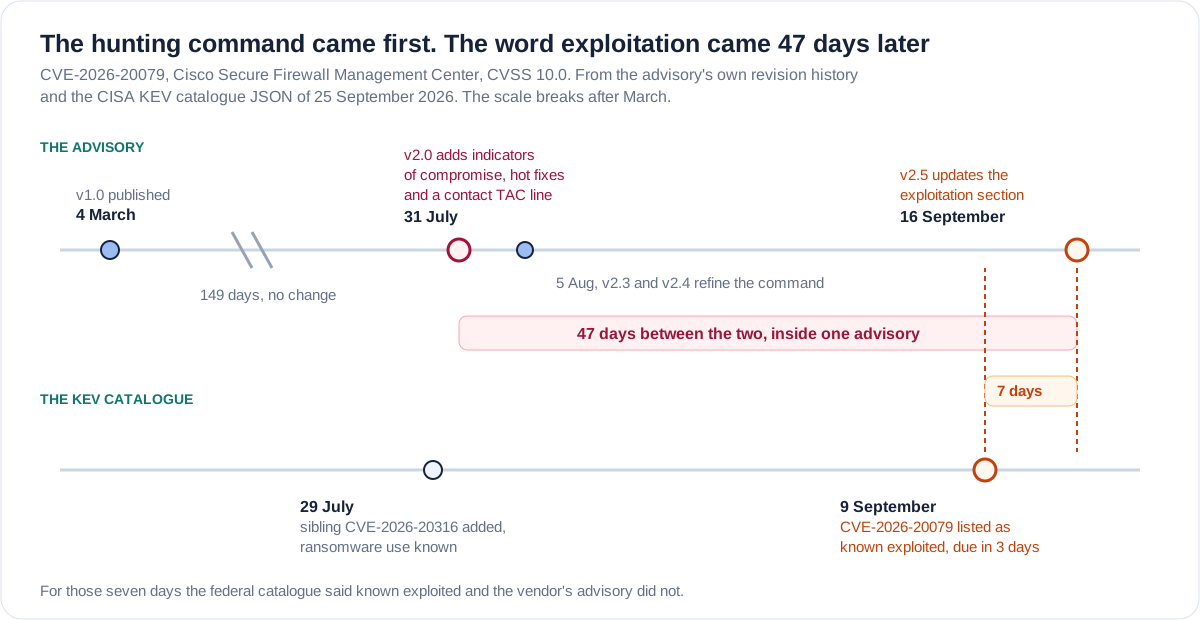
On 31 July 2026, version 2.0 added "indicators of compromise, and hot fixes". Version 2.2, the same day, was "updated to make it clear to contact TAC if compromise is suspected". The indicators section now carries a command to run on the appliance and tells the reader that if the output contains a particular temporary file path, "this vulnerability may have been exploited". It adds that the hot fixes are "for preventing future exploitation only and may not address existing compromise".
The advisory's Exploitation and Public Announcements section was not updated until 16 September 2026, version 2.5, "to indicate that active exploitation has been observed". That is 47 days later.
CISA had added the same CVE to the Known Exploited Vulnerabilities catalogue on 9 September, with a due date of 12 September. So for seven days the United States federal catalogue listed the flaw as known exploited while the vendor's own advisory did not.
What that does not establish. It does not establish that Cisco knew of exploitation on 31 July. Cisco's own wording is that "In August 2026, the Cisco PSIRT became aware of active exploitation of this vulnerability", and August is after July. It does not establish a breach of any disclosure policy, because the policy is Cisco's own and it is not published as a contract. It does not establish how many organisations were compromised, because nobody has said. And it does not establish bad faith, for a reason that is more interesting than the accusation.
The innocent explanation, which makes it worse rather than better
There is a sibling flaw. CVE-2026-20316 is a hard-coded password vulnerability in the same product. CISA added it to KEV on 29 July 2026, and it is one of the comparatively few KEV entries flagged as known to be used in ransomware campaigns.
Two days later, Cisco added indicators of compromise to the CVE-2026-20079 advisory.
The most likely reading, and the most charitable one, is that the indicators came from investigating exploitation of the sibling. That is prudent behaviour and nobody should be criticised for it. But follow what it means for the reader. The same artefact on disk is evidence for both flaws. Anyone hunting for the confirmed-exploited hard-coded password bug in late July was, without being told, also hunting for a separate maximum severity authentication bypass that their tooling still recorded as not exploited.
Dates from Cisco's own revision history and from the CISA KEV catalogue JSON, version 2026.09.25. Intervals are ours.
| Date | What happened | Said to be exploited? |
|---|---|---|
| 4 March 2026 | CVE-2026-20079 advisory published, version 1.0, CVSS 10.0 | No |
| 29 July 2026 | Sibling CVE-2026-20316 added to KEV, ransomware use known | For the sibling, yes |
| 31 July 2026 | Version 2.0 adds indicators of compromise and hot fixes | No |
| 5 August 2026 | Versions 2.3 and 2.4 refine the hunting command | No |
| August 2026 | Cisco PSIRT becomes aware of active exploitation, date not given | Not yet in the advisory |
| 9 September 2026 | CISA adds CVE-2026-20079 to KEV, due 12 September | Yes, by CISA |
| 16 September 2026 | Version 2.5 updates the exploitation section | Yes, by Cisco |
What the flaw is, in one paragraph
The advisory describes the cause as "an improper system process that is created at boot time". A startup process leaves a partial administrative session in place, and if nobody authenticates after the system boots, that session persists and can be reached by crafted HTTP requests to the web interface, yielding the ability to run scripts and commands as root. There are no workarounds. Cisco adds that where the management interface has no public internet access, the attack surface is reduced, which is worth reading as the mitigation it is rather than the reassurance it sounds like.
Two details about provenance matter. The flaw was found by Brandon Sakai of Cisco during internal security testing, so there is no external researcher deadline anywhere in this story and no disclosure dispute. And on 16 September Cisco replaced the hot fixes with full hardening releases that also fix, in its own words, "multiple other internally discovered vulnerabilities".
Cisco Talos has since linked exploitation of this flaw and its sibling to three activity clusters, tracked as UAT-12197, UAT-11823 and UAT-11988, spanning state aligned actors and ransomware operators, with Qilin encryptors deployed in some cases. Sophos separately identified an implant recovered from compromised appliances as a variant of Cyclops Blink, malware previously associated with Sandworm. Both of those attributions are reported rather than read here, and both are named for completeness rather than relied on for any claim in this piece.
Why this matters more than an editorial quibble
Almost nobody reads a security advisory. Tooling reads it.
Vulnerability management platforms, CVE enrichment feeds, ticketing integrations and internal dashboards parse the structured parts: the CVSS vector, the fixed release table, the CWE, and the exploitation field. The exploitation field is what turns a critical into an emergency, because it is the input to the phrase every organisation uses to decide what jumps the queue: known exploited.
For 47 days that field said nothing while the indicators section said, in effect, here is how to find out whether it has already happened to you. An advisory can be entirely accurate in every sentence and still be read as two different documents by a person and by a machine.
The practical test, and it costs nothing: when a vendor advisory acquires an indicators of compromise section, treat that as a signal in its own right, independent of what the exploitation field says. Nobody writes a hunting command for a vulnerability they believe has never been used. They write one because somebody, somewhere, needed to look.
The wider pattern the same month produced
This advisory is one of a set. Eclypsium's InfraTrust Pulse for September 2026 counted 158 advisories across 17 vendors covering 1,699 vulnerabilities between 25 August and 17 September, a window of 23 days. Forty two advisories were rated critical, eight carried a maximum CVSS of 10.0, and 71 vulnerabilities were remotely exploitable without authentication. Five advisories contained something that reached KEV.
Its stated trend is the part worth carrying: for the second consecutive month, the highest value exploited flaws in infrastructure were in administrative software rather than in the devices themselves. The report's own line about the affected products is the best sentence in it: "None of those is a firewall, switch, router, or fabric. Each one is the console that configures them, holds their credentials, and provides a change-control path into all of them at once."
That is the same failure shape as the exchange incident published this week, where key custody held and the system that decides what the keys sign did not. Control planes are where the authority actually lives, and they are consistently defended as though they were management tooling rather than as though they were the crown jewels.
The five management plane flaws from this window that reached the KEV catalogue, with dates and due dates from the KEV JSON of 25 September 2026.
| Vulnerability and product | Added to KEV | Days to the federal due date |
|---|---|---|
| CVE-2026-20316, Cisco Secure FMC, hard-coded password | 29 July 2026 | 3 |
| CVE-2026-83548, SonicWall SMA1000, server side request forgery | 2 September 2026 | 3 |
| CVE-2026-83549, SonicWall SMA1000, OS command injection | 2 September 2026 | 3 |
| CVE-2026-20079, Cisco Secure FMC, authentication bypass | 9 September 2026 | 3 |
| CVE-2026-76460, Cisco Identity Services Engine, privileged API | 16 September 2026 | 3 |
CVE-2026-76460 is worth a second look. Cisco disclosed it on 16 September and CISA added it to the catalogue the same day, with a due date three days later. A federal agency had 72 hours to patch an identity management platform from a standing start, on the day the fix appeared.
One more figure from the report, because it is the kind of arithmetic nobody does. A single Linux kernel privilege escalation, CVE-2026-31431, added to KEV back in May, appears in 19 separate advisories from six vendors. Fourteen of those, 74 per cent, are Dell's. One upstream defect, nineteen remediation tasks, nineteen advisory numbers, nineteen vendor schedules.
What to do about it
Take this with you
In the order worth doing
- Check the FMC indicator now if you run one, regardless of patch state. Cisco's own wording is that the hot fixes prevent future exploitation and may not address existing compromise, which means a patched appliance is not a cleared appliance.
- Change how your vulnerability process treats an advisory revision. If a vendor adds an indicators of compromise section, raise the item, even when the exploitation field is unchanged. Most tooling does not watch revision histories at all.
- Inventory your management planes separately from the devices they manage, and hold them to the standard you hold a domain controller to: no public exposure, separate credentials, separate monitoring, and an alert when an administrator is created.
- For each management console, write down what an attacker with root on it can reach in one step. For a firewall manager the honest answer is every firewall policy in the estate.
- Where a KEV due date is three days and you cannot meet it, record the compensating control and the date you decided, because that record is the only thing that distinguishes a considered risk decision from a missed one.
- Track upstream component advisories as one item with many tickets rather than many items. Nineteen advisories for one kernel flaw is a reporting artefact, not nineteen problems.
The question this leaves
Eclypsium sells infrastructure security products and its report recommends treating administrative platforms as high value targets, which is also its market. Declaring that does not weaken the counts, which come from published advisories anyone can recount, and the sentence about consoles is true whoever is paid to say it.
The finding that belongs to nobody's marketing is the one in the revision history. A vendor published a way to check for compromise on 31 July and the words "active exploitation" on 16 September. Both statements were accurate on the day they were made. The gap between them was invisible to every process that reads advisories the way machines read them.
So the question for your own vulnerability process: when a vendor quietly adds a hunting command to an advisory you have already triaged and closed, who in your organisation finds out, and how?
Sources
- PrimaryThe CVE-2026-20079 advisory, read in full including the expanded revision history, used for every date, the indicators of compromise and the exploitation wordingCiscoaccessed 2026-09-25
- PrimaryThe KEV catalogue JSON, version 2026.09.25, used for the dates added and due dates of the six vulnerabilities named hereCISAaccessed 2026-09-25
- Reported byCoverage of Eclypsium's InfraTrust Pulse for September 2026, used for the report's counts, its quoted lines and the list of affected management platformsBleepingComputeraccessed 2026-09-25