Gyazo exposed about 492.4 million image records. Its notice cannot rule out private-image viewing
The confirmed fields include OCR text, source URLs, IP addresses, EXIF location and private-image passphrase hashes. That makes this more than an account breach even before image-file access is resolved.
By Parminder Kumar Sharma · · 8 min read

23.62 million users and two image-metadata sets are confirmed
Gyazo has confirmed unauthorised access to systems holding user and image information. Its incident notice describes two large datasets: records associated with about 23.62 million users, and metadata for about 490 million images, primarily created before January 2019. A further 2.4 million image-metadata records were affected under separate conditions.
The user data may include names or nicknames, email addresses, password hashes, user IDs, device IDs, login session IDs, profile information, latest login time, plan or billing status, an X access token and the email address used for Google sign-in. Exposure varies by account. Gyazo says payment-card data was not included.
The scale is important, but the field types matter more. Screenshot services often capture fragments of work that users never intended to publish: support tickets, internal dashboards, authentication errors, customer records and code. Metadata can make that content easier to locate and correlate.
The notice confirms the middle of the chain and leaves both ends open
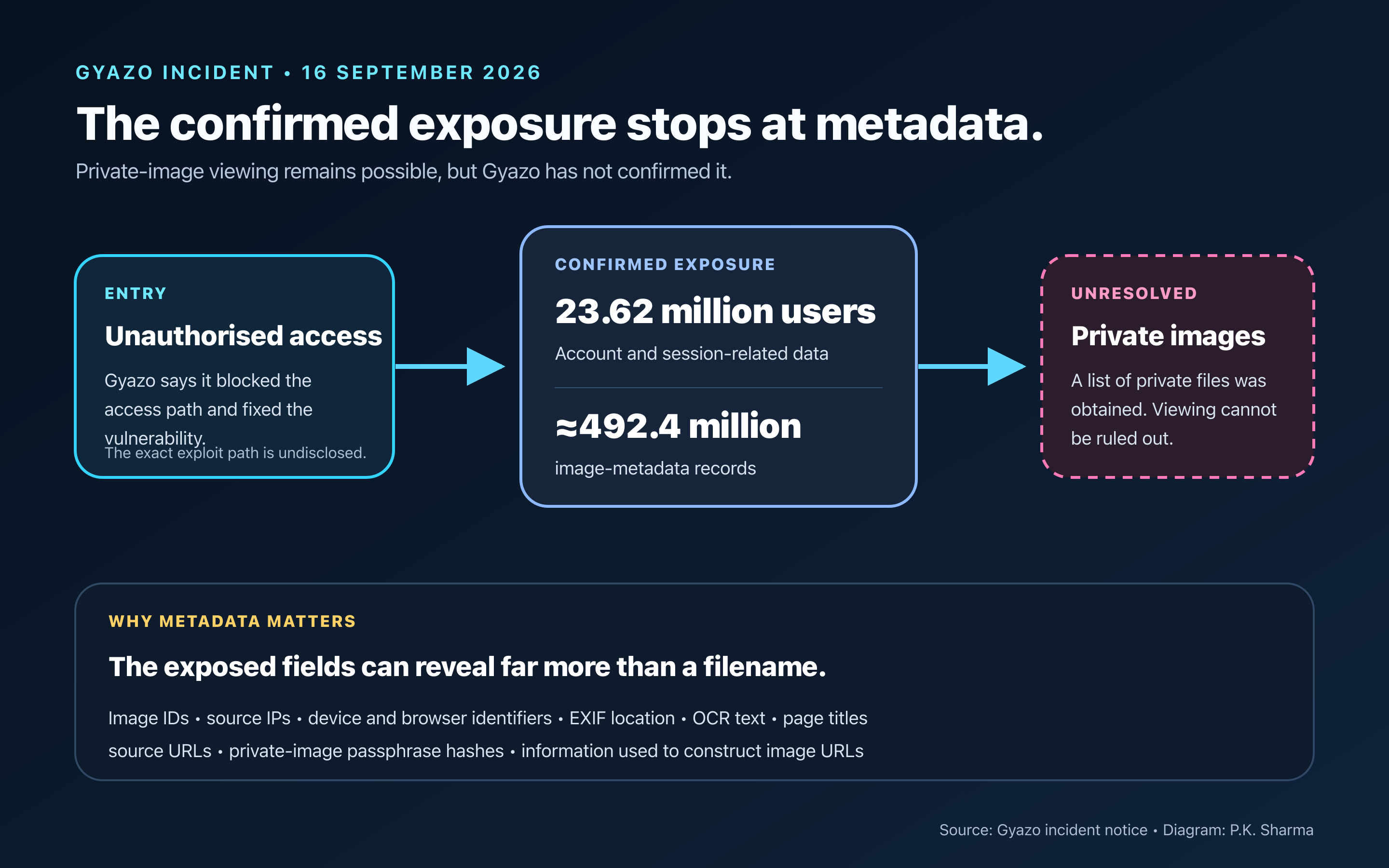
OCR, EXIF and source URLs can reconstruct what a screenshot was about
Gyazo says the affected image metadata can include image IDs, source IP addresses, User-Agent strings, EXIF location data, text produced by optical character recognition, titles, source URLs and hashes of passphrases used for private images. It also says the exposed information included data used to construct image URLs.
Those fields can be combined. An IP address can suggest an organisation or location. A source URL can name an internal application. OCR can reveal text displayed inside the screenshot. EXIF may carry precise location. A title can identify a customer, incident or project. An image ID and URL-construction information may help an attacker locate the related object. The risk is therefore not limited to identity theft. It includes reconnaissance, targeted phishing, credential discovery and the exposure of operational context.
How exposed Gyazo fields can be abused
| Field | What it may reveal | Example risk |
|---|---|---|
| OCR text | Words visible inside a screenshot | Credentials, ticket text or customer data become searchable |
| Source URL and title | The application and page where capture occurred | Internal-system mapping and targeted phishing |
| Source IP and User-Agent | Network and device context | Organisation or user correlation |
| EXIF location | Where a source image was created | Physical-location exposure |
| Image ID and URL information | How an image object may be addressed | Attempted retrieval or enumeration |
| Private passphrase hash | A verifier for protected images | Offline guessing if weak passphrases were used |
No image loss does not mean no image access
Gyazo has not publicly described the vulnerability or the path used to enter its systems. It says it blocked the access route and fixed the vulnerability. That means a diagram of a specific exploit, malware chain or remote-code-execution path would go beyond the evidence.
The service also distinguishes loss from access. It reports no image loss, meaning images were not deleted or destroyed. That statement does not establish that no image was viewed or copied. The conservative response is to identify sensitive captures, rotate any secrets visible in them and investigate downstream access.
Rotate what the screenshot exposed, not only the Gyazo password
Take this with you
Immediate response
- Change a reused Gyazo password everywhere it was used and enable multi-factor authentication where available
- Sign out of active sessions and review connected X and Google sign-in access
- Search password managers, tickets and repositories for secrets that may have appeared in screenshots
- Rotate API keys, tokens, recovery codes and credentials visible in sensitive captures
- Treat messages that reference real screenshot context as high-risk phishing
- For managed estates, look for Gyazo use in browser telemetry and ask teams to identify business-sensitive captures
Organisations should focus on secrets and context rather than attempting to inventory hundreds of millions of records. A practical hunt starts with screenshots used in engineering, customer support, security operations and finance. Those workflows are most likely to contain credentials, internal URLs or personal data.
The incident is also a retention lesson. Screenshot tools are fast precisely because they make capture and sharing frictionless. That convenience can turn a temporary debugging image into a long-lived record. Teams should define approved tools, default retention, access controls and a rule that secrets must never be captured.
The 492.4 million figure is arithmetic, not Gyazo’s estimate of people
Gyazo reports approximately 490 million image-metadata records, mainly for images registered before January 2019, plus approximately 2.4 million records obtained under separately narrowed conditions. Adding them produces about 492.4 million records. It does not produce 492.4 million affected people or even 492.4 million unique images unless the two sets are known to be disjoint and one row maps to one image. Gyazo has not published that schema.
The 23.62 million user figure is a separate population. One account can have many screenshots, and an anonymous device may create images without mapping neatly to a registered person. The useful incident model therefore has three datasets: user and session data, the older bulk metadata set and the separately narrowed metadata set. Converting any one of them into a single victim count would go beyond the notice.
The three confirmed populations in Gyazo’s notice
| Population | Approximate count | What the count represents |
|---|---|---|
| Gyazo users | 23.62 million | Accounts or users with one or more affected fields |
| Primary image metadata | 490 million | Mostly images registered before January 2019 |
| Additional image metadata | 2.4 million | Records obtained under separately narrowed conditions |
| Private images viewed | Not established | Gyazo cannot rule out viewing but gives no count |
The affected authentication data crosses four different response paths
Password hashes, login session IDs, device IDs, X integration tokens and Google sign-in email addresses are not interchangeable. A password hash may support offline guessing, especially where a password was weak or reused. A live session identifier can matter without the password. An integration token can carry the permissions granted to the connected service. A Google SSO email address is an identifier rather than the Google credential itself.
Gyazo says it assessed the design and potential misuse of authentication-related information and applied invalidation or restrictions where appropriate. It does not identify which token types were invalidated, when the action completed or whether every affected session was terminated. Users should therefore treat the service’s password-change advice as the minimum response, not the full boundary.
The account response and the screenshot response are also different. Changing a password does not rotate an API key visible inside an old screenshot, remove an address from OCR text or invalidate a recovery code captured on screen. The sensitive object may belong to another system entirely.
A field-by-field response is more useful than one password reset
| Affected field | Primary risk | Response |
|---|---|---|
| Password hash | Offline guessing and reuse | Change Gyazo and every similar password |
| Login session ID | Session replay if still valid | Terminate sessions and verify invalidation |
| X integration token | Connected-account access within granted scope | Review and revoke the integration |
| Google SSO email | Targeted phishing and account correlation | Treat as exposed identity context |
| OCR or screenshot text | Secrets and personal data from another system | Find and rotate each still-valid secret |
Gyazo disabled image delivery because the risk was still active
Gyazo’s frequently asked questions explain why some images and share links stopped working. The company temporarily disabled access to some images to prevent secondary harm and resumed delivery for images uploaded after countermeasures were completed. That is operational evidence that the investigation was not only retrospective.
The notice says the paths used for unauthorised access were blocked and the vulnerability fixed. It does not name the vulnerability, affected component, first-access date, dwell time or logging coverage. Without those facts, nobody outside the investigation can reproduce the intrusion path or calculate how long records were exposed. The current diagram deliberately begins at confirmed unauthorised access rather than inventing the missing exploit.
Helpfeel and Cosense run on separate configurations, and Gyazo says it has not confirmed exposure from those systems. Images embedded there may still be unavailable because they depend on Gyazo delivery. That is a dependency impact, not evidence that those separate systems were breached.
The question that exposes the gap
Which private-image objects were requested using the exposed URL-construction data, and which logs can still answer that question?
The incident notice is unusually specific about fields and counts, but its central content question remains open. A list of private files was obtained, image URLs could be constructed from exposed information and viewing cannot be ruled out. The next useful update is not another aggregate number. It is the evidence Gyazo has for object access, the period that evidence covers and the users whose screenshots can no longer be assumed private.
Sources
- PrimaryNotice regarding unauthorized access to GyazoGyazoaccessed 2026-09-20
- PrimaryUsing password managersUK National Cyber Security Centreaccessed 2026-09-20
- PrimaryPhishing attacks: defending your organisationUK National Cyber Security Centreaccessed 2026-09-20