GnuPG says GPGME 2.3.1 fixes a critical double free in all prior versions; disclosure moved up 5 days after Ruby2Shell
GnuPG's advisory of 20 November 2026 says GPGME 2.3.1 fixes a critical double free that a crafted OpenPGP key can trigger, and that disclosure came 5 days early because of Ruby2Shell (derived). No saved page gives a score, a CVE record or an exploitation statement.
By Parminder Kumar Sharma · LinkedIn · · 18 min read
GnuPG went public 8 days after it was told and 5 days before its first date, and says another project's bug moved it (derived)
On Friday 20 November 2026 at 19:01:51 CET, which is 18:01:51 UTC (derived: CET is UTC+1 in November), the GnuPG announce list carried a security advisory for GPGME. It says GPGME 2.3.1 "fixes a critical security bug found in all prior versions". GPGME is the library that lets applications call GnuPG for encryption, signing, verification and key management, as its project page puts it. By GnuPG's account a crafted OpenPGP key with a very long user id triggers a double free, a memory error, and "an immediate update is highly suggested".
The dates. The announcement says GnuPG was informed by GitLab on 2026-11-12, "initially" set 2026-11-25 for a coordinated disclosure, and disclosed on 2026-11-20 because, in its words, "due to the new Ruby2Shell bug GitLab had to update earlier". From the informing to the public date is 8 days; the planned span was 13 days; the public date is 5 days earlier than the planned one (all derived from the three dates: 20 minus 12, 25 minus 12, 25 minus 20). The Ruby flaw it names is the subject of this site's brief on Ruby2Shell, and a section below says what that brief does and does not hold about GitLab.
What this does not establish. The saved pages give no severity score and no CVE record: GnuPG prints the id CVE-2026-129975, and this site's check of CVE.org's API at about 17:12 UTC on 21 November got a 404, meaning no record yet (the absence of a record is not an event). "Critical" is GnuPG's own word. No page says anyone exploited the flaw. GnuPG says exfiltration "can be used" and remote code execution "can't be ruled out", and neither is shown. No page lists which distributions have fixed packages, whether any 1.24.x or 2.2.x release carries the fix, or which mail clients are reachable ("most" is not a list). The pages do not say why a GitLab update bore on GnuPG's date. This site names no individual: the announcement and the ticket name the discoverer, the sender and ticket participants, and none is named here.
Whose interest. GnuPG is a free software project and the announcement gives GPGME away. It also says it releases GnuPG Desktop and GnuPG VS-Desktop versions that use GPGME; the saved pages do not show who sells those products, and this site read no price page. No vendor pays this site, and it shares no vendor's interest.
What GnuPG says the bug is: two readers, a stale pointer and a second free
The announcement's description, in its own order, has four parts. The trigger: "an OpenPGP key containing a crafted very long user id". The memory error: a double free. The two things GnuPG says it permits: it "can be used exfiltrate data from applications by sending for example signed data", and an attack for remote code execution "can't be ruled out". And the root cause.
The root cause, as the announcement describes it in prose: two internal functions of GPGME read the status lines and the key listings from gpg. Each starts with a buffer of 1024 bytes and grows it when more space is needed. The new pointer is stored back into the context only at the end of the function, so when the function returns early, because of a read error or another event, "the context is not updated and keeps the stale pointer to the freed memory" and frees it a second time when the context is released. GnuPG adds: "Due to other allocations in between the common double free checks of memory allocators may not be triggered."
Three wording differences are worth keeping apart. First, the description names two readers (status lines and key listings), while the changelog line and both commit titles name only "the status line read code"; the ticket's own title names two functions. Second, the announcement ties the trigger to a very long user id, while the report quoted in the ticket describes the cause through a buffer that is grown and an early return, and does not mention user ids; this site read no page that says which input reaches the early return. Third, the announcement says GnuPG "was informed by GitLab", while the ticket speaks only of "the reporter"; no saved page says whether the reporter is the discoverer, GitLab or another party. The ticket quotes the flawed functions in the reporter's words. This site read that excerpt and prints none of it: the announcement's prose is enough to say what the flaw is and what a defender needs.
Which versions: the page resolves most of the apparent inconsistency, and leaves one gap
The announcement says the bug is "found in all prior versions" in its opening, and in its Impact section that software "using a GPGME version prior to 2.3.0" is affected. Read alone, the two phrases look different. The announcement closes the gap itself: "version 2.3.0 was never publicly available". So for every version a user could have installed, "all prior versions" and "prior to 2.3.0" describe the same set. The announcement does not say whether the unreleased 2.3.0 contained the flaw, and no reader needs to know. Its changelog is written "compared to version 2.2.0", which suggests, and this site infers without a saved page saying it, that 2.2.0 was the last public release before 2.3.1.
The gap is the older branches. The report quoted in the ticket says the flaw is "present up to current master (also in 1.18.0 and later releases shipped in distributions)". The announcement names one fixed release, 2.3.1, and for anything older gives the attached patch, which it says "likley applies cleanly even to very old versions". The ticket's related objects list a release ticket for GPGME 1.24.3, and the log shows the security ticket mentioned there at 10:26:24 UTC on 20 November (derived from the UTC+1 stamp). None of that says a 1.24.x release carries the fix. Whether any 1.24.x or 2.2.x release does is not stated.
What each saved page says about versions (announcement and ticket T8557, read at about 15:56 UTC on 21 November 2026)
| Where | What it says | What it leaves open |
|---|---|---|
| Announcement, opening | "found in all prior versions" (prior to 2.3.1) | Whether the never public 2.3.0 was affected |
| Announcement, Impact | "prior to 2.3.0" as a shared library, DLL or statically linked | Nothing more for public releases: 2.3.0 "was never publicly available" |
| Report quoted in the ticket | Present up to master, "also in 1.18.0 and later releases shipped in distributions" | Whether anything before 1.18.0 was tested |
| Announcement, Solution | Update to 2.3.1; or apply the attached patch to an older version | A fixed 1.24.x or 2.2.x release number |
| Ticket, related objects | Release tickets for GPGME 2.3.1 and GPGME 1.24.3 are listed | What the 1.24.3 release contains; the page prints no fixed version for it |
| Project page | "The current version is 2.3.1." | Older supported branches |
The clock: informed 12 November, fix with the reporter by 18 November, public 20 November
Diagram 1 puts every stamp on a time axis. Panel 1 runs 12 to 26 November by the day and panel 2 zooms into the evening of 20 November by the hour. The ticket prints UTC+1 stamps, converted here to UTC; the announcement prints CET, which is also UTC+1 on that date.
The fix reached the reporter early. The ticket's comment stamped 09:21:48 UTC on 18 November says GnuPG has "fixed this with gpgme 2.3.1" and has "provided the tarball and a patch to the reporter for further distribution to Linux distros". It adds: "The announcement is planned for the 25th." That is 6 days after the informing date and 2 days before the public date (derived, by calendar date). The comment shows the handover had happened by 09:21 UTC on 18 November at the latest; it does not say when. The comment is marked Edited, so this site cannot say the saved wording is the original wording. It also means that, on the pages, the Linux distributions were meant to hear through the reporter before 20 November. This site read no distribution tracker and cannot say what any of them did.
The date moved after that comment. The 18 November comment still says the 25th. The announcement says the move to the 20th was "due to the new Ruby2Shell bug". So, if the saved comment is unedited, the decision to move came after 09:21 UTC on 18 November. No saved page gives the day or hour of the decision, who made it, or what GitLab's update involved.
The release date and the commit dates. The changelog dates GPGME 2.3.1 as 2026-11-19, 1 day before the announcement, and the 18 November comment already speaks of the fix as made. The ticket then logs two commits titled "Fix a double free in the status line read code" on 20 November, at 09:09:19 and 11:26:56 UTC (derived from the UTC+1 stamps), one to two days after the comment. The saved pages do not say when the 2.3.1 tarball first became downloadable, what the two commits are (they carry different identifiers) or why there are two.
Ticket T8557 and announcement stamps, converted to UTC (stamps as printed, ticket page living, saved at about 15:56 UTC on 21 November 2026)
| As printed | UTC (derived) | What it is |
|---|---|---|
| Fri Nov 20 19:01:51 CET 2026 | 20 Nov 18:01:51 | Announcement sent to the announce list |
| 2026-11-13 03:17:32 (UTC+1) | 13 Nov 02:17:32 | Ticket created |
| 2026-11-13 03:46:57 (UTC+1) | 13 Nov 02:46:57 | Comment: the reporter gave the patch |
| 2026-11-16 17:42:52 (UTC+1) | 16 Nov 16:42:52 | Status changed from Open to Testing |
| 2026-11-18 10:21:48 (UTC+1) | 18 Nov 09:21:48 | Comment, marked Edited: tarball and patch provided; announcement planned for the 25th |
| 2026-11-20 10:09:19 and 12:26:56 (UTC+1) | 20 Nov 09:09:19 and 11:26:56 | Two commits added to the ticket |
| 2026-11-20 18:58:06 (UTC+1) | 20 Nov 17:58:06 | Ticket closed as Resolved; visibility changed to All Users in the same group of lines |
| 2026-11-20 20:01:40 (UTC+1) | 20 Nov 19:01:40 | Visibility changed from All Users to Public (No Login Required) |
| 2026-11-20 20:05:17 (UTC+1) | 20 Nov 19:05:17 | External Link set to the announcement |
The announcement links a ticket whose public setting changed an hour later
The announcement says "Our internal ID is T8557" and links the ticket. The ticket's log shows, in this order (UTC, derived): it was closed as Resolved at 17:58:06, in a group of lines that also changes its visibility from "g10code (Project)" to "All Users" and prints no separate stamp for that line; the announcement was sent at 18:01:51, 3 min 45 s after the closing stamp (derived); the ticket noted a mention in a repository commit titled Security Announcement T8557 at 18:19:01; its visibility changed from "All Users" to "Public (No Login Required)" at 19:01:40, 59 min 49 s after the announcement stamp (derived); and its External Link was set to the announcement at 19:05:17, 63 min 26 s after it (derived).
That is all the stamps show. This site does not know what "All Users" permits on that tracker, because the saved page does not say, so it cannot say who could open the ticket in the hour in between. It does not know whether the announcement's date line is the send time, and it draws no conclusion from the order.
Ruby2Shell and GitLab: what brief 755 holds, and what the GnuPG page leaves out
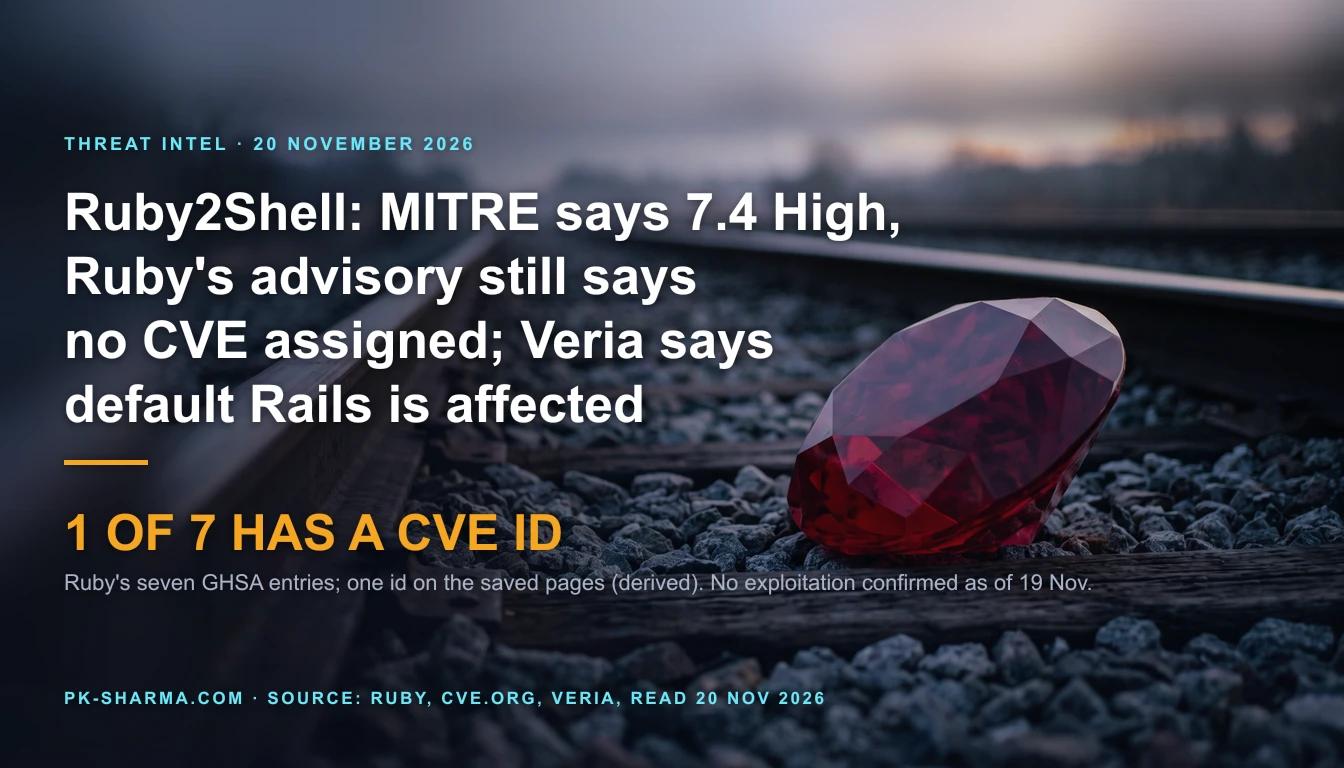
The announcement ties its date to "the new Ruby2Shell bug" and to GitLab. This site's brief 755 read Ruby's advisory on seven flaws, dated 18 November 2026, and the CVE record CVE-2026-132825, assigned by mitre and published at 06:34:26 UTC on 19 November. That brief holds three things about GitLab, none about GnuPG. Veria Labs's self hosted software table, as printed on 20 November at 15:00 UTC, lists GitLab 19.6.0 and earlier as Patched with fixed versions 19.6.1, 19.5.8 and 19.4.10. Previdian's page, published on 19 November, lists GitLab as affected and says that is what Veria's list showed then. And the CVE record's reference list includes a commit in the omnibus GitLab repository, which brief 755 did not open. Brief 755 says nothing about GnuPG, GPGME or a disclosure date.
The GnuPG announcement, for its part, gives no GitLab date, no GitLab version and no link to a GitLab page, and this site read no GitLab page. The order of events on the pages is consistent with the announcement's explanation: Ruby's advisory is dated 18 November, the CVE record is dated 19 November, and GnuPG's disclosure came on 20 November. That is an order of dates, not a stated chain of cause. One more coincidence is on the record, and no saved page connects it to anything: 25 November, the date GnuPG first set, is also the date brief 755 reports Veria Labs gave for publishing a proof of concept for Ruby2Shell (25 November 2026, or later if major vendors have not shipped a fix).
What "affected" means for a library: three delivery routes, three fixes
GPGME is a library, so the people who need to act are rarely the people who installed it. The announcement says: "All software using a GPGME version prior to 2.3.0 either as shared libary, DLL, or statically linked is affected." It lists as examples Gpg4win, GnuPG Desktop, GnuPG VS-Desktop, "Most mail clients", "Many XMPP clients", Samba and "Flatpack" (the page's own spelling of the name). It names no mail client and no XMPP client. It also says it released new Gpg4win and GnuPG Desktop and VS-Desktop versions, which "all make use of GPGME".
The three routes matter because each has a different owner. A shared library is updated by whoever maintains the system's packages. A DLL ships inside a Windows application or installer, so its owner is the application's publisher. A statically linked binary carries its own copy and is fixed only when its publisher rebuilds it; no system update touches it. The announcement says each fix in turn and says there is "no need to udpate GPGMEPP or GPGMEQT" (its spelling).
The three routes and the fix each gets in the announcement (read 21 November 2026), with what this site did not check
| Route | The announcement's fix | Not checked or not stated |
|---|---|---|
| Shared library | "Please update your GPGME shared library to version 2.3.1." | Any distribution's package version: the announcement lists none and this site read no tracker |
| DLL | "If you need a DLL you may take it from from the updated Gpg4win version." Gpg4win 5.1.2 is named | Which other Windows applications ship their own DLL |
| Statically linked | "remmeber to build them against GPGME 2.3.1" | Which products are built this way; the announcement names none |
| Cannot update | The attached patch, which "likley applies cleanly even to very old versions" | The archive copy this site read lists one scrubbed attachment, the signature file; no patch was visible in it |
| The project's own packages | The announcement says it provides Debian style packages for a couple of Debian variants | Whether those packages carry 2.3.1 |
What the pages state, and what they do not
Stated and not stated across the saved pages (announcement 20 November, ticket and project page saved 21 November 2026)
| Question | What the saved pages state | What they do not state |
|---|---|---|
| How severe is it? | "critical security bug", GnuPG's word | A CVSS score or vector; this site read no CVE record (CVE.org's API: 404 at about 17:12 UTC) |
| Who assigned CVE-2026-129975? | GnuPG prints the id in the announcement and the ticket | The assigner (the CNA); no record to show it |
| Has anyone exploited it? | Nothing | Any exploitation, or a statement that there has been none |
| Can data be exfiltrated? | "can be used" to exfiltrate data, for example via signed data | A demonstration, a victim or the kind of data |
| Can code run remotely? | "can't be ruled out" | Any demonstration or claim that it was shown |
| Who is affected? | All software using GPGME before 2.3.0, as shared library, DLL or static; seven examples | Which mail clients, which XMPP clients |
| Is there a fix? | GPGME 2.3.1, Gpg4win 5.1.2, a rebuild, a patch for older versions | Distribution package versions; a 1.24.x or 2.2.x fixed release |
| Is there a workaround? | Nothing other than updating or patching | Any mitigation for a system that cannot update yet |
| What must an application do? | A crafted key with a very long user id is the trigger; signed data is an example | What an application must do with the key to reach the flaw |
| Why did the date move? | GitLab "had to update earlier" because of Ruby2Shell | GitLab's date, its page, or how that bore on GnuPG |
What to do, in order
First what GnuPG says, then this site's suggestions, marked as such.
Take this with you
Actions, in the order worth doing
- GnuPG's advice: update your GPGME shared library to version 2.3.1.
- GnuPG's advice: if you need a Windows DLL, take it from the updated Gpg4win, version 5.1.2.
- GnuPG's advice: rebuild statically linked binaries against GPGME 2.3.1.
- GnuPG's advice: if GPGME cannot be updated, apply the attached patch, which GnuPG says likely applies cleanly even to very old versions. GPGMEPP and GPGMEQT need no update.
- This site's suggestion: list installed packages that depend on the GPGME shared library, and any static or vendored copies. The announcement says statically linked builds are affected, and a system update will not reach them.
- This site's suggestion: check your distribution's security tracker for a fixed package. This site did not, and the announcement lists no package versions.
- This site's suggestion: in a mail or chat client that handles keys, treat keys and signed messages from unknown parties with care until the client is updated. The announcement names no workaround; this is caution, not a control.
- This site's suggestion: record 2.3.1 as the fixed version and the older branch question (1.24.x, 2.2.x) as open, with the date you last checked the ticket.
- This site's suggestion: re-read the ticket and look for a CVE.org record in a day or two for a score, a CNA name and any exploitation statement, and rank the work only then if you cannot update at once.
What the announcement prints for the release
The announcement prints a changelog, a file name with its size and a checksum, and the Gpg4win version. Nothing in it is exploit material. The first block is the changelog entry as printed, with the release date GnuPG gives; a package or build record can quote the id and date from it. The announcement's changelog also lists new algorithm constants for 2.3.1, which are left out here.
Noteworthy changes in version 2.3.1 (2026-11-19)
[compared to version 2.2.0]
 * Fix a double free in the status line read code.
 [T8557,CVE-2026-129975]
The second block is the source tarball name and size, the checksum the announcement prints beside it, and the Windows installer version. A defender who builds from source can compare a downloaded file's checksum with this line. The announcement says only "The checksum for gpgme is" and does not name the algorithm; the value is 40 hexadecimal characters long (derived), the length of a SHA-1 digest, but the page does not say so. It also names a signature file for the tarball and refers to a separate integrity page that this site did not read.
gpgme-2.3.1.tar.bz2 (1393k)
1134a407b50204ee6fb9efaa6e1451c2460e543e gpgme-2.3.1.tar.bz2
A new version of Gpg4win (5.1.2)
The third block is the two commit identifiers the ticket lists, with the title each carries. They are the only code references in the saved pages that a defender can follow into the source; the ticket does not say which branch each commit is on.
rM14499348b966 Fix a double free in the status line read code.
rMb4358e92e33a Fix a double free in the status line read code.
The question the announcement leaves open
GnuPG's announcement says the library sits under most mail clients, many chat clients and Samba, and names not one mail or chat client. The ticket says the fix reached the reporter by 18 November for onward distribution to Linux distributions, and the announcement lists no distribution package. It says statically linked builds are affected, and a copy built into a binary may appear on no package list. So: which of your applications link GPGME, and who would know?
Key facts
Sources
- PrimaryGnuPG Security Advisory for GPGME (T8557, CVE-2026-129975), message dated Fri Nov 20 19:01:51 CET 2026, saved at about 15:56 UTC on 21 November 2026: description, impact, solution, changelog, dates informed and planned, checksumGnuPG (gnupg-announce mailing list archive)accessed 2026-11-21
- PrimaryTicket T8557, a living page saved at about 15:56 UTC on 21 November 2026, stamps UTC+1: report excerpt (not reproduced), event timeline, visibility and External Link changes, commit identifiersGnuPG (Maniphest ticket T8557)accessed 2026-11-21
- PrimaryGPGME project page, saved at about 15:56 UTC on 21 November 2026: what the library is for, and the line saying the current version is 2.3.1GnuPG (GPGME project page)accessed 2026-11-21