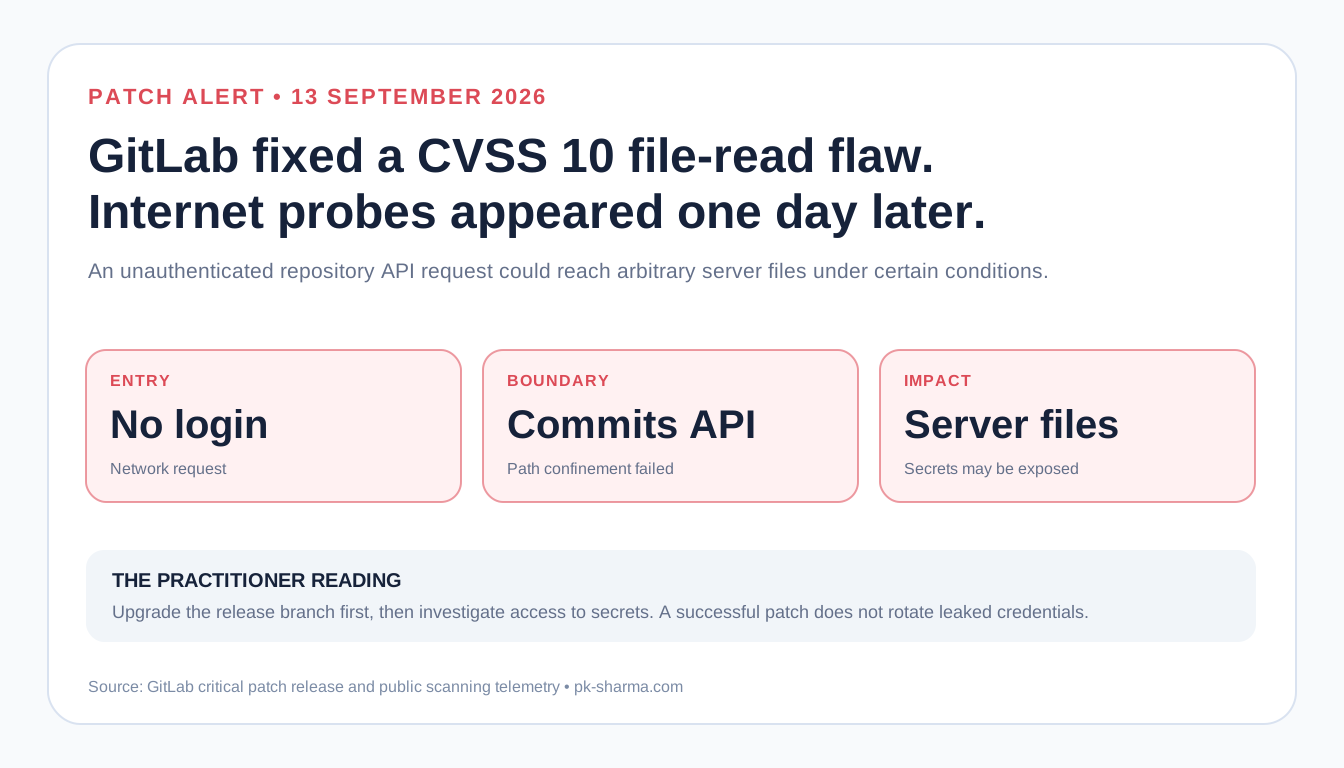
GitLab fixes a CVSS 10 file-read flaw. Internet probes appeared one day later.
CVE-2026-85706 allows an unauthenticated request to cross the repository commits API boundary and read arbitrary server files under certain conditions. Self-managed installations need a fixed branch and an investigation plan for any secret the service could read.
By Parminder Kumar Sharma · · 4 min read

The advisory names an unauthenticated server-file boundary failure
GitLab released critical patches 19.3.2, 19.2.6 and 19.1.8 on 10 September 2026. Its official advisory assigns CVE-2026-85706 a CVSS 3.1 score of 10.0.
GitLab says that, under certain conditions, an unauthenticated user could read arbitrary files from a GitLab server because the repository commits API did not enforce authentication and path confinement correctly. The published vector is AV:N/AC:L/PR:N/UI:N/S:C/C:H/I:H/A:N. The scope change and high integrity impact reflect what exposed files can enable, even though the immediate primitive is file read.
Public scanning was reported within a day of disclosure. Scanning is evidence that systems are being tested, not proof that every request succeeded or that a named organisation was compromised. The urgent case already exists in the vendor advisory: no login, network reachability and access to files readable by the service.
Three supported release branches have different fixed endpoints
Affected and fixed GitLab CE and EE branches
| Installed branch | Affected range | Minimum fixed release |
|---|---|---|
| 18.7 through 19.1 | 18.7 and later, before 19.1.8 | 19.1.8 |
| 19.2 | Before 19.2.6 | 19.2.6 |
| 19.3 | Before 19.3.2 | 19.3.2 |
The advisory applies to all deployment types where none is specified, including omnibus, source and Helm-based installations. GitLab.com was already patched when the bulletin appeared. GitLab says Dedicated customers do not need to act. The operational burden therefore falls on self-managed CE and EE owners.
Record the complete running version before and after the change. “GitLab 19 patched” is not sufficient because 19.1.7, 19.2.5 and 19.3.1 sit in different branches and all remain below their fixed endpoint. Where the current branch is unsupported, move to a supported release rather than trying to transplant one change.
A file-read flaw becomes an identity incident when secrets are reachable
The remediation question has two halves. The first is whether the vulnerable API was reachable. The second is what the GitLab service account could read. Configuration files can contain database credentials, object-storage keys, signing material, OAuth secrets, runner tokens or integration credentials. The exact set depends on deployment and permissions; the public advisory does not confirm that a specific secret was taken.
Review reverse-proxy, web application firewall and GitLab request logs for unusual unauthenticated traffic to repository commit API paths around disclosure and earlier, within retained evidence. Preserve logs before restarting or rotating systems if retention is short. A request-shaped indicator copied from public reporting is a lead for investigation, not a universal signature.
If evidence shows access to a sensitive file, rotate the credential and assess where it could be used. Installing 19.3.2 prevents the same route. It does not revoke a token already copied, invalidate a signing key or remove persistence established through another service.
Closure evidence for the vulnerability and its possible consequences
| Question | Evidence | Follow-up |
|---|---|---|
| Was the vulnerable branch running? | Version and deployment record | Upgrade to the branch’s fixed release |
| Was the API externally reachable? | Routing, proxy and access-control configuration | Restrict management and API exposure |
| Were suspicious requests received? | Preserved request and security telemetry | Investigate source, timing and response behaviour |
| Could a secret-bearing file be read? | Service account permissions and file inventory | Rotate exposed material and trace its downstream access |
The position
CVE-2026-85706 deserves emergency treatment because it combines remote reachability, no authentication and a server-side file primitive. The CVSS 10 label is useful, but the branch-specific fixed versions and the service account’s file access determine the actual response.
Patch first to stop continuing exposure. Then treat any confirmed read of secrets as a separate incident with its own rotation and investigation work. A green vulnerability scanner after the upgrade proves the old version is gone. It does not prove that credentials remained private.
Sources
- PrimaryGitLab Critical Patch Release: 19.3.2, 19.2.6, 19.1.8GitLabaccessed 2026-09-13
- PrimaryCVE-2026-85706 recordCVE Programaccessed 2026-09-13
- Reported byGitLab CVSS 10 File-Read Flaw Draws In-the-Wild Probes After DisclosureThe Hacker Newsaccessed 2026-09-13