GitHub ships AI Scan and agentic autofix: one flags pull-request risks, the other proposes reviewed repairs
Two GitHub security features reached general availability on 15 October. AI Scan adds advisory findings on pull requests, including languages CodeQL does not cover. Agentic autofix works on default-branch code-scanning alerts and opens draft repair pull requests after rerunning CodeQL. Their scope, merge controls and costs differ.
By Parminder Kumar Sharma · · 5 min read
Two releases at different points in the security workflow
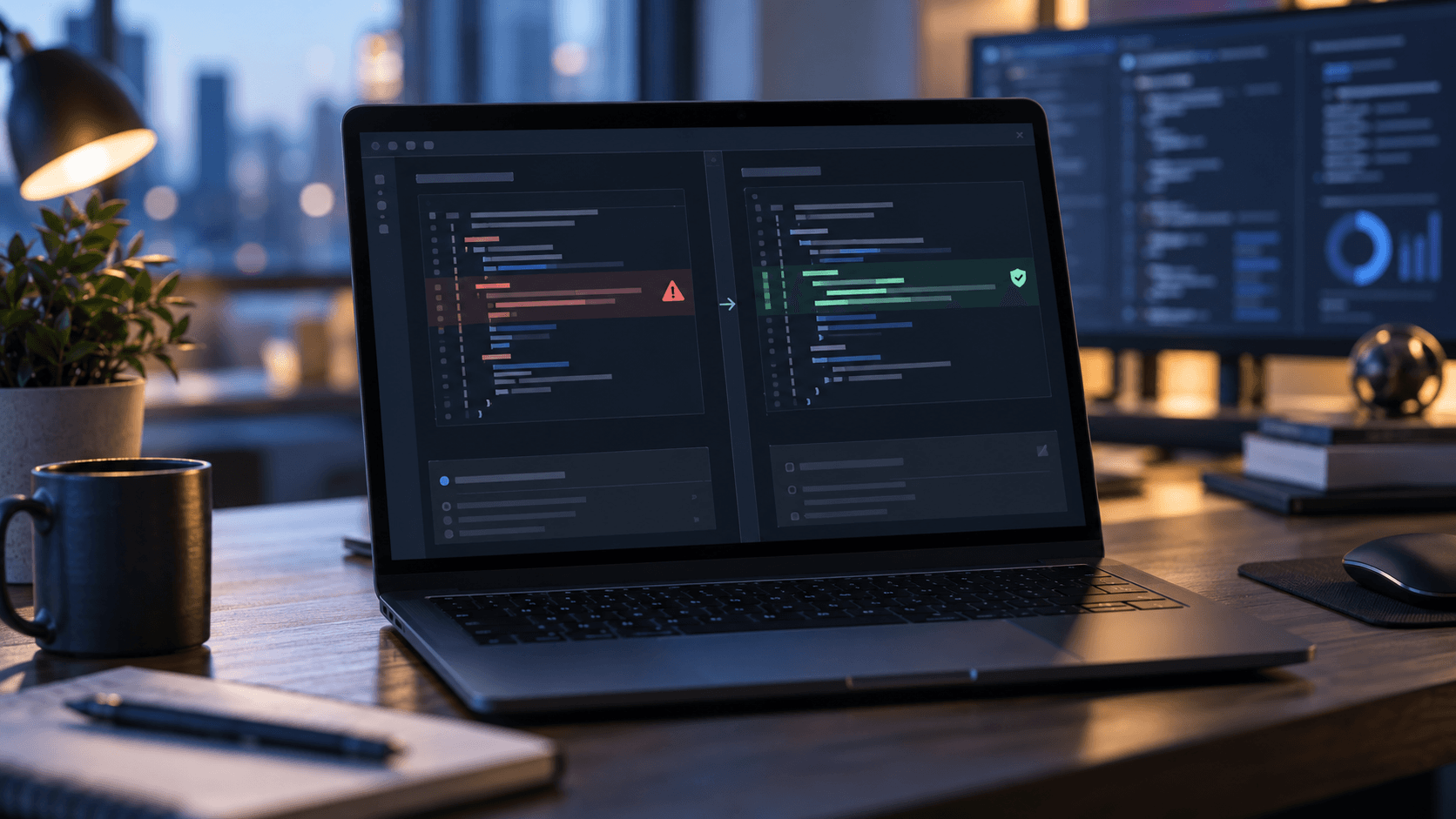
GitHub announced general availability for AI Scan for pull requests and agentic autofix for code-scanning alerts on 15 October 2026. The names sound similar, but the products operate at different moments. AI Scan examines changes proposed in a pull request and reports possible vulnerabilities. Agentic autofix starts with a code-scanning alert already on the default branch, investigates relevant files, proposes a change, reruns CodeQL and opens a draft pull request for review.
The practical news for a security team is the division of labour, not a claim that a model can certify code. AI Scan findings are advisory and cannot make the code-scanning check fail or block a merge through rulesets. Agentic autofix produces a draft PR, not an automatic merge, and GitHub’s CodeQL rerun verifies that the targeted alert closes; human review and broader tests still matter.
AI Scan versus agentic autofix
GitHub’s published GA scopes and limits, compared side by side.
| Question | AI Scan for pull requests | Agentic autofix |
|---|---|---|
| When does it act? | On eligible pull-request changes | On code-scanning alerts in the default branch |
| Main output | AI-labelled advisory finding with explanation and possible suggested fix | Draft pull request containing a proposed fix and validation notes |
| Can it block a merge? | No: findings do not fail the check or meet a blocking ruleset requirement | The fix remains a reviewable draft PR; merging is a separate action |
| Important branch limit | No fork or Dependabot pull requests | No alerts found only on PRs or other branches |
| Batching | Runs per eligible pull request | Up to 25 alerts can be assigned together to one PR |
| Access and cost | Public repos eligible; private/internal organisation repos need Code Security or Advanced Security. Uses Code Security AI Credits; no Copilot licence required | Enterprise Cloud Code Security or Advanced Security, enterprise policy and Copilot billing method. Uses Code Security AI Credits plus Actions minutes |
This HTML comparison is more useful than a bar chart because GitHub published feature states and constraints, not benchmark results or comparable detection rates. There is no measured false-positive rate, cost per alert or time-to-fix figure in the GA posts. Any chart assigning relative security strength would be invented.
What AI Scan adds, and what it cannot guarantee
GitHub says AI Scan complements CodeQL by inspecting pull-request changes in areas CodeQL does not currently cover, naming PHP, Shell/Bash, HCL Terraform files, Dockerfiles, Java JSP and C# Blazor among examples. Findings appear in the Conversation and Files changed views with an AI marker. They can explain a risk and suggest a fix. The feature runs automatically when code scanning and the repository’s effective AI Scan setting are enabled.
The advisory-only status is a governance decision worth noticing. A team whose rulesets block CodeQL findings must not assume AI Scan findings inherit that control. Reviewers need to read the AI-labelled result and decide whether to request changes. Fork and Dependabot PRs are excluded, so the feature is not an across-the-board gate on contributed code. AI Scan does not require a Copilot licence, but it does consume Code Security AI Credits. Private and internal organisation repositories need GitHub Code Security or GitHub Advanced Security.
How the agentic repair loop is bounded
For an eligible default-branch alert, a user assigns it to Copilot. GitHub says the agent explores relevant files, creates a proposed fix, reruns CodeQL, iterates if needed and opens a draft PR with a summary and validation steps. An alert that exists only in a PR or another branch cannot be assigned. A list view or security campaign can assign up to 25 alerts into a single repair PR.
Enterprise Cloud organisations must have Code Security or Advanced Security, an enterprise administrator must enable the Agentic autofix policy, and an organisation or repository administrator must switch it on. GitHub also requires a Copilot billing method. The feature consumes Code Security AI Credits and GitHub Actions minutes. A CodeQL rerun can show the targeted alert is resolved; it does not prove that the change preserves application behaviour, covers every related vulnerability or is ready to merge without tests.
A sensible rollout for a security team
Pilot AI Scan in a repository with real PHP, shell, infrastructure or other uncovered changes. Measure which findings reviewers accept, reject or miss, while keeping existing CodeQL and test gates in place. Tell maintainers explicitly that an AI Scan warning cannot stop a merge by itself. Budget for credits before enabling it widely.
For agentic autofix, start with a small set of well-understood default-branch alerts. Require a named reviewer, normal test suite and code-owner approval on every draft. Compare the agent’s CodeQL result with the original alert and inspect adjacent code for regressions. Review the enterprise policy, Copilot billing method, Actions usage and the effect of grouping multiple alerts into one PR. Both tools can reduce manual triage and repetitive repair work, but neither removes the need for an accountable merge decision.
Take this with you
Before enabling both features
- Confirm repository eligibility and the effective AI Scan/code-scanning settings.
- Decide who reviews advisory AI findings, since they do not block merges.
- Set AI Credit budgets and monitor Actions minutes for agentic autofix.
- Enable agentic autofix through enterprise policy and repository/organisation settings where appropriate.
- Keep tests and human review on every generated draft PR; track accepted fixes and regressions.
Source notes
This comparison uses GitHub’s AI Scan GA announcement and agentic autofix GA announcement, both dated 15 October and read 16 October 2026. Availability and billing reflect those announcements, not a product benchmark or an independent security effectiveness test.
Sources
- PrimaryAI Scan for pull requests generally availableGitHubaccessed 2026-10-16
- PrimaryAgentic autofix for code scanning alerts general availabilityGitHubaccessed 2026-10-16