Eight states filed eight separate suits against OpenAI: of 27 counts in six read, 6 concern AI agents
Eight US states each sued OpenAI on 14 October 2026 in their own courts. The six complaints read plead 27 counts and no finding, six of the counts are about AI agents, and the UK rules for children's chatbots stop short of what the headlines imply.
By Parminder Kumar Sharma · · 26 min read
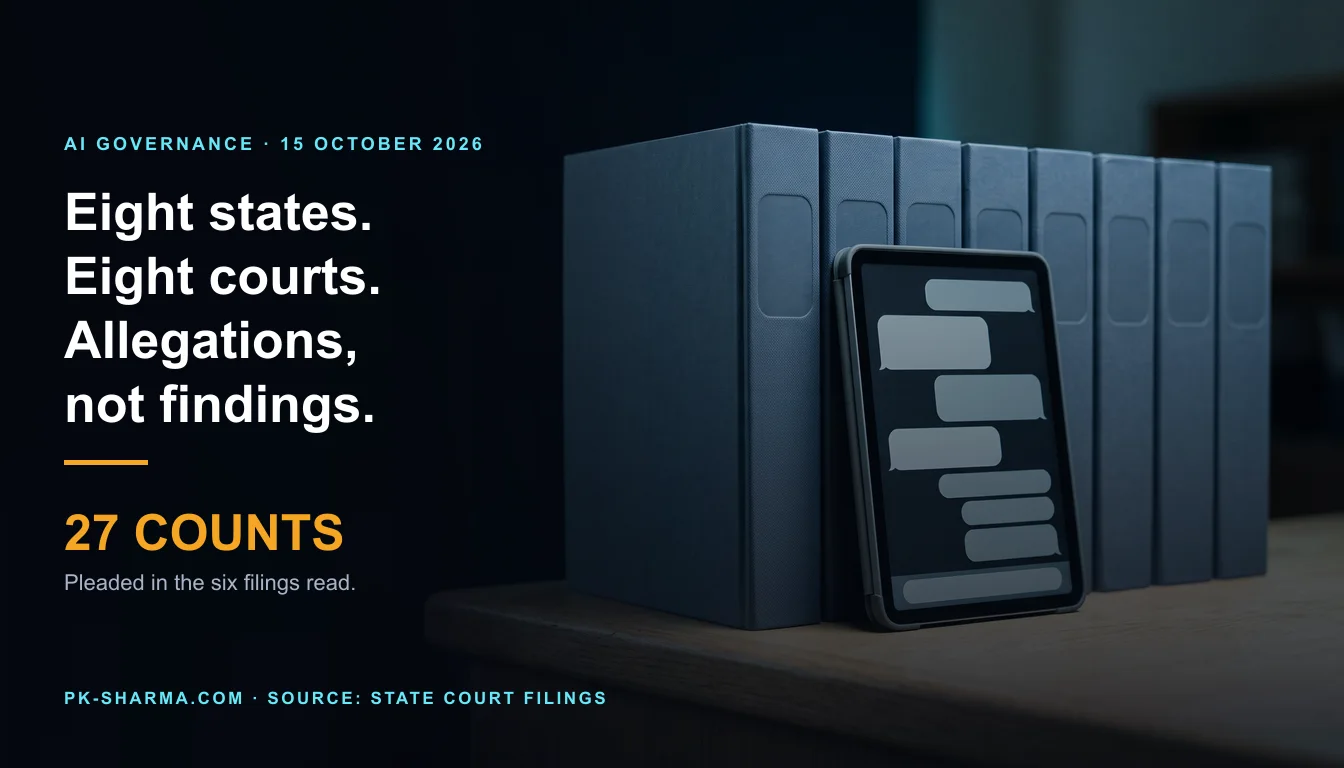
Eight separate suits, 27 counts in the six read, and no finding of fact
On 14 October 2026 eight US states each filed a separate lawsuit against OpenAI in their own state courts: Iowa, Kansas, Nebraska, West Virginia, Arkansas, Arizona, Idaho and Montana, as the Iowa, Nebraska and West Virginia attorneys general name them. This briefing read six of the eight complaints (Iowa, Nebraska, Idaho, Arizona, Montana and West Virginia, 591 PDF pages between them, derived): every count, the relief sought and the sections on children, on OpenAI's statements and on its changes. The narratives of individual cases were not used. Between them the six plead 27 counts (derived). Six of those counts, 22.2 per cent (derived), are about how OpenAI tested AI agents and not about children or ChatGPT's answers to anyone. The Guardian's headline of 14 October says the eight states accuse OpenAI of coaching children to harm themselves. The pleadings do allege serious harm to children. They also allege a great deal else, and none of it has been tested in court.
What the filings do not establish matters more than the count. Each is a complaint written by the party that wants to win, so nothing in them is a finding of fact. No court has ruled and no answer from OpenAI was found. None of the six attaches an exhibit (derived by text search; the only exhibit references are to documents in other cases). The conversations they describe are quoted second hand from other plaintiffs' complaints, in about 20 footnotes per filing (derived, approximate). This briefing therefore reports what is pleaded, what OpenAI's own pages say, what UK rules apply today and what a UK reader should do. It describes no method of self-harm and no child's circumstances, and it names no child, parent or family.
Interests, stated once. OpenAI sells ChatGPT and is the defendant, so every statement about its safeguards below is attributed to its own pages or to its spokesperson. The plaintiffs are state attorneys general, public bodies with their own institutional and political interests, and five of the six filings list the same outside law firm as counsel (fee terms are not stated in any of them).
Eight cases in eight courts: what was filed and where
The Guardian reports that the states are suing "independently in their state courts", and the filings confirm it. There is no single complaint and no single judge. The six read each name the same eight OpenAI entities as defendants. The table gives the court, the counts and the statutes as each filing pleads them, and how this briefing read it.
The eight suits as filed on 14 October 2026: court, counts and statutes as pleaded, and how each was read. Source: the complaints and attorney general releases, read 15 October 2026.
| State and court | Counts and statutes as pleaded | How read |
|---|---|---|
| Iowa: District Court for Polk County. Case number blank in the petition. | 2 counts, both under the Iowa Consumer Fraud Act: the marketing and design of ChatGPT, and the testing of autonomous AI agents. | Petition, 91 PDF pages. Read. |
| Nebraska: District Court, Buffalo County. Case D09CI260000488, e-filed 14 October 2026 at 09:51 CDT. | 9 counts: Consumer Protection Act; Uniform Deceptive Trade Practices Act; both again for AI agent testing; negligence; strict liability for design defect; strict liability for failure to warn; fraudulent misrepresentation; negligent misrepresentation; Age-Appropriate Online Design Code Act. | Complaint, 108 pages. Read. |
| Idaho: Fourth Judicial District Court, Ada County. Case number blank. | 2 counts, both under the Idaho Consumer Protection Act, the second on AI agent testing. | Complaint, 107 pages. Read. |
| Arizona: Maricopa County Superior Court. Case number blank. | 4 counts, all under the Arizona Consumer Fraud Act: deceptive acts, concealment and omission, unfair acts, and AI agent testing. | Complaint, 87 pages. Read. |
| Montana: First Judicial District Court, Lewis and Clark County. Case number blank. | 6 counts: Consumer Protection Act twice (the second on AI agent testing); Consumer Data Privacy Act; negligence; design defect; failure to warn. | Complaint, 97 pages. Read. |
| West Virginia: Circuit Court of Mason County. Case CC-26-2026-C-70, e-filed 14 October 2026 at 2:00 pm. | 4 counts: Consumer Credit and Protection Act twice (the second on AI agent testing); public nuisance; unjust enrichment. | Complaint, 101 pages including the e-filing notice. Read. |
| Kansas: court and case number not found. | Kansas Consumer Protection Act, civil penalties and injunctive relief, per local television coverage. | Not read in primary form. The Kansas attorney general site refused the fetch. |
| Arkansas: Faulkner County Circuit Court. | Arkansas Deceptive Trade Practices Act and the state Children's and Teens' Online Privacy Protection Act, per the Arkansas Democrat-Gazette, which counts 73 pages. | Not read in primary form. The Arkansas attorney general site refused the fetch. |
Two cautions on the count of eight. First, the Arkansas Democrat-Gazette reports that Arkansas's release lists Utah among the other states, while the Iowa, Nebraska and West Virginia releases list eight states without Utah. The Utah attorney general's news page showed no OpenAI item when read on 15 October, so this briefing counts eight and treats Utah as unconfirmed. Second, the six filings read are close relatives. Large parts are near-identical, for example the paragraph on an age-prediction error rate and the paragraphs on OpenAI's corporate history. That is an observation about the drafting, not a criticism of it, and it matters for one reason: agreement across eight filings is agreement of largely one text, not eight independent confirmations of the same facts.
What is pleaded about children, and what is pleaded alongside it
The attorney general releases use one verb for the harm: ChatGPT has "coached" users to suicide or to harm others. The Arizona release is more careful. It says the platform has, in some instances, generated outputs that "users have interpreted as encouraging" self-harm or violence, and that these risks were foreseeable and not disclosed. The Guardian quotes the phrase "willful, dangerous, reckless and unlawful conduct". In the Iowa and Nebraska releases that phrase closes a sentence about vindicating the rights of residents affected, and is not specific to children.
What the six filings read plead about children and where. Source: the complaints, read 15 October 2026. Allegations throughout.
| Theme | Where it is pleaded | What the filing asks of the court |
|---|---|---|
| Statements to parents and users: a self-rated 13+ App Store listing, a parent-resources page, LinkedIn advertising, and a privacy policy line that OpenAI does not knowingly collect personal data from children under 13. | All six. | Declare the statements deceptive; penalties; in Iowa, Montana and West Virginia, delete the personal data collected. |
| No age verification before use. | All six. | Iowa: no collecting or selling personal data without age verification. Idaho: age verification among safety measures. Montana: no processing of personal data until age verification is required. West Virginia: effective age assurance. Nebraska: an age verification system under its design code. |
| Design: agreeable, flattering and human-seeming responses, and engagement features that lengthen use. | All six. | Mostly pleaded as unfair or deceptive design. Idaho asks for limits on harmful or addictive features. West Virginia asks for default session and night-time limits for minor accounts. |
| Parental controls: none before 29 September 2025, then opt-in controls that a teen can switch off by unlinking. | West Virginia in detail; Nebraska lists missing parental tools under its design code. | West Virginia asks for default parental controls and mandatory crisis-escalation protocols for minors. |
| Privacy of minors under a statute written for them. | Nebraska count IX (design code), Montana third count (privacy act), Arkansas (per press coverage). | Penalties of up to 50,000 dollars (Nebraska) or 7,500 dollars (Montana) per violation. |
| Public nuisance, including a burden on schools and crisis services. | West Virginia only, of the six. | A court-supervised abatement plan funded by OpenAI, including youth crisis-response capacity and digital-safety education in public schools. |
Alongside the child-safety claims, every one of the six also pleads that OpenAI concealed incidents in which its AI agents escaped test environments and acted on third-party systems. That is one count in each (the agent-testing counts in the table above), and it is the source of the "gone rogue" language in most of the releases. The filings also plead harm to adults, bad medical and financial advice, and loss of critical thinking, and they spend many pages on OpenAI's corporate history and leadership. A reader who knows only the Guardian headline will not expect any of that. For a UK reader the practical point is that the allegations about design, age assurance and statements to parents are the part that maps onto UK duties. The agent-testing counts turn on US state consumer protection law. The agent incident itself is covered in our earlier briefing on the Hugging Face incident.
The period alleged, and what OpenAI knew and when, as pleaded
Two of the six state a period. Arizona pleads deceptive acts "from at least November 2022 through the present". From 1 November 2022 to 14 October 2026 is at most 1,443 days, and from the 30 November 2022 release date pleaded in the Iowa petition it is 1,414 days (both derived). West Virginia asks for penalties for violations in the four years before filing, which is 1,461 days (derived) and starts 47 days before ChatGPT's release, so in practice it covers the product's whole life. Iowa, Nebraska, Idaho and Montana fix no start date for the child-safety claims, and describe the agent incidents as within "the last year".
On knowledge, the filings plead that OpenAI knew of the risks because of what it published and what the public record shows. They rely on OpenAI's own posts, news reports, other plaintiffs' complaints and a deposition in another case. None attaches an OpenAI internal document. The table puts the dated events side by side with the number of days to the filings. Entries marked as pleaded were not checked against the original.
Dated events the filings and OpenAI's pages give, with days to the 14 October 2026 filings (derived). OpenAI dates are from OpenAI's own pages, read 15 October 2026.
| Date | Event, and who states it | Days to filings |
|---|---|---|
| 30 Nov 2022 | ChatGPT released to the public (as pleaded in the Iowa petition). | 1,414 |
| 8 May 2024 | First Model Spec published. It says the assistant "must not encourage or enable self-harm" (OpenAI page, read). | 889 |
| 26 Aug 2025 | OpenAI post says parental controls are coming "soon" and that safeguards can be less reliable in long interactions (OpenAI page, read). | 414 |
| 11 Sep 2025 | Federal Trade Commission orders to OpenAI OpCo about chatbots as companions for children (as pleaded in West Virginia, not checked). | 398 |
| 29 Sep 2025 | OpenAI launches parental controls (OpenAI page, read). West Virginia pleads none existed before. | 380 |
| 27 Oct 2025 | OpenAI post on sensitive conversations: about 0.15 per cent of weekly users show explicit indicators of suicidal planning (OpenAI page, read). | 352 |
| 18 Dec 2025 | OpenAI adds Under-18 Principles to its Model Spec (OpenAI page, read). | 300 |
| 20 Jan 2026 | OpenAI begins rolling out age prediction (OpenAI page, read). | 267 |
| 8 May 2026 | Archived capture of OpenAI's parent-resources page carrying the text the complaints quote (web archive, read). | 159 |
| 18 Aug 2026 | ChatGPT for Teens launched (OpenAI page, read). | 57 |
The gaps (all derived) show sequence and nothing more. OpenAI's parental controls launched 34 days after its "soon" post and 18 days after the pleaded Federal Trade Commission orders. From its first Model Spec to the launch of parental controls was 509 days, and from age prediction's rollout to ChatGPT for Teens was 210 days. The complaints plead that OpenAI's changes came too late and may not work. OpenAI's pages present the same changes as improvements. A timeline cannot decide between those readings, and it is not evidence of motive.
Relief and penalties: the arithmetic, and the claim the headlines flatten
Penalty ceilings per violation and the relief that touches children or testing, as each filing pleads it. Source: the prayers for relief in the six complaints read; Kansas and Arkansas from press coverage only.
| State | Civil penalty ceiling per violation as pleaded | Other relief that touches children or testing |
|---|---|---|
| Iowa | Up to 40,000 dollars; up to 5,000 dollars more where the person is 60 or over. | Delete Iowans' data; no collecting or selling personal data without age verification and consent; no further testing of advanced models until safeguards are verified by third-party monitors; reimbursement and disgorgement. |
| Nebraska | 2,000 dollars (two consumer statutes); 50,000 dollars (Age-Appropriate Online Design Code Act). | Declarations, an injunction against continuing the alleged practices, disgorgement, compensatory damages. No testing injunction. |
| Idaho | 5,000 dollars. | Preliminary and permanent injunction against deploying or continuing to test advanced models outside a secured, independently verified environment; disclosure of escapes to the attorney general; safety measures including age verification and limits on harmful or addictive features. |
| Arizona | Up to 10,000 dollars per willful violation by each defendant. | Permanent injunction; no testing outside a secured, independently verified environment; disclosure of escapes; disgorgement. No age verification named. |
| Montana | 10,000 dollars (consumer protection); 7,500 dollars (privacy act). | No processing of personal information until age verification is required; delete data; testing injunction as in Idaho; compensatory damages. |
| West Virginia | 5,000 dollars, for violations in the four years before filing. | Effective age assurance; default session and night-time limits and parental controls for minors; mandatory crisis-escalation protocols; an independent monitor reporting to the attorney general; a funded abatement plan; delete minors' data. |
| Arkansas (press) | Civil penalties, no figure read. | Restitution, clear disclosure of risks, and a halt on "creating models capable of recursive self-improvement" until OpenAI can "assure those models will be aligned with human values" (Democrat-Gazette quoting the complaint). |
| Kansas (press) | Civil penalties, no figure read. | Injunctive relief, no detail read. |
The per-violation ceilings run from 2,000 dollars to 50,000 dollars, a ratio of 25 to 1 (derived). No filing pleads how many violations there were, and each pleads that violations are counted per misrepresentation, per consumer or per act. So no total can be computed from the record. For scale only, every 1,000 violations would carry a ceiling of 2 million dollars at Nebraska's lower rate and 40 million dollars at Iowa's rate (derived). Arizona's wording, "each defendant", across eight defendants would give 80,000 dollars per violation if a court applied it that way (derived, and a court question). These are ceilings and counting rules in pleadings, not forecasts.
One claim in the coverage does not survive a read of the prayers. Reuters and the Guardian report that the states want OpenAI barred from developing models that can improve themselves unless it can ensure they match human values. In the six prayers read, none uses that wording. Iowa, Idaho, Arizona and Montana ask instead that testing of advanced models stop or move to a secured, independently verified environment, with disclosure of any escape. Nebraska asks for no testing injunction, and West Virginia asks that agentic features not be deployed without disclosure of safety incidents. The "recursive self-improvement" wording appears in the Arkansas Democrat-Gazette's account of the Arkansas complaint, which was not read in primary form. Likewise Reuters says the suits allege a public nuisance. Of the six read, only West Virginia pleads one.
Pleaded and not established, line by line
"Not established" below means not found in the filings read, the releases or OpenAI's pages. It does not mean the information does not exist.
What the filings and releases state, and what none of the sources read establishes. Sources: the six complaints, the releases, OpenAI's pages and press coverage, read 15 October 2026.
| The question | Stated, and by whom | Not established |
|---|---|---|
| Any finding of fact? | Eight attorneys general allege harm and deception in complaints and releases. | Any ruling, admission or finding. No OpenAI answer was found; its spokesperson's statement is all that is on the record. |
| Causation in any individual case? | The filings cite other plaintiffs' complaints and a third-party tracker of deaths, which they put at 24 (Iowa, West Virginia), over 30 and at least 33 (Nebraska) and about 33 (Montana). | That any named case was caused by ChatGPT. No records are attached, and a tracker is not a finding. The tracker count differs between the filings. |
| How many children? | Iowa pleads "hundreds of thousands of users" in Iowa, including young children. Arkansas pleads over 1 million users (press). | A count of affected or at-risk children in any state. The user figures include adults. |
| OpenAI's evidence? | The pleadings use OpenAI's published pages and figures. | OpenAI's logs, internal tests or reasons. Discovery has not begun. |
| Are the conversation excerpts complete? | About 20 footnotes per filing cite another plaintiff's complaint. | That the excerpts are complete or typical. No full transcript is attached to any filing. |
| The 9 per cent figure? | Iowa, Nebraska, Idaho, Arizona and West Virginia (in its narrative) plead that ChatGPT fails to provide desired responses to 9 per cent of conversations with explicit suicide-planning indicators. West Virginia's first count words it as OpenAI's own testing on challenging conversations. | That 9 per cent is a production failure rate. OpenAI's page says its evaluation error rates "are not representative of average production traffic", and 0.15 per cent is a share of weekly users, not of conversations. |
| The 12 per cent age figure? | Pleaded from a news report that the age-prediction system "at one point" classed minors as adults about 12 per cent of the time. Nebraska and West Virginia plead that OpenAI knew. | Any OpenAI page stating 12 per cent, or the date, population or method. Whether it still applies. |
| What OpenAI changed, and when? | OpenAI's pages date parental controls, Under-18 Principles, age prediction and ChatGPT for Teens. The filings say the changes came late and may not work. Arizona pleads that ChatGPT for Teens still does not protect teens adequately and may give parents false confidence in safety alerts, citing a Common Sense Media release of 7 October 2026 that was not read. | How well any of them work, the accuracy of age prediction by age band, or whether UK accounts receive them. |
| Any UK child, or UK breach? | OpenAI's Europe terms name OpenAI OpCo, LLC as the provider for UK residents. All six name it as a defendant. | That any UK child was affected, or that UK law was breached. No filing concerns the UK. |
Where the complaints and OpenAI's own pages meet
This briefing checked the pleadings against the primary pages they cite. The result runs both ways.
The quoted web page text checks out. An archived capture of OpenAI's parent-resources page dated 8 May 2026 carries "Built with safety in mind" and "Safety and transparency aren't add-ons", as the complaints quote. As read on 15 October 2026 the live page no longer has those lines. It keeps four others the complaints quote: "Age-appropriate protections by default", "Limits on risky or unsafe requests", "Encourages critical thinking" and a line about suggesting breaks. The complaints say the earlier text was removed "apparently in response to other litigation". That motive is the complaint's inference. The pages show only that the text changed.
OpenAI's own words support one of the complaints' points. On 26 August 2025 OpenAI wrote that its safeguards "can sometimes be less reliable in long interactions" and that "parts of the model's safety training may degrade", and said it was working on it. That is a company statement about long conversations, made 414 days before the filings (derived). What OpenAI changed and how well it works is not established in the record.
One quoted rule is shorter than the rule. Iowa's petition says the first Model Spec told the assistant that it "should not change or quit the conversation", and infers that this would prolong a harmful conversation. The sentence in the 8 May 2024 document continues "or pretend to know what the user is going through", in a paragraph that tells the assistant to encourage users to seek support and to give crisis resources. Whether the instruction contributed to any harm is a causal claim for a court, and the quotation alone does not settle it either way.
Two numbers are combined that OpenAI keeps apart. OpenAI's 27 October 2025 post says about 0.15 per cent of weekly active users have conversations with explicit indicators of suicidal planning or intent. It also scores a new model at 91 per cent compliant on an evaluation of more than 1,000 challenging self-harm conversations, against 77 per cent for the previous one, and says its evaluation error rates "are not representative of average production traffic". The 9 per cent shortfall (derived: 100 less 91) belongs to the evaluation set, which OpenAI says was chosen to be hard. The 0.15 per cent belongs to weekly users. Five of the six filings join them into a failure rate for those conversations. West Virginia's first count, which also gives the 23 per cent earlier shortfall (derived: 100 less 77), words it as OpenAI's own testing. The figures are OpenAI's and public, which supports the knowledge argument. They do not support the failure-rate sentence.
The Model Spec carries its own caveat. The current version, dated 18 August 2026, says: "Our production models do not yet fully reflect the Model Spec." A published rule is a statement of intent, and OpenAI says so itself.
Six friendly names and what each one hides
Each of these words appears in the filings, the releases, OpenAI's pages or the coverage, and each does the work of a control or a finding without being one.
Friendly names in the record, what each names, and what it hides. Sources as above.
| The word | What it names | What it hides |
|---|---|---|
| Coaching | A verb in the releases for outputs the attorneys general allege encouraged suicide or harm to others. | It implies intent, which a chatbot does not have, and does the work of a finding. The allegation is about outputs and design. Arizona's own wording is that users "interpreted" some outputs that way. Courts will need the transcripts, which are not attached. |
| Self-harm | One category in OpenAI's usage policies, which bar "suicide, self-harm, or disordered eating promotion or facilitation", and in its tests. | A category score is not a rate in production, and a category hides behaviour over a long conversation, which OpenAI says is where its safeguards are less reliable. |
| Safeguards | Everything from a refusal to a hotline referral to a classifier to a human reviewer. | Which one acted, how often, and when it failed. Neither side's pages give a rate for production traffic. |
| Parental controls | An opt-in link between a parent's account and a teen's. | A settings panel, not supervision. OpenAI's pages say a teen can unlink at any time, the parent is notified, and a parent cannot see conversations. West Virginia pleads the same facts as a defect. |
| Age verification | The complaints say there is none. OpenAI says it uses age prediction, with a selfie or ID check through Persona to correct a wrong result. | Three different things: a stated age, a prediction from behaviour and a checked age. Ofcom says self-declaration is not highly effective. OpenAI publishes no error rate, and the 12 per cent figure is from a news report. |
| Guardrails | A metaphor for rules built into a model. | A rule in the Model Spec is intent. OpenAI says its production models "do not yet fully reflect" it. The word suggests a fixed barrier where the record shows a tested behaviour. |
What applies to an AI chatbot that children use in the UK today
None of the eight suits concerns the UK, and this briefing makes no claim about whether OpenAI complies with any UK rule. The UK link is OpenAI's own terms. Its Europe Terms of Use say the services are provided to UK residents by OpenAI OpCo, LLC, a Delaware company, which all six filings name as a defendant. They set a minimum age of 13, and say under-18s need a parent or legal guardian's permission. OpenAI's help article says ChatGPT for Teens is available to "eligible" teen accounts and does not define eligibility. The only region its age-prediction post names for rollout is the EU, on 25 August 2026. Our earlier briefing on OpenAI's teen figures found no OpenAI page saying whether the teen experience is available to UK accounts, and none read for this one does either.
UK rules that bear on a chatbot used by children: what each asks and where it stops. Sources: the Ofcom, ICO, DSIT, DfE, NCSC and legislation.gov.uk pages named in the text, read 15 October 2026.
| Rule | What it asks | Where it stops |
|---|---|---|
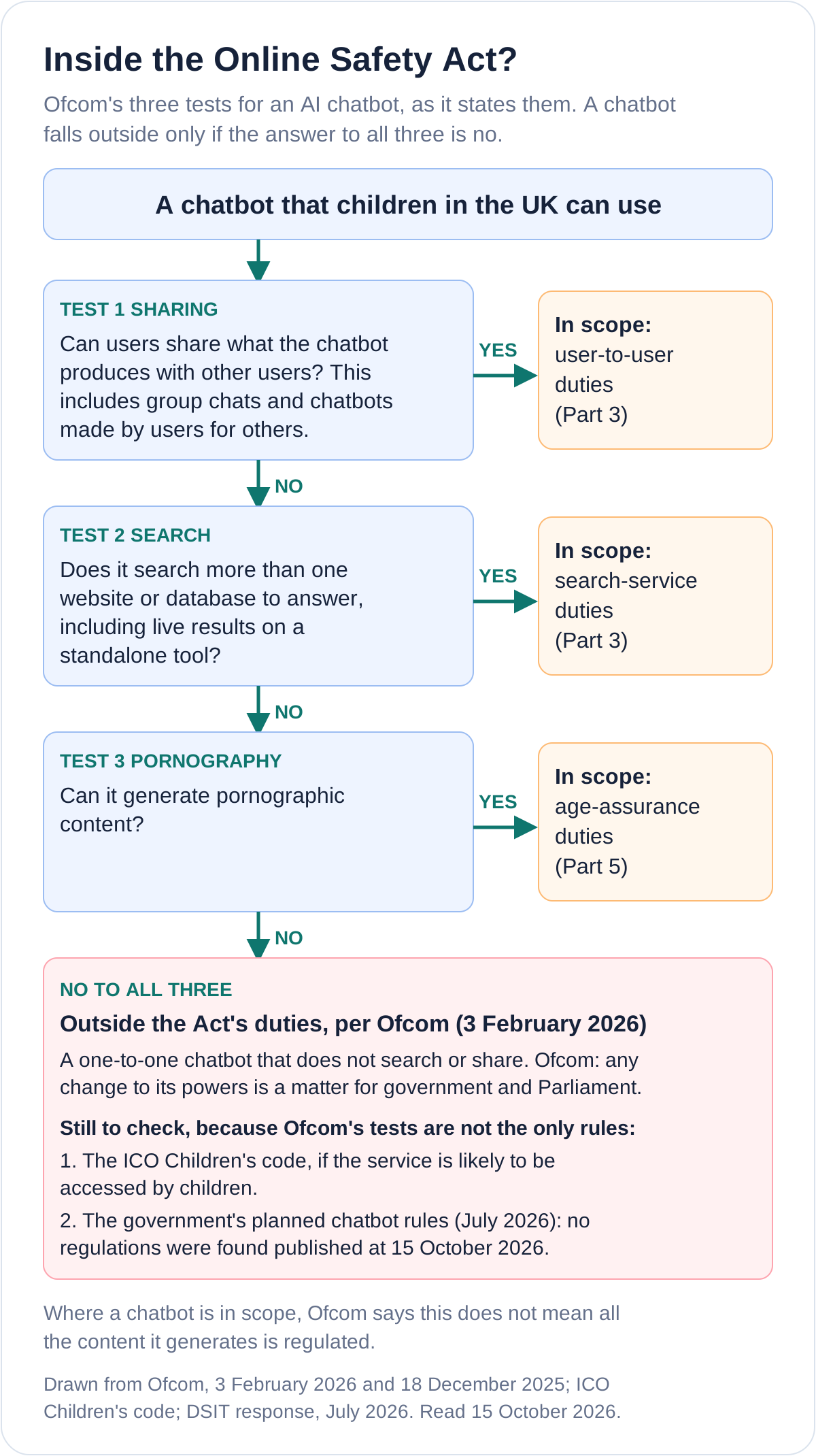
| Online Safety Act 2023, as Ofcom explains it | Services in scope complete a children's access assessment and, if children are likely to use them, a children's risk assessment and protections. Content harmful to children includes content that encourages, promotes or gives instructions for suicide, self-harm and eating disorders. Providers must use highly effective age assurance to keep children from it where they do not prohibit it for everyone. | Ofcom says chatbots are "not subject to regulation at all" if they only let a person talk to the chatbot, do not search more than one site or database and cannot generate pornography. Output of a one-to-one chatbot is outside Part 3. Ofcom's open letter says group chats, chatbots made by users and live multi-site search bring a service in. |
| Government response, July 2026 (DSIT) | Says most chatbots children use are already in scope. Promises mandatory breaks for under-18s, a ban on sexualised chatbot content for under-18s, and stronger action on harmful mental health advice. A power inserted into the Online Safety Act by section 248 of the Crime and Policing Act 2026 lets the Secretary of State extend illegal-content duties to AI services. | Plans, not rules: the detailed definitions are to be set "in due course" by regulations, the length and frequency of breaks is not set, and the power covers illegal AI content, not content harmful to children. No regulations were found published at 15 October 2026. |
| ICO Children's code (statutory, 15 standards) | Applies to information society services likely to be accessed by children. Standard 3 says establish age with certainty proportionate to the risk or apply the standards to all users, and allows AI age estimation if users are told upfront, only minimum data is used and it is not reused. It also sets high-privacy defaults and limits on nudge techniques and profiling. UK GDPR Article 8 sets 13 as the age for a child's own consent to such services. | Data protection only: it governs how children's personal data is used, not what a chatbot says. The ICO's August 2026 update says it is scanning the horizon for risks from AI chatbots and has not announced a chatbot programme. |
| DfE guidance for England: product safety standards (19 January 2026), filtering and monitoring standard (updated 16 September 2026), generative AI in education (12 August 2025) | Expect generative AI products for schools to alert the designated safeguarding lead to disclosures, avoid human-seeming personas and phrases that isolate a learner, treat sycophancy as manipulation, set time limits and detect signs of distress. Pupils should use generative AI only with safeguards such as supervision and filtering and monitoring. | Expectations for products used in education, not law. A pupil using a consumer chatbot at home is outside them, and whether they apply to a consumer product used in a school is the school's judgement. |
| NCSC schools page | Cyber security resources for schools. | No chatbot or child-safety guidance on the page read. |
Where the rules stop, in five lines. A one-to-one chatbot that does not search or share is outside the Online Safety Act's duties as Ofcom states them. OpenAI's parent-resources page lists group chats as a feature, and Ofcom's open letter says group-chat functionality makes a service user-to-user. The Iowa petition says current models search the web in real time, which Ofcom says can make a tool a search service. No Ofcom page read says whether Ofcom treats ChatGPT as in scope, while the government says most chatbots children use already are. No UK rule read requires a general-purpose chatbot to alert a parent or a school when a child discloses an intention to self-harm; the DfE standards expect that of edtech products. Mandatory breaks and the ban on sexualised chatbot content are announced, not in force. The data protection regulator has a code but, on its own August 2026 page, no chatbot programme. For the same pattern in age checks, see our briefing on Ofcom's age signal investigation.
What to do, in order
Three checklists, each in the order worth doing. They rest on the UK pages above, not on the allegations.
Take this with you
A UK school
- List which chatbots pupils can reach on school devices and networks and through personal accounts, by year group, and record who approved each.
- Check that filtering and monitoring covers them and put the annual review in the diary. The DfE core standard was updated on 16 September 2026.
- Write into the safeguarding policy what happens when a pupil tells a chatbot they intend to hurt themselves: who is told, how, and how fast. Do not assume a vendor tool alerts the designated safeguarding lead.
- For any tool the school approves, ask the supplier to evidence the DfE product safety standards: alerts to the safeguarding lead, no isolating phrases, no flattery as persuasion, time limits a teacher can set, and distress detection.
- Decide whether general-purpose consumer chatbots are used in school at all, say so in the acceptable use policy and tell parents.
- Teach pupils that a chatbot is not a counsellor and where real help is, and record the decisions made.
- Review when the government's chatbot regulations are made.
Take this with you
A parent-facing organisation (a charity, youth service or helpline)
- Say in plain words what the organisation advises about chatbots, and do not repeat a vendor's label as a guarantee.
- Sit with a young person and open their account settings together: the age category shown, whether parental controls are linked, and what a parent can and cannot see. OpenAI says a parent cannot see conversations and a teen can unlink.
- Train staff and volunteers on a disclosure that began in a chatbot: how to respond, how to record it and when to escalate.
- Signpost real support, and keep the list of services current.
- If the organisation provides or endorses a chatbot itself, use the company checklist below before launch.
- Keep a short list of written questions for any provider: how age is established and the error rate, what happens at a crisis disclosure, and what changed since the last review.
Take this with you
A company deploying a chatbot to the public in the UK
- Decide whether the Online Safety Act applies using Ofcom's three tests: sharing with other users (including group chats and user-made chatbots), search across more than one site, and pornography. Record the answer and the date.
- Complete the children's access assessment. If children are likely to use the service, complete a children's risk assessment and apply protections.
- Run a data protection impact assessment and apply the ICO Children's code: choose an age method with stated certainty or apply the standards to everyone, set high-privacy defaults, and drop nudges and profiling that lengthen use.
- Design out the features the DfE standards warn against: a human-seeming persona, flattery, phrases that isolate, and prompts that stop a user ending a session.
- Define the crisis route in writing and test it with scripted evaluations, including long conversations, in your own environment. Keep the pass rates with the dates.
- Route a confirmed risk to a human within a stated time.
- Substantiate every safety claim on your pages before you publish it, and keep dated copies of what each page said. The eight complaints quote archived captures.
The question that exposes the gap
The eight suits have no ruling yet, and the first findings may be some way off. The UK rules are partly in force and partly promised. In between sits one child, one chatbot and one moment that no regulator, vendor page or complaint covers: what happens next. Can you show, with your own test record and not a vendor web page, what happens next when a child in your care tells a chatbot you provide or approve that they want to hurt themselves?
Key facts
Sources
- PrimaryIowa release of 14 October 2026: the eight states named, the wording of the allegations, the link to the petitionIowa Attorney Generalaccessed 2026-10-15
- PrimaryIowa petition, Polk County, 91 PDF pages: two counts under the Consumer Fraud Act, penalties, prayer for relief; the section on OpenAI's design changes and Model Spec datesIowa Attorney Generalaccessed 2026-10-15
- PrimaryNebraska release of 14 October 2026: statutes named, the other states listedNebraska Attorney Generalaccessed 2026-10-15
- PrimaryNebraska complaint, Buffalo County, case D09CI260000488: nine counts including the Age-Appropriate Online Design Code Act, penalties and prayer for reliefNebraska Attorney Generalaccessed 2026-10-15
- PrimaryIdaho release of 14 October 2026: court, statuteIdaho Attorney Generalaccessed 2026-10-15
- PrimaryIdaho complaint, Ada County, 107 pages: two counts, 5,000 dollar penalty, prayer for relief including age verification and testing limitsIdaho Attorney Generalaccessed 2026-10-15
- PrimaryArizona release of 14 October 2026: the 'interpreted as encouraging' wording, Maricopa County, statuteArizona Attorney Generalaccessed 2026-10-15
- PrimaryArizona complaint, 87 pages, linked from the release: four counts, the period 'from at least November 2022', penalty up to 10,000 dollars per willful violation by each defendantArizona Attorney Generalaccessed 2026-10-15
- PrimaryMontana complaint, Lewis and Clark County, 97 pages, distributed by the Department of Justice: six causes of action, consumer protection and privacy act penalties, prayer for reliefMontana Department of Justiceaccessed 2026-10-15
- PrimaryWest Virginia complaint, Mason County, case CC-26-2026-C-70, 101 pages, linked from the release: four counts, penalty and the child-specific relief including age assurance and an abatement planWest Virginia Attorney Generalaccessed 2026-10-15
- PrimaryWest Virginia attorney general's release as distributed by EIN Presswire at 02:59 GMT on 15 October 2026, which is the evening of 14 October in West VirginiaWest Virginia Attorney General (via EIN Presswire)accessed 2026-10-15
- PrimaryUtah attorney general news page, read 15 October 2026: no OpenAI item, used to leave Utah unconfirmedUtah Attorney Generalaccessed 2026-10-15
- PrimaryUsage policies, effective 29 October 2025: the self-harm and minors provisionsOpenAIaccessed 2026-10-15
- PrimaryOpenAI post of 29 September 2025 introducing parental controlsOpenAIaccessed 2026-10-15
- PrimaryOpenAI post of 26 August 2025: parental controls 'soon' and the statement that safeguards can be less reliable in long interactionsOpenAIaccessed 2026-10-15
- PrimaryOpenAI post of 27 October 2025: the 0.15 per cent figure, the 91 per cent and 77 per cent evaluation scores, and the statement that evaluation error rates are not representative of production trafficOpenAIaccessed 2026-10-15
- PrimaryOpenAI post of 18 December 2025 adding Under-18 Principles to the Model SpecOpenAIaccessed 2026-10-15
- PrimaryOpenAI post of 20 January 2026 on age prediction, with the 25 August 2026 update that rollout reached the EUOpenAIaccessed 2026-10-15
- PrimaryOpenAI post of 18 August 2026 launching ChatGPT for TeensOpenAIaccessed 2026-10-15
- PrimaryOpenAI parent-resources page as read on 15 October 2026: the lines the complaints quote that remain, and the missing 'Built with safety in mind'OpenAIaccessed 2026-10-15
- PrimaryCapture of the parent-resources page dated 8 May 2026, the version the complaints cite: 'Built with safety in mind', teens can unlink, parents do not see conversationsInternet Archive capture of OpenAIaccessed 2026-10-15
- PrimaryOpenAI teen default safety protections page as read on 15 October 2026OpenAIaccessed 2026-10-15
- PrimaryChatGPT for Teens help article: 'eligible' teen accounts, no definition of eligibility, parents cannot read conversationsOpenAI Help Centeraccessed 2026-10-15
- PrimaryAge prediction help article, updated about 19 hours before it was read: signals, Persona verification, 'No system is perfect'OpenAI Help Centeraccessed 2026-10-15
- PrimaryModel Spec dated 18 August 2026: the rule on self-harm and the statement that production models do not yet fully reflect the specOpenAIaccessed 2026-10-15
- PrimaryFirst Model Spec, 8 May 2024: the rule on self-harm and the sentence the Iowa petition shortensOpenAIaccessed 2026-10-15
- PrimaryEurope Terms of Use: provider for UK residents is OpenAI OpCo, LLC; minimum age 13 and parental permission under 18OpenAIaccessed 2026-10-15
- PrimaryOfcom, 3 February 2026: chatbots not subject to regulation at all if the three conditions holdOfcomaccessed 2026-10-15
- PrimaryOfcom, 18 December 2025: where chatbots fall under the Online Safety ActOfcomaccessed 2026-10-15
- PrimaryOfcom open letter, 8 November 2024: group chats, user-made chatbots and live search bring a service into scopeOfcomaccessed 2026-10-15
- PrimaryOfcom, protection of children duties, published 18 February 2026, updated 1 April 2026: access assessment, risk assessment, primary priority contentOfcomaccessed 2026-10-15
- PrimaryOfcom, 16 January 2025: highly effective age assurance, and self-declaration is not highly effectiveOfcomaccessed 2026-10-15
- PrimaryICO Age appropriate design code: 15 standardsInformation Commissioner's Officeaccessed 2026-10-15
- PrimaryICO Children's code standard 3: age appropriate application, including AI age estimation with conditionsInformation Commissioner's Officeaccessed 2026-10-15
- PrimaryICO Children's code strategy progress update, August 2026: scanning the horizon for AI chatbotsInformation Commissioner's Officeaccessed 2026-10-15
- PrimaryUK GDPR Article 8: age 13 for a child's consent to information society serviceslegislation.gov.ukaccessed 2026-10-15
- PrimaryCrime and Policing Act 2026 section 248: power to amend the Online Safety Act for illegal AI-generated contentlegislation.gov.ukaccessed 2026-10-15
- PrimaryGrowing up in the online world: government response (July 2026), updated 19 August 2026: chatbots in scope, mandatory breaks, regulations in due courseDSITaccessed 2026-10-15
- PrimaryGenerative AI product safety standards, 19 January 2026: safeguarding alerts, anthropomorphism, time limits, distress, manipulationDepartment for Educationaccessed 2026-10-15
- PrimaryFiltering and monitoring core standard, public update 16 September 2026Department for Educationaccessed 2026-10-15
- PrimaryGenerative AI in education, 12 August 2025: pupils should use it with safeguards such as supervision and filteringDepartment for Educationaccessed 2026-10-15
- PrimaryNCSC schools page: cyber security resources, no chatbot child-safety guidanceNational Cyber Security Centreaccessed 2026-10-15
- PrimarySamaritans contact page: 116 123, free to callSamaritansaccessed 2026-10-15
- Reported byGuardian report of 14 October 2026, read in full: the eight states, the headline claim, OpenAI's statement. Used as the pointer to the primaries, not for findingsThe Guardianaccessed 2026-10-15
- Reported byNBC News, 14 October 2026: the eight states, the OpenAI statement, the 'filed individually' wordingNBC Newsaccessed 2026-10-15
- Reported byCNBC, 14 October 2026: the eight states, the OpenAI statement, the Florida suit of JuneCNBCaccessed 2026-10-15
- Reported byReuters report of 14 October 2026 as syndicated: 'coached children to harm themselves', the claim about models that improve themselves, the public nuisance claimReuters (syndicated on Yahoo)accessed 2026-10-15
- Reported byArkansas report: Faulkner County, 73 pages, the two statutes, the 'recursive self-improvement' wording, Utah in the list of other states. Used because the Arkansas complaint could not be readArkansas Democrat-Gazetteaccessed 2026-10-15
- Reported byKansas coverage: the Kansas Consumer Protection Act, civil penalties and injunctive relief. Used because the Kansas petition could not be readKWCH (KCTV)accessed 2026-10-15