Two CISA advisories, 17 CVEs each scored twice, and the number at the top of both pages is the lower one
CISA published advisories for a robot vacuum and a dashcam on 24 September, every flaw carrying both a CVSS v3.1 and a v4.0 score. Thirteen of the seventeen score higher under v4.0, six cross into a worse band, and none crosses down.
By Parminder Kumar Sharma · · 9 min read
Seventeen flaws, thirty four scores, and one number on the cover
CISA published two advisories on 24 September 2026. ICSA-26-267-01 covers Botslab G980H dashcams and carries fourteen CVEs. ICSA-26-267-02 covers the Eufy Omni C20 and Omni X10 Pro robot vacuums and carries three. Every one of the seventeen is scored twice, once under CVSS v3.1 and once under v4.0, and both numbers are printed on the page.
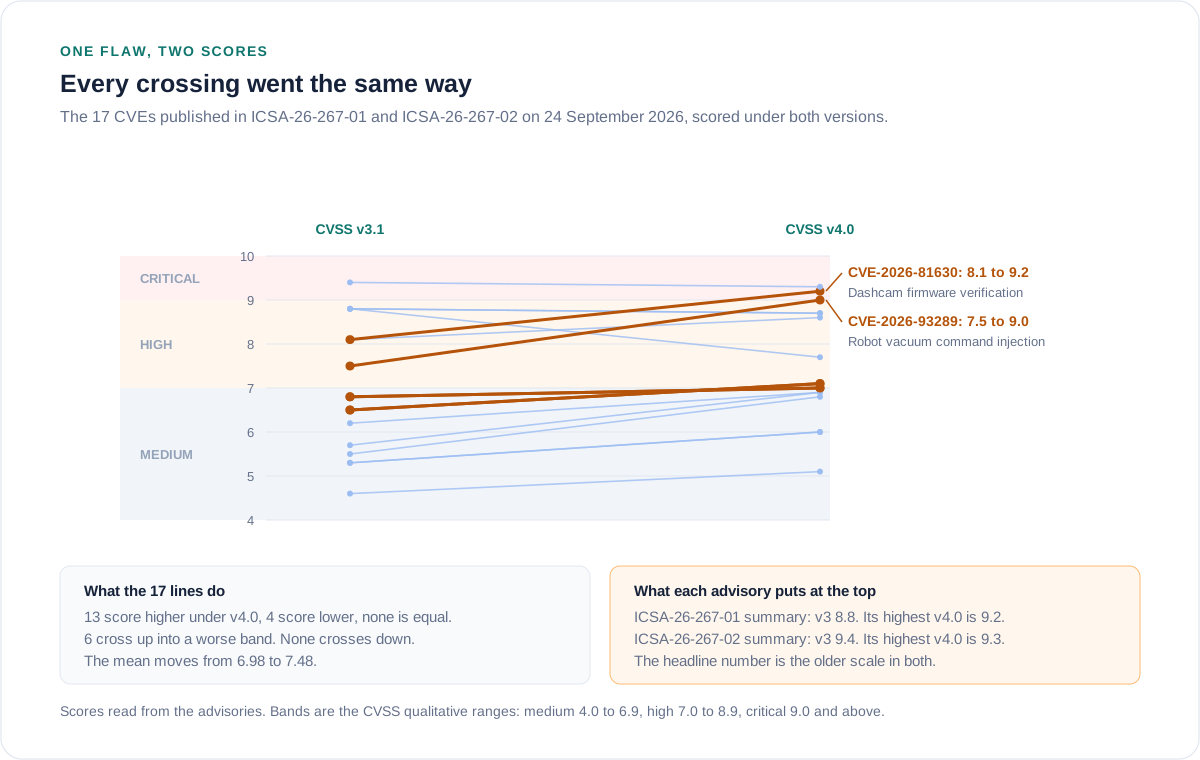
Thirteen of the seventeen score higher under v4.0. Four score lower. None is unchanged. Six cross upward into a more severe qualitative band, and not one crosses downward. The mean moves from 6.98 to 7.48.
The summary table at the top of each advisory, the part a reader sees first and a ticket usually inherits, gives a v3 score in both cases. ICSA-26-267-01 headlines v3 8.8, high, while the page below it contains a 9.2 critical. ICSA-26-267-02 headlines v3 9.4.
What that does not establish. It does not establish that v4.0 is the better scale, only that it is the newer one and that on this sample it reads higher. It does not establish that CISA is hiding anything: both numbers are published, in full, with vectors, on the same page. It does not establish a trend, because seventeen vulnerabilities from two consumer devices is a small and unrepresentative sample. And it does not establish that any of these flaws is being exploited, because neither advisory says so.
What it does establish is that when a vulnerability carries two official scores, somebody chooses which one travels, and on this occasion the choice went to the older scale in both documents.
The six that changed band
A band change matters more than a decimal, because most remediation policies are written in bands. "Criticals in seven days, highs in thirty" is a sentence that appears in thousands of standards, and it does not care whether the score is 8.9 or 9.0 except at the boundary, where it cares completely.
Every CVE whose qualitative band differs between the two versions, read from the advisories
| CVE | v3.1 | v4.0 | What it is |
|---|---|---|---|
| CVE-2026-81630 | 8.1 high | 9.2 critical | Insufficient verification of firmware, dashcam |
| CVE-2026-93289 | 7.5 high | 9.0 critical | OS command injection during pairing, vacuum |
| CVE-2026-82708 | 6.5 medium | 7.1 high | Path traversal, dashcam |
| CVE-2026-82585 | 6.5 medium | 7.1 high | Cleartext transmission of video and location, dashcam |
| CVE-2026-79959 | 6.8 medium | 7.0 high | Hard coded root password reachable over UART, dashcam |
| CVE-2026-88956 | 6.8 medium | 7.0 high | Missing authentication for a critical function, dashcam |
Run a policy of "critical in seven days, high in thirty, medium in ninety" over those six rows twice, once with each column, and the two runs disagree about every single one of them. Two flaws move from a thirty day clock to a seven day clock. Four move from ninety days to thirty.
The flaws did not change. The scale did.
Why the same flaw scores differently
This is not a rounding difference or an error. CVSS v4.0 measures partly different things, and the changes tend to push scores up for the kind of flaw these two advisories are full of.
The biggest structural change is to impact. Version 3.1 had a single set of confidentiality, integrity and availability metrics plus a Scope flag to indicate that the blast radius left the vulnerable component. Version 4.0 drops Scope and splits impact in two: Vulnerable System confidentiality, integrity and availability, written VC, VI and VA, and Subsequent System confidentiality, integrity and availability, written SC, SI and SA. A flaw that compromises the device and then whatever the device is connected to now says so in six metrics rather than one flag.
Version 4.0 also adds Attack Requirements, written AT, which records deployment conditions an attacker needs beyond their own effort, and it gives User Interaction a third value, Passive, between none and active.
Compare the two vectors for the command injection in the robot vacuums, both printed in the advisory:
v3.1  AV:A/AC:H/PR:N/UI:N/S:U/C:H/I:H/A:H                      7.5 high
v4.0  AV:A/AC:H/AT:P/PR:N/UI:N/VC:H/VI:H/VA:H/SC:H/SI:H/SA:H     9.0 critical
Both say adjacent network, high attack complexity, no privileges, no user interaction, and high impact on everything. The v3.1 vector then says S:U, scope unchanged, and stops. The v4.0 vector says the subsequent system takes high confidentiality, integrity and availability impact too, and adds that attack requirements are present. The first version had one bit for the idea that the damage does not stop at the device. The second has three metrics, and using them moves this flaw across the critical line.
What the two products actually are
Both advisories are filed under Industrial Control Systems, which is the process CISA uses for operational technology. One covers a robot vacuum. The other covers a dashcam.
The sector labels are worth reading slowly. The Eufy advisory records the critical infrastructure sector as Information Technology. The Botslab advisory records it as Transportation Systems. Both list worldwide deployment and a company headquarters in China. A household robot vacuum is therefore, on the record, an information technology asset, and a consumer dashcam is a transportation systems asset.
That is not a criticism of the labels. It is what happens when consumer devices are catalogued through a scheme designed for plant equipment: the taxonomy still has to put them somewhere, and the label it produces will be read later by people who filter on it.
The two advisories of 24 September 2026 side by side
| Field | ICSA-26-267-01 | ICSA-26-267-02 |
|---|---|---|
| Product | Botslab G980H dashcams | Eufy Omni C20 and Omni X10 Pro |
| CVEs | 14 | 3 |
| Summary score printed | v3 8.8 | v3 9.4 |
| Highest v4.0 on the page | 9.2 | 9.3 |
| Sector recorded | Transportation Systems | Information Technology |
| Fix available | No | Yes, version 1.6.4 or later |
| Reported by | Julian of Software Secured | Jared of Somerset Recon |
Fourteen flaws and no fix
The scoring story is the interesting one. The dashcam story is the serious one.
Against every one of the fourteen dashcam CVEs, the mitigation field says the same thing: "Botslab has not responded to requests to work with CISA to mitigate this vulnerability." Users are invited to contact the vendor through its own about page. There is no patch, no version to upgrade to and no workaround from the manufacturer.
What the fourteen add up to is a device that records continuously in a vehicle and defends itself with almost nothing. CVE-2026-79959 is a hard coded root password in the firmware that a user cannot change, recoverable by anyone who obtains the firmware or gets physical access, usable over the UART interface. CVE-2026-82585 is cleartext transmission: recordings, live video, location information, images and diagnostic logs travel over unencrypted HTTP and RTSP to the mobile application, readable by anyone on the same wireless network. Around those sit replay based authentication bypass, predictable identifiers, session expiry failures, missing authentication on critical functions, a path traversal, an out of bounds write and hard coded cryptographic keys.
The advisory's own summary is that successful exploitation "could allow an attacker to bypass authentication controls, gain unauthorized access to sensitive data and privileged device functionality, modify device configuration, disrupt device operation".
What neither advisory says
Stated in the two advisories against not established by them
| Stated | Not established |
|---|---|
| Both v3.1 and v4.0 scores, with vectors, for all 17 CVEs | Which score the reader is expected to act on |
| The Eufy flaws are fixed in version 1.6.4 | How many devices have taken that update |
| Botslab has not responded to CISA | Whether Botslab received the contact, or intends to respond |
| Sector, country of deployment and vendor headquarters | Any installed base, sales or fleet figure |
| Researcher credit for both advisories | Any disclosure timeline, or how long the vendors had |
| Recommended network isolation measures | Any claim of exploitation, for any of the seventeen |
That last row matters. Neither advisory says anything is being exploited. These are not KEV entries and they carry no federal deadline. The reason to act on them is the mechanism, not a clock.
What to do about it
Take this with you
In the order worth doing
- Check which CVSS version your vulnerability management tooling stores, displays and alerts on, and whether it keeps both when an advisory publishes both.
- Where your remediation policy is written in bands, decide explicitly which version the band refers to, and write that down in the policy.
- Re-run your last quarter of advisories with the v4.0 score where one exists, and see how many items change tier. Six of seventeen did here.
- Treat a summary score on an advisory as a headline, not as the finding. The per CVE table underneath is the record.
- If you operate vehicles with Botslab G980H dashcams, isolate them from any network that matters, assume video and location are readable on the local wireless network, and plan for replacement rather than patching.
- If you have Eufy Omni C20 or X10 Pro units on a corporate network, update to 1.6.4 or later and check whether they were ever paired on a network you care about.
- Add a rule to your intake process: when an advisory carries two scores that fall in different bands, the higher band governs until somebody with authority decides otherwise.
The question this leaves
Nobody did anything wrong in these two documents. CISA published both scores and both vectors for every flaw, which is more transparency than most vendors manage, and the summary field has carried a v3 number for years because that is what the field was built for.
But a vulnerability that carries two official numbers has, in practice, whichever number survives contact with a spreadsheet. On these two pages the surviving number is the lower one in thirteen cases out of seventeen, and in two of those the difference is the word critical.
The transition from v3.1 to v4.0 is going to run for years, and during it every organisation is quietly choosing a scale, usually by inheriting whatever their tooling defaults to. So: which version does your patching policy mean when it says critical, and would anybody in your team be able to answer that without looking?
Sources
- PrimaryBotslab G980H Dashcams advisory, read in full for every CVE, score, vector, CWE, mitigation and sector label quoted hereCISAaccessed 2026-09-25
- PrimaryEufy Omni C20 and Omni X10 Pro advisory, read in full for the same fieldsCISAaccessed 2026-09-25
- PrimaryThe CVSS version 4.0 specification, used for the qualitative severity ranges and for what the new metrics measureFIRSTaccessed 2026-09-25