BlueMoon chains 3 zero-days across Chrome and Windows. Four espionage groups adopted it in days.
Proofpoint observed four espionage-motivated groups using one exploit kit that moves from a phishing link through Chrome’s V8 engine and into the Windows kernel. The fastest-moving risk is the public patch gap between Chromium fixes and downstream browser releases.
By Parminder Kumar Sharma · · 6 min read

Four groups adopted one chain between 28 August and early September
Proofpoint published its BlueMoon investigation on 9 September 2026. Its researchers identified four espionage-motivated threat actors using the same underlying exploit chain in targeted spearphishing campaigns. The first observed use was by the China-aligned group TA412 on 28 August. Other clusters appeared within days.
The targets were narrow rather than indiscriminate. Proofpoint describes US non-governmental organisations, mining and commodity-trading firms, US aerospace companies, a Vietnamese manufacturer and other espionage targets. One TA412 route ultimately installed a malicious Chromium extension called GemStone. Another delivered ShadowPad. The shared browser-to-kernel chain did not dictate the final payload.
This distinction matters for detection. A team searching only for one malware family can miss the common delivery behaviour. The useful common denominator is the sequence before the payload: an actor-controlled link, V8 exploitation, sandbox escape, Windows privilege elevation and execution outside the browser renderer.
The chain crosses three security boundaries
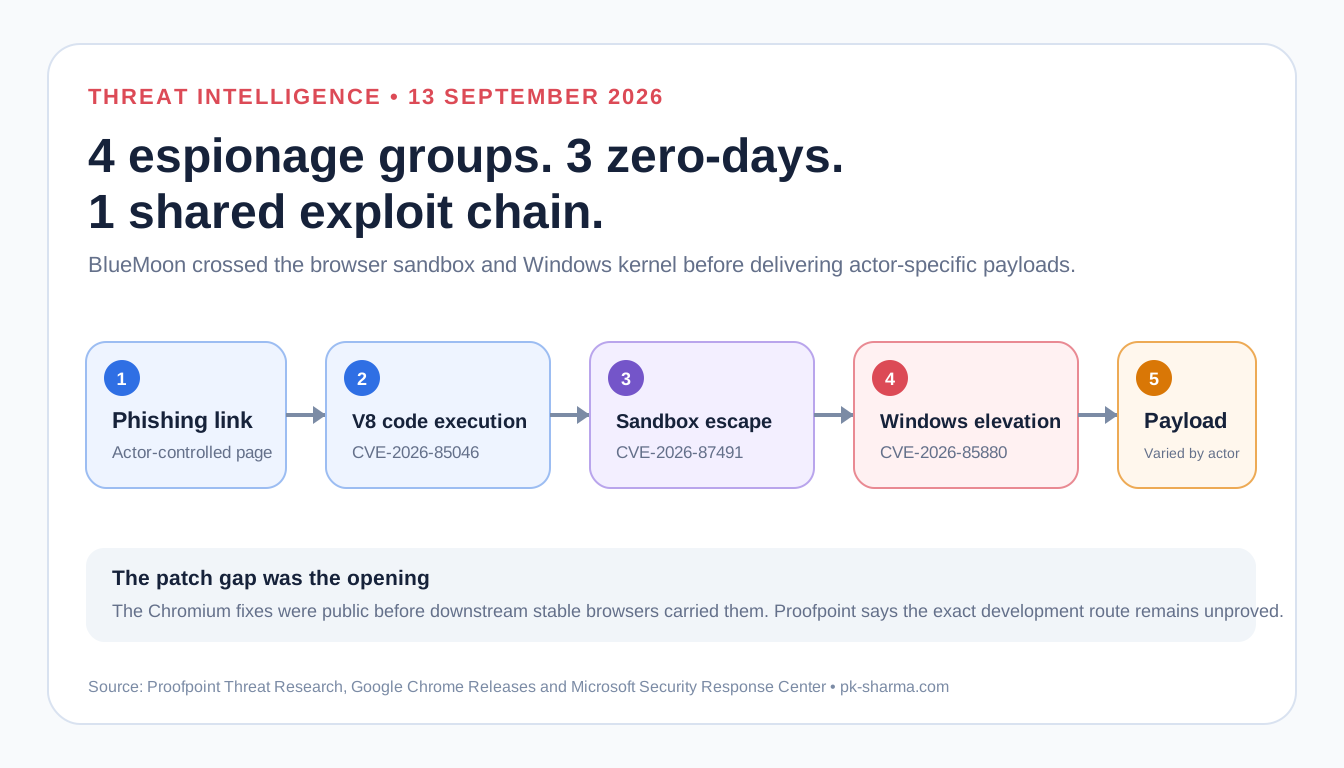
The first vulnerability, CVE-2026-85046, is a type confusion flaw in Chrome’s V8 JavaScript engine. Proofpoint says BlueMoon uses it to gain arbitrary read and write capability inside V8’s heap cage. Google shipped the fix in Chrome 152.0.7977.82 or .83 for desktop on 3 September.
The second flaw, CVE-2026-87491, allows the chain to escape the V8 sandbox. Chrome 153.0.8010.36 or .37, released on 8 September, includes that fix. Proofpoint then observed a reflectively loaded reconnaissance component checking the Windows build and token integrity before deciding whether to attempt the third stage.
The third flaw, CVE-2026-85880, is a Windows kernel elevation-of-privilege vulnerability involving Advanced Local Procedure Call and Windows Notification Facility behaviour. The observed exploit elevates the renderer token and enables execution through the parent browser process. Microsoft’s security record is the authority for affected products and updates.
A malicious page alone is therefore insufficient for the complete route. The browser flaws provide code execution and escape; the Windows flaw provides local elevation on supported builds; the operator then supplies the payload. Defence has several opportunities to break the chain.
The three vulnerabilities and the boundary each one crosses
| Stage | Identifier | Observed role | Primary fix source |
|---|---|---|---|
| V8 renderer | CVE-2026-85046 | Type confusion leading to renderer code execution | Chrome 152 stable update, 3 September |
| V8 sandbox | CVE-2026-87491 | Sandbox escape used to load the host reconnaissance component | Chrome 153 stable update, 8 September |
| Windows kernel | CVE-2026-85880 | Local privilege elevation on selected older Windows builds | Microsoft September security update |
The patch gap exposed downstream browsers before their stable release
Proofpoint calls both V8 issues patch-gap zero-days. The source changes had already appeared in public Chromium code, but stable browsers used by the public did not yet contain them. For CVE-2026-85046, Proofpoint dates the fixing commit to 7 August and the Chrome stable release to 3 September, a gap of almost four weeks.
A public fix is useful to maintainers and simultaneously informative to exploit developers. The risk continues until every downstream Chromium browser has integrated, released and deployed the change. Chrome’s version is not proof that Edge, Brave, Vivaldi or an embedded Chromium runtime has reached the equivalent fixed build. Each product needs its own version evidence.
This is the wider pattern. Patch management often measures the interval from a vendor bulletin to installation. Open-source dependency chains create an earlier clock: upstream fix, downstream integration, stable release, enterprise approval and endpoint installation. An organisation can complete its normal patch process quickly and still spend days inside a supply-chain release gap.
Windows builds for which Proofpoint says the BlueMoon elevation component checked support
| Build | Product generation |
|---|---|
| 17763 | Windows 10 1809 or Windows Server 2019 |
| 19041–19045 | Windows 10 2004 through 22H2 |
| 20348 | Windows Server 2022 |
| 22000 | Windows 11 21H2 |
Check browser lineage, Windows age and post-exploitation evidence
Start with browser inventory rather than a Chrome-only dashboard. Record the running version for every Chromium-derived browser and embedded runtime, then map it to that vendor’s release carrying the two V8 fixes. A device that reports a current Windows cumulative update can still expose an old browser. A current browser can still sit on an unsupported Windows build.
Next, prioritise the older Windows generations listed in the observed exploit checks. Patch where Microsoft supplies an update, and retire unsupported systems rather than treating browser hardening as a permanent substitute for an operating-system fix. Restrict outbound execution paths and monitor for a browser process creating command-line download utilities or injecting into its parent. These are defensive observations from the published chain, not universal BlueMoon indicators.
Finally, investigate beyond initial access. Proofpoint observed actor-specific payloads, including a browser extension that could collect cookies, storage, keystrokes and screenshots. A browser update removes the vulnerable path but does not remove persistence already installed. Review unauthorised extensions, browser policy changes, scheduled tasks and credential exposure according to the evidence on the affected host.
The position
BlueMoon is significant because four espionage groups adopted one high-value capability within days, then connected it to different infrastructure and payloads. That compresses the time defenders have to turn one researcher’s chain into inventory, detection and remediation work.
The stronger lesson is the release boundary. Public upstream patches can expose the shape of a vulnerability before stable downstream products protect users. Browser security therefore needs dependency-aware version tracking, not a single green “automatic updates enabled” control.
Proofpoint’s AI-development clues are interesting but unproved. The operational finding does not depend on them. A reusable exploit kit moved rapidly between actors, crossed three technical boundaries and remained noisy enough to detect. Patch each product lineage, remove old Windows builds and hunt for the activity that remains after the browser closes.
Sources
- PrimaryOnce in a BlueMoon: Multiple State-Aligned Threat Actors Rapidly Adopt Novel Exploit Chain Using Chrome and Windows Zero-DaysProofpointaccessed 2026-09-13
- PrimaryStable Channel Update for Desktop, 3 September 2026Google Chrome Releasesaccessed 2026-09-13
- PrimaryChrome 153 Stable Channel Update, 8 September 2026Google Chrome Releasesaccessed 2026-09-13
- PrimaryCVE-2026-85880 Security Update GuideMicrosoft Security Response Centeraccessed 2026-09-13
- PrimaryMind the Patch Gap: Multiple Chinese Threat Actors Chain 0-day Exploits in Chrome and WindowsVolexityaccessed 2026-09-13