16 NHS non-users of Palantir's platform in 25-plus FOI replies; NHS England lists at least one of them as live
The Guardian says 16 NHS bodies told FOI requests they do not use Palantir's data platform, in more than two dozen replies it reviewed. NHS England's own list counts one of the named trusts as live and realising benefits, and the contract's term ends in February or March 2027.
By Parminder Kumar Sharma · · 30 min read
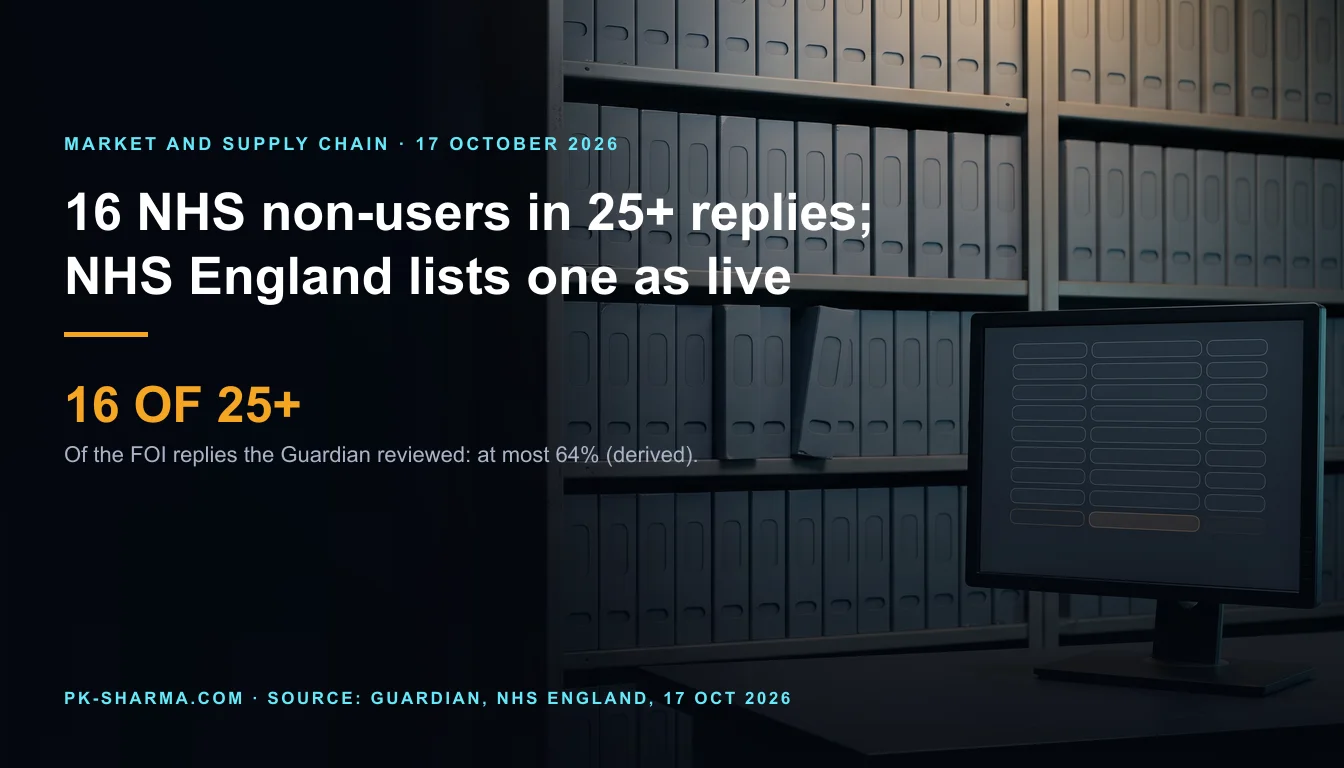
16 of at least 25, against 235 organisations
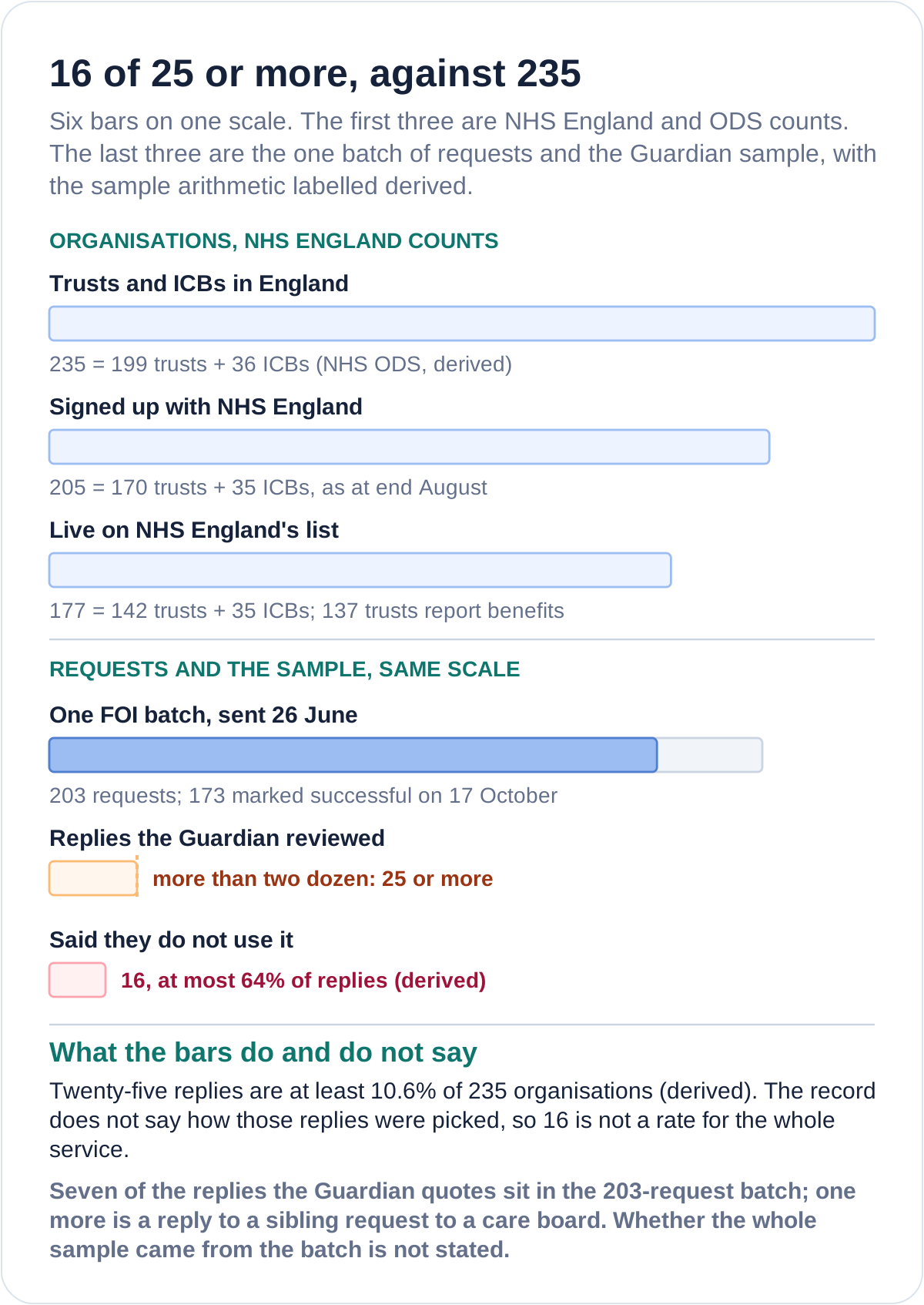
The Guardian reported on 17 October 2026 that, in "more than two dozen" freedom of information responses it reviewed, 16 NHS trusts and health boards said they do not use the Federated Data Platform (FDP), the platform NHS England bought from a consortium led by Palantir. More than two dozen means 25 or more, so 16 is at most 64% of the replies it reviewed (derived). Against the 235 trusts and integrated care boards in England (199 trusts and 36 boards, derived from NHS England's organisation data), 25 replies are at least 10.6% of the organisations (derived), and 16 is 6.8% of 235 (derived). Those last two figures are arithmetic on a sample whose selection is not stated. They are not a rate for the service.
What that does not establish. It does not establish how the replies were chosen: the Guardian says the responses were gathered by Medact, a health campaign that opposes Palantir's role in the NHS, and posted to WhatDoTheyKnow, and does not say how it picked its set from that pool. It does not establish what "do not use" covers, because each reply is a body describing itself in answer to a question it was asked. It does not show that any of the 16 is required to use the platform: a ministerial letter of 21 August says "There is therefore no requirement to use the FDP". It does not measure what the platform does for waiting lists, which NHS England says it cannot do from its own before and after figures: "We cannot therefore draw conclusions about cause and effect". And it does not say when the government must decide about the contract, because two official sources give the end of the contract's initial term as 15 February 2027 and as March 2027.
The second checkable fact. NHS England's uptake page, updated on 25 September, counts 142 trusts and 35 integrated care boards as live, and 137 trusts as reporting benefits, as at the end of August. The University Hospitals of North Midlands NHS Trust, which the Guardian lists among the 16, is on the live list in bold, the page's mark for a trust "realising benefits". Its own reply, dated 24 July, says "FDP is not live. We do not intend to roll it out in the future." The two documents are 63 days apart (derived) and use "live" in different ways, which is the subject of the middle of this briefing.
Interests, in one sentence. Palantir Technologies UK Limited leads the consortium that holds the contract and so has a commercial interest in uptake, Medact campaigns against the contract, and NHS England is both the buyer and the publisher of the uptake figures.
What was read. The Guardian's report in full; the contract and its notice on Contracts Finder; NHS England's uptake, methods, contract, FAQ, privacy and data protection impact assessment pages and its programme board minutes; the letters from the Health and Social Care Committee, the National Data Guardian and the health minister; the Science, Innovation and Technology Committee report; and the replies themselves on WhatDoTheyKnow. Palantir's response is read only as the Guardian prints it: no statement published by Palantir was found. Everything is as read on 17 October 2026, and the NHS England lists change each quarter.
Who picked the replies, and from how many
The Guardian's wording is that the FOIs "were gathered by Medact" and "posted to a public transparency website, WhatDoTheyKnow". The replies it quotes can be found there. Seven of the eight bodies whose quoted replies were located sit in one WhatDoTheyKnow batch titled "Up to date information on Apps adopted by the trust as part of the Federated Data Platform rollout", sent to 203 authorities on 26 June 2026: Dorset HealthCare, University Hospitals of North Midlands, Humber Teaching, University Hospitals Birmingham, Cambridgeshire and Peterborough, West Suffolk, and Avon and Wiltshire Mental Health Partnership. The eighth, NHS Greater Manchester Integrated Care Board, answered a sibling request to integrated care boards. On 17 October the site marked 173 of the 203 requests in the batch successful, 22 long overdue, 4 awaiting internal review, 2 awaiting classification, 1 refused and 1 handled by post (counted from the batch page).
If the Guardian's set came from this batch, 25 replies is at least 14.5% of the 173 marked successful (derived). That is a floor: the Guardian does not give the exact count and does not say the set came from this batch. Medact's July report says its requests went to "every trust in England" in two rounds with a third under way, so the pool may be wider than one batch. A selection of 25 or more from 173 or more tells a reader what some bodies wrote. It cannot say how many of the rest would write the same, or something different.
The question defines its own term. The batch asks: "Is the federated data platform currently live at your trust (where live means having the platform available for the trust to use, known as a local instance)?" A body that answers "no" is saying it has no local instance. The Guardian does not say which question, or which test, produced its 16.
The Guardian's sample, stated against not stated. Read from the Guardian's report of 17 October 2026 and the WhatDoTheyKnow pages; counts of the batch are derived from the batch page.
| Question | Stated | Not stated |
|---|---|---|
| How many replies were reviewed | "More than two dozen FOI responses"; so 25 or more. | The exact number, and a list of them. |
| Who gathered them | Medact, a health campaign that opposes Palantir's role in the NHS; the replies are public on WhatDoTheyKnow. | How the Guardian chose its set from the pool, or whether any reply was left out. |
| How many do not use it | "16 trusts and health boards declared they do not use it". | The split between trusts and care boards, the names of all 16, and the date of each reply. |
| What the others said | Some said the platform made waiting lists easier to manage and improved surgery scheduling (the Guardian's summary). | How many; whether they are in the 25 or beyond it. |
| The test applied | The batch question defines live as having a local instance. | Whether the Guardian's 16 rests on that test, or on each body's own words. |
| The pool it came from | One batch of 203 requests, 173 marked successful; Medact says earlier rounds went to every trust. | Whether the Guardian's set is from this batch, an earlier round or both. |
What NHS England counts, and against what
NHS England's uptake page says the platform "is available for all trusts and integrated care boards in England", that the numbers update every three months, and that the next update is December 2026. As printed on the 25 September update, with shares derived against two denominators: the government's own figure of 205 providers of secondary and tertiary care (Lords written answer HL14478, 24 February 2026) and the 199 NHS trust records in force for England on the NHS organisation data service (derived: 247 active records, less 45 with a legal end date and 3 Welsh trusts). The two denominators do not match and the record does not say why. The contract itself funds "up to 240 NHS organisations".
NHS England's published counts, as at end of August 2026 (page updated 25 September), with product counts as at end of June. Shares are derived.
| NHS England's count, as printed | Share (derived) | Not stated |
|---|---|---|
| **Signed up:** 170 trusts and 35 ICBs. A trust or board that has "signed a Memorandum of Understanding (MOU) to join". | 82.9% of 205 providers; 85.4% of 199 ODS trusts. ICBs: 35 of 36 (97.2%); NHS Greater Manchester is the one not signed up. | What the MOU requires of the signatory, and by when. |
| **Live:** 142 trusts and 35 ICBs. For a board, "live with an NHS Federated Data Platform tenant"; for a trust, "live on the NHS Federated Data Platform". | 69.3% of 205; 71.4% of 199. 28 signed-up trusts are not live. | The test for a trust. The page gives a list of names, not a definition of live, and counts a body by name, not by use. |
| **Reporting benefits:** 137 trusts, "through the use of different types of products", some of which "relate to data analysis and submission tools" for back-office work. | 66.8% of 205; 68.8% of 199. 5 live trusts are not reporting benefits. | How many of the 137 use a product that supports patient care. |
| **Patient-care products, end of June:** inpatient theatres module 40 trusts, inpatient waiting-list module 37, referral to treatment validation 31, OPTICA discharge planning 30, outpatient 16, Cancer 360 six using and five realising benefits. | The largest, 40 trusts, is 19.5% of 205. | Overlap between products; why product counts are end of June while the headline counts are end of August. |
Three series, not one. The programme board's minutes of 6 November 2025 say "157 Trusts had formally signed up to implement the FDP. A total of 125 Trusts were live / in delivery." The Lords answer says that at the end of January 2026 "110 NHS trusts live or in delivery" and 167 signed up. On those printed figures signed-up trusts rose by 10 while "live or in delivery" fell by 15 (derived). By the end of August the page prints 170 signed up and 142 live. The three sources use three labels, and none says whether the same test was applied each time.
One more figure, not verified at source. Medact's July report cites a BMJ report of NHS England data released under FOI: only 85 of 139 live trusts recorded any user activity in the eight apps the data covered in the year to June 2026. The BMJ report and the release were not read for this briefing, so the figure is attributed here and not relied on. It is the kind of count the checklists below ask for.
Ten bodies against two NHS England lists
For the eight bodies the Guardian quotes whose replies could be located, and two more trusts whose replies sit in the same batch, a reply can be set beside NHS England's two lists. Replies are dated 29 June to 31 July 2026 (the Birmingham follow-up is 18 September); NHS England's data is as at the end of August. Wording is as printed in the replies.
Replies on WhatDoTheyKnow and a Greater Manchester disclosure log, set against NHS England's signed-up and live lists (page updated 25 September 2026). "Bold" is the live list's mark for a trust realising benefits.
| Body and reply date | What its own reply says | NHS England's lists |
|---|---|---|
| University Hospitals of North Midlands NHS Trust, 24 July (named by the Guardian) | "FDP is not live. We do not intend to roll it out in the future." Main reason: "it does not appear to provide functionality over and above what we have already". It trialled two products "for a few weeks". | Signed up. Live, in bold. |
| Royal Cornwall Hospitals NHS Trust, 23 July (not named by the Guardian) | Not live: "has not implemented a local instance of the FDP although are compliant with the four key data flows". Plans to re-appraise after a new patient record goes live in April 2027. | Signed up. Live, in bold. |
| Gateshead Health NHS Foundation Trust, 31 July (not named by the Guardian) | Live: "onboarded ... with select functionality in use"; three products implemented; "no active users for CCS or OPTICA", because "Lack of integration with other Trusts systems led to increased workloads for operational teams". | Signed up. Live, in bold. |
| Humber Teaching NHS Foundation Trust, 23 July and 3 August | "the FDP is not live in our Trust, and we have no plans to use it." On review: its own platform and NHS-owned products "already exceed the functionality currently provided by the FDP". | Signed up. Not on the live list. |
| Cambridgeshire and Peterborough NHS Foundation Trust, 29 June | Not live. "Plans for FDP rollout within this Financial Year", OPTICA first; "FDP to date has not offered significant improvements on local systems". Of a crisis tool it considered: "No trial has happened, only a review of the product demonstration". | Signed up. Not on the live list. |
| West Suffolk NHS Foundation Trust, 6 July | "WSFT does not use FDP, and no rollout dates have been agreed." Reason: "We have other systems that currently supersede the functionality on offer from the FDP." | Signed up. Not on the live list. |
| Avon and Wiltshire Mental Health Partnership NHS Trust, 2 July | "No, we are not live." In discussion with NHS England, "active and will continue during 2026-27"; no app yet offers "significantly more than our local reporting / EPR capabilities". | Not on either list. |
| Dorset HealthCare University NHS Foundation Trust, 23 July | "has not adopted the FDP and will not be adopting or going live with the FDP"; uses an in-house service that gives "more local relevant data". | Not on either list. |
| University Hospitals Birmingham NHS Foundation Trust, July and 18 September | "currently not live"; the barrier is "limited expected benefit over existing solutions". A request for detail was withheld under section 24(1), national security. | Not on either list. |
| NHS Greater Manchester Integrated Care Board, 3 July | "deferred adoption"; "no plans to roll FDP out". Five factors: public trust, professional support, no peer-reviewed evaluation, no cost estimate, and an offer that is "duplicative" and "a retrograde step". | Not among the 35 boards signed up or live. |
Counted from the table (derived). Of the eight bodies the Guardian quotes, 4 are on NHS England's signed-up list, 1 is on its live list and 4 are on neither. The Guardian writes only "from Gateshead to Truro", so the two further trusts, Royal Cornwall Hospitals and Gateshead Health, are matched by place and by reply text, not by the Guardian's wording; each is listed live in bold, while its own reply says it has no local instance, or no active users of two of its three products.
Three readings, each an inference. One: the sources define "live" differently, since the batch asks about a local instance and NHS England's trust count has no stated test. Two: NHS England's count may include trusts that send national data flows through the platform; Royal Cornwall's reply says it is "compliant with the four key data flows" without a local instance. Three: the list lags, since it is a quarterly snapshot, though a trust saying in July that it does not intend to roll the platform out is unlikely to have gone live by the end of August. Neither NHS England nor the trusts say which reading holds.
Two places where the Guardian's description and the located reply differ or are missing. The Guardian says Cambridgeshire and Peterborough "has used the system"; the 29 June reply read here says that no trial of the one product it considered has happened and that a roll-out is planned this financial year. The Guardian may have read another reply, which was not found. And "not live" is not "rejected": one reply says discussions with NHS England continue, another that roll-out is planned.
Is use required?
The Guardian's headline says trusts "rejected" the platform. Whether a trust may reject it depends on whether use is required, and the documents use different words for that, including one trust's own word, "mandated".
What NHS England, the programme board, the department and the Health and Social Care Committee say about requirement. Wording as printed.
| Source and date | Wording | Leaves open |
|---|---|---|
| NHS England FAQ, quoting its Medium Term Planning Framework 2026/27 to 2028/29 | "sets out the expectation that all providers and integrated care boards onboard to the NHS Federated Data Platform and start making use of core products ... by 2028/29". | Whether a body with a local alternative must still onboard; what follows if it does not; what onboard means. |
| Programme board minutes, 6 November 2025 | The framework "encourages local organisations to adopt FDP as their primary platform, particularly when renewing product licences or procuring new solutions". | Primary for what, and who checks. |
| NHS England FAQ | "Each NHS trust and ICB is the data controller for their instance ... They can choose which national solutions and products to use." | Choice of products, or of whether to have an instance at all. |
| Overarching data protection impact assessment, issued 5 July 2024 | "Local FDP User Organisations decide whether to use FDP, what Products to use, what data to commit to FDP and how to use it". | Whether that still holds after the 2025 framework. |
| Health and Social Care Committee letter, 8 July 2026 | Welcomes "your clarification that you would not mandate the use of the FDP where better tools exist", citing the minister's oral evidence. | The oral evidence was not read. |
| Leicestershire Partnership NHS Trust, reply of 8 July 2026 (on neither NHS England list) | "The use of Palantir has been mandated to all NHS organisations and, although the trust has not yet commenced work to transfer to the new provider, we expect to do so." | Whether NHS England told the trust so; the trust is counted by neither list. |
| Minister's reply to the committee, 21 August 2026 | "There is therefore no requirement to use the FDP. NHS England has never mandated its use or forced any ICB or NHS Trust to use it." | Whether an "expectation" with a 2028/29 date counts. |
Read together, the documents describe an expectation, an encouragement, a choice, a mandate and no requirement. None says what happens to a body that has not onboarded by 2028/29. The same letter says NHS Greater Manchester has "not signed up", while "all the NHS Trusts in Greater Manchester have". So a board can decline while its trusts sign, which is one more reason a count of "trusts and health boards" mixes two kinds of body.
The contract, as published: dates, exit and measures
The contract sits on Contracts Finder: a notice published on 22 December 2023, replaced on 21 March 2024, with the agreement in four redacted parts. The parts read in full for this section are clauses 4, 7, 33 and 34 and the definitions, Schedule 2.2 on performance levels and Schedule 7.2 on payments on termination. Prices and the key performance targets are redacted under section 43 of the Freedom of Information Act, commercial interests.
The contract, stated against not stated. Contracts Finder notice of 21 March 2024 and the published agreement, NHS England's contract explainer, the Science, Innovation and Technology Committee report of 3 June 2026 and ministers' statements.
| Item | Stated | Not stated |
|---|---|---|
| Value | Notice value £182,242,760, "not a committed amount"; it "could increase to a forecasted amount of £330m. This figure is also not a committed amount." Minister, 16 April: "up to £330 million over a maximum of the seven-year term. So far, £210 million has been invested". Schedule 7.1: service charges are "scalable by the metrics set out in Annex 2", payable quarterly for services "consumed". | What the metrics are; what the £210 million covers; a price per trust. The Annex 2 charging tables are redacted. |
| Start | Agreement "made on 22 November 2023". NHS England: "formally began in March 2024"; its uptake page says roll-out to trusts began in April 2024. | The contract's Go Live Date as a calendar date in the text read. |
| End of the initial term | Contracts Finder end date 15 February 2027; the committee: "The initial three-year commitment ends on 15 February 2027". NHS England: "The initial three year term comes up in March 2027." The contract: three years "from and including the Go Live Date". | Why the two dates differ by about a month. |
| Extension | Clause 4.1: the agreement ends "at the end of the Initial Term" unless the Authority "elects to extend" by "at least 90 days' notice". One extension of 2 years, then two of 12 months; NHS England gives a potential end of March 2031. | Who signs the notice and what the review must find. |
| Exit | Clause 33.1(a): the Authority may terminate "for convenience at any time" and pay a Termination Payment: unpaid charges plus an "Unavoidable Fixed Price Loss Amount", capped at the fixed-price charges that would have been payable. | The amount; the loss amount's definition is redacted. |
| "Break clause" | Used by the committee ("the February 2027 break clause"), by ministers and by the Guardian. | The word "break" does not appear in the four published parts as extracted. |
| Measures | Schedule 2.2 sets availability, system response time, service-request response and fix time, with service credits as the Authority's usual financial remedy for a failure. | The KPI targets table (redacted). No uptake or adoption measure appears in the unredacted text read. |
| Decision | Minister, 16 April: "We will decide later this year whether to extend it." Letter, 21 August: review "expected to complete in the Autumn"; a successor contract is "unlikely" to be in place "by March". | The date of the decision, and what evidence will be published. |
The dates, as arithmetic (all derived). The Guardian's report came 1,060 days after the agreement was made and 121 days before 15 February 2027. If 15 February is the last day of the initial term, 90 days before it is 17 November 2026, 31 days after the Guardian's report. If the term instead ends in March 2027, as NHS England's page says, the same count falls between 1 and 31 December 2026. The published text gives no calendar Go Live Date, so the record does not settle which.
The action that needs a date is the extension, not a break. By clause 4.1 the agreement ends at the end of the initial term unless the Authority gives notice to extend. Separately it may terminate for convenience at any time, at a cost. "Break clause" is the label committees and the press use for the decision at the end of the initial term. That label, a friendly name, makes the choice sound like an act of exit; the text makes it a choice to continue.
Ceilings are not payments. At the ceiling, £330 million over seven years is £47.1 million a year and £1.375 million for each of 240 funded organisations (derived). The notice value of £182,242,760 over the 3.23 years to 15 February 2027 is £56.4 million a year (derived). The notice says the Authority "pays for data platform services as they are consumed", so neither is a price per trust, and the minister's £210 million is 63.6% of the ceiling (derived) without a statement of what it covers.
The words doing the work
Each of these words appears in the coverage or in NHS England's own pages, and each does work that a count cannot. The third column says what the word hides.
Labels read in the Guardian's report, NHS England's pages, the contract and the replies, with what each hides.
| Word | Where it appears | What it hides |
|---|---|---|
| "rejected", "declined" | Guardian headline and standfirst | Replies from "will not be adopting" to "in discussion with NHS England" and "plans for roll-out within this financial year". A body that has not adopted may be late, in talks or committed. |
| "mandated" | One trust's reply (Leicestershire Partnership); the minister says "no requirement" | A body that believes use is required answers "not yet" where another answers "no". Both are "not live" in a count. |
| "do not use it" | Guardian: 16 "trusts and health boards" | Two kinds of body, and two tests: no local instance, or no product in use. The record does not give the split. |
| "trial", "reverted" | Guardian | A trial of "a few weeks" at one trust; "no trial" at another; "no active users" at a third. |
| "signed up", "onboarded" | NHS England (a memorandum of understanding); minutes ("formally signed up to implement") | A signature. The uptake page does not say what the MOU commits a trust to do, or by when. |
| "live" | NHS England list; the FOI question; the programme board ("live / in delivery") | At least two tests: a name on a list, and a local instance. Trusts answer "not live" while listed live. |
| "reporting benefits" | NHS England; Guardian quoting NHS England | Back-office analysis tools count alongside patient-care products, and the benefit figures are before and after comparisons with no controls. |
| "duplicative" | NHS Greater Manchester ICB reply | One of five stated factors, the others being public trust, professional support, no peer-reviewed evaluation and no cost estimate. The department's reply calls the board's system an analytics platform that cannot "enact specific actions related to direct patient care". |
| "federated" | The platform's name | Each trust and board runs its own instance and is its own controller, on the same software under one national contract. Federation here means data can be shared across instances where agreed, not that buyers choose the supplier. |
| "platform" | Everywhere | National instances, local instances, products, privacy-enhancing technology and national data flows are counted under one word. |
| "break clause" | Committee, ministers, Guardian | The published text has an end of the initial term, an extension notice and a termination for convenience, and no clause with that name. |
What each party says, as attributed
Statements are given as printed and attributed. A company's account of itself is a claim, and a public body describing its own use is a description.
Responses to the Guardian's report and the nearest primary statements, read 17 October 2026.
| Party and source | Says | Not stated or not found |
|---|---|---|
| Palantir, a spokesperson quoted by the Guardian | Accused Medact of "slanted analysis" and of "misleading the public"; "The FDP is, objectively, a successful programme"; its purpose, in the Guardian's paraphrase, is to give trusts tools to draw on depending on their existing capabilities and needs. It points to 117,000 additional operations and a 14.3% fall in discharge delays for long-stay patients, which match NHS England's 117,539 and 14.34% (before and after comparisons). | A statement published by Palantir (none found); a reply to any named trust. |
| NHS England, a spokesperson quoted by the Guardian | "137 NHS trusts have now reported benefits from the wide range of tools available on the platform". | Whether any of the 16 is among the 137, and how "reported" is tested. |
| The health minister, letter of 21 August 2026 | There is "no requirement" to use it; Greater Manchester's own system "cannot enact specific actions related to direct patient care" and scaling it nationally "is unproven"; a successor contract by March is "unlikely". | The evidence for "unproven"; the decision. |
| The National Data Guardian, letter of 9 October 2026 | "There is evidence that a significant number of local organisations" are "reluctant to actively adopt", citing "concerns about the supplier, the overhead costs of managing local objections, and a preference for other solutions"; the "trust factor" should have "substantial weight"; the benefits evidence is "a mixed picture". | How many organisations; the independent evaluations "will not conclude in time to inform current decisions". |
| Office for Statistics Regulation, 22 July 2026 | NHS England added its cause-and-effect caveat on 6 June and agreed to caveat the uptake page, publish a schedule for trust-level benefit data and say that case studies are written by the organisations using the platform. | Anything on the uptake counts: the statement concerns benefit metrics. |
| Imperial College London, draft evaluation strategy | A "final report will be shared at the end of the project, in April 2029". | Interim findings, before the contract decision. |
UK health-data governance: what each instrument decides, and where it stops
None of the instruments below decides whether a trust uses the platform. They decide who is accountable if it does. Under UK GDPR a controller "determines the purposes and means of the processing" and a processor acts "on behalf of the controller", and a controller "shall use only processors providing sufficient guarantees" under a binding contract. NHS England's privacy notice says each trust or board is controller for its local instance, NHS England for the national instances and jointly for some aspects, and that Palantir (the data platform) and IQVIA (privacy-enhancing technology) are processors acting on written instructions "for each Product that a User Organisation chooses to use". The ICO's controller and processor guidance is marked as under review after the Data (Use and Access) Act. Two earlier briefings are relevant: the ICO's finding of no impact assessment where a police force uploaded people's details to a supplier's platform, and Denmark's account of one company's lawful access reaching most of a national register.
What each instrument decides about uptake, and where it stops. Read 17 October 2026 from the pages named in the sources.
| Instrument | What it decides about uptake | Where it stops |
|---|---|---|
| UK GDPR articles 4 and 28; NHS England privacy notice | Who is controller and who processor; that a processor needs a written contract and instructions per product. The notice says a trust "makes decisions about how to use the FDP, which Products it wants to use". | It does not say whether to use the platform, or compare it with a local system. |
| UK GDPR article 35; the overarching DPIA | A DPIA before high-risk processing. The [overarching DPIA](https://www.england.nhs.uk/wp-content/uploads/2024/08/PRN01442ii-overarching-dpia-for-the-federated-data-platform.pdf) (version issued 5 July 2024) says "Local FDP User Organisations decide whether to use FDP"; the minister's letter says the DPIA for the national tenant described supplier access wrongly and is corrected. | It assesses the risk of processing that happens. A body that does not use a product has no product DPIA, and a DPIA does not compare alternatives. |
| National Data Guardian (advice of 9 October 2026; the Caldicott Principles) | Advice: "Public and professional trust should be given substantial weight when evaluating any supplier of a system involving people's health and care data." The Caldicott Principles set eight tests for using confidential information. | Advice, not a decision. The National Data Guardian says some factors are "outside my remit" and the independent evaluations will come too late for the current decision. |
| Data Security and Protection Toolkit | A self-assessment against the National Data Guardian's 10 data security standards, which every organisation with access to NHS patient data and systems must use. | It assures how a body secures data it holds. It does not rank platforms or require adoption. |
| NCSC supply chain security guidance and the Cyber Assessment Framework (principle A4, supply chain) | Twelve principles for understanding supplier risk, establishing control, checking arrangements and improving. | Guidance. It says nothing about this platform and decides no purchase. |
| Freedom of Information Act 2000, sections 1, 10 and 16 | A right to information a body holds, a reply within 20 working days, and a duty to give advice and assistance. Exemptions seen here: section 24(1) (Birmingham) and section 43 (the contract's redactions). | A reply is a self-description. The Act does not oblige a body to create information, so a count is only as comparable as the question. |
Where each stops, in one line. The law makes the controller the owner of the decision to use and of the risk if it does. The National Data Guardian advises on trust. The toolkit and the NCSC guidance assure the security of whatever is chosen. No instrument tells a board which of two tools to buy, so the choice sits with the trust, subject to the national framework's expectation and the department's statement that there is no requirement. The independent evaluation by Imperial College London reports in April 2029, and the National Audit Office has a study in progress on patient data integration; the National Data Guardian understands that the independent assessments "will not conclude in time to inform current decisions".
What to do, in order
Take this with you
For a trust board member
- Ask for the trust's own entry on NHS England's three lists (signed up, live, reporting benefits) and the evidence that makes each true.
- Ask for the memorandum of understanding the trust signed, who signed it and what it commits the trust to; get the text.
- Keep three questions apart: is there a local instance, which products are in operational use with their go-live dates, and which national data flows pass through the platform.
- Ask how many staff used each product in the last 90 days, from the product's own records.
- Ask for the product-level impact assessment and the processing agreement for every product in use, and the screening questionnaire for any considered.
- Ask what local alternative exists, what it costs, who maintains it and what the trust would need if the national contract ended or was extended.
- Ask the executive whether the trust believes use is required, on what document, and whether NHS England has said so in writing.
- Ask the executive to give the board one paper whose wording matches the trust's FOI replies, or to say why it differs.
- Record patient objections received and the staff time they take.
Take this with you
For a data protection officer
- Confirm the trust is controller for its local instance and read the joint controller table to see what NHS England controls.
- Check there is a written processing agreement for each product, naming the data platform supplier and the privacy-enhancing technology supplier, and that the sub-processor list is current.
- Check a product DPIA exists for every product in use, and read the national-tenant DPIA correction on supplier access.
- Check the privacy notice the trust publishes matches actual use: an instance with no products, or products with no instance, needs different wording.
- Check the Data Security and Protection Toolkit return and the supplier risk record follow the NCSC supply chain principles.
- If the trust is not live, write down the decision, the date, who decided and the reason, so an FOI reply can be given in the same words.
- Log objections and opt-out requests that name the platform, and the time they take.
Take this with you
For a journalist or researcher using FOI
- Send the same text to every body and publish the batch, so anyone can count the requests, the replies and the gaps.
- Ask separately, each as yes or no first, then explain: signed the memorandum of understanding and on what date; a local instance exists and since when; products in operational use with go-live dates; products trialled and stopped, with dates and reasons; national data flows sent through the platform; whether the body understands use to be required, and on what document.
- Quote NHS England's own terms in the question: "live" and "reporting benefits" as on its list, and ask the body whether it agrees it is on that list and why or why not.
- Fix one reference date, such as 1 December 2026, for every answer.
- Ask NHS England for the test it uses for "live" and "signed up", the date each body was first counted, and product usage records by organisation.
- Use the duty to give advice and assistance (section 16) when a reply is vague; ask for the exemption and request an internal review when information is withheld.
- Code each reply into published categories, such as not live and no plans, not live and plans, live with no product in use, and live with products in use, and keep the exact words.
- Print the denominator: requests sent, replies received, replies reviewed, and the rule for choosing which are quoted.
The question that exposes the gap
A trust can be listed as live and realising benefits by NHS England and say "not live" to its own FOI request in the same quarter. The contract's initial term ends on 15 February 2027 or in March 2027, and notice to extend must be given at least 90 days before: by 17 November 2026 on the February reading, 31 days after the Guardian's report. So which document will the decision rest on, the list of 142 or the replies of the 16, and has anyone asked the 142 to answer the 16's question in the 16's words?
Key facts
Sources
- PrimaryFDP uptake and benefits page, updated 25 September 2026: 142 trusts live, 137 reporting benefits, 35 ICBs live, 170 trusts and 35 ICBs signed up, with footnote definitions and product counts.NHS Englandaccessed 2026-10-17
- PrimaryNHS organisations live with the FDP: 142 trusts and 35 ICBs by name, 137 trusts in bold as realising benefits.NHS Englandaccessed 2026-10-17
- PrimaryNHS organisations signed up to the FDP: 170 trusts and 35 ICBs by name.NHS Englandaccessed 2026-10-17
- PrimaryMethods for the published uptake and benefits information: product-level uptake tests and the cause-and-effect caveat.NHS Englandaccessed 2026-10-17
- PrimaryContract explainer: award in November 2023, formal start in March 2024, three-year committed term, extensions to March 2031, up to 240 organisations, Palantir as processor.NHS Englandaccessed 2026-10-17
- PrimaryFDP FAQs: controller role of each trust and ICB, 'can choose which national solutions and products to use', and the Medium Term Planning Framework expectation to onboard by 2028/29.NHS Englandaccessed 2026-10-17
- PrimaryFDP Programme Board minutes, 6 November 2025: 157 trusts signed up, 125 live or in delivery, and the framework's encouragement to adopt FDP as the primary platform.NHS Englandaccessed 2026-10-17
- PrimaryFDP privacy notice: user organisations as controllers, Palantir and IQVIA as processors, written instructions per product, legal grounds.NHS Englandaccessed 2026-10-17
- PrimaryOverarching data protection impact assessment for the FDP, version issued 5 July 2024: local organisations decide whether to use FDP and which products.NHS Englandaccessed 2026-10-17
- PrimaryFDP information governance framework page: the product screening questionnaire that decides whether a product DPIA is needed.NHS Englandaccessed 2026-10-17
- PrimaryFederated Data Platform and Associated Services, awarded-contract notice of 21 March 2024: value, forecast, start and end dates, supplier, four contract parts.Contracts Finder (NHS England)accessed 2026-10-17
- PrimaryFDP-AS Contract, part 1 of 4: clause 4 term, clause 7 performance, clauses 33 and 34 termination and payment, definitions of Initial Term, Extension Period and Go Live Date. Redacted under FOIA section 43.Contracts Finder (NHS England)accessed 2026-10-17
- PrimaryFDP-AS Contract, part 2 of 4: Schedule 2.2 performance levels; the KPI targets table is redacted.Contracts Finder (NHS England)accessed 2026-10-17
- PrimaryFDP-AS Contract, part 3 of 4: Schedule 7.2 payments on termination.Contracts Finder (NHS England)accessed 2026-10-17
- PrimaryLetter from the health innovation minister, 21 August 2026: 'no requirement to use the FDP', Greater Manchester ICB, the DPIA correction, the contract review expected in the autumn, a successor contract 'unlikely' by March. Answers in a browser; the Parliament site refuses plain automated requests.UK Parliament, Health and Social Care Committeeaccessed 2026-10-17
- PrimaryCommittee letter to the minister, 8 July 2026: recommends not extending the contract; welcomes the minister's clarification on not mandating use. Same access note.UK Parliament, Health and Social Care Committeeaccessed 2026-10-17
- PrimaryRewiring the state: Delivering digital government (HC 61), 3 June 2026, paragraphs 86 and 95: 'The initial three-year commitment ends on 15 February 2027' and the break clause recommendation. Same access note.UK Parliament, Science, Innovation and Technology Committeeaccessed 2026-10-17
- PrimaryWritten question HL14478, answered 24 February 2026: 110 trusts live or in delivery, 167 signed up, 81% of 205 providers. Same access note.UK Parliament, House of Lordsaccessed 2026-10-17
- PrimaryWritten question 126740, answered 28 April 2026: contract review, extension decision expected this year, exit provisions. Same access note.UK Parliament, House of Commonsaccessed 2026-10-17
- PrimaryWestminster Hall debate on the NHS Federated Data Platform, 16 April 2026: the minister's statements on value up to 330 million pounds, 210 million invested, break clauses and a decision later this year. Same access note.UK Parliament, Hansardaccessed 2026-10-17
- PrimaryLetter to the health innovation minister, 9 October 2026: the 'trust factor', reluctance of local organisations to adopt, mixed evidence, independent evaluations too late for current decisions.National Data Guardian (GOV.UK)accessed 2026-10-17
- PrimaryStatement of 22 July 2026 on NHS England's presentation of FDP metrics: the 6 June caveat and the steps NHS England agreed.Office for Statistics Regulationaccessed 2026-10-17
- PrimaryDraft evaluation strategy for the FDP: final report in April 2029.Imperial College London (Imperial Consultants)accessed 2026-10-17
- PrimaryWork in progress: Integrating patient records, which names the FDP among current initiatives; scope only, no findings.National Audit Officeaccessed 2026-10-17
- PrimaryBatch page: 203 requests sent on 26 June 2026 with the status of each as shown on 17 October 2026.WhatDoTheyKnowaccessed 2026-10-17
- PrimaryUniversity Hospitals of North Midlands NHS Trust reply of 24 July 2026: 'FDP is not live. We do not intend to roll it out in the future.'WhatDoTheyKnowaccessed 2026-10-17
- PrimaryHumber Teaching NHS Foundation Trust replies of 23 July and 3 August 2026 (attached letters read): not live, no plans to use it, existing products 'already exceed' the FDP.WhatDoTheyKnowaccessed 2026-10-17
- PrimaryUniversity Hospitals Birmingham NHS Foundation Trust: July reply (not live), the quoted 'limited expected benefit' answer, and the 18 September refusal under section 24(1).WhatDoTheyKnowaccessed 2026-10-17
- PrimaryCambridgeshire and Peterborough NHS Foundation Trust reply of 29 June 2026: not live, roll-out planned this financial year, 'only a review of the product demonstration'.WhatDoTheyKnowaccessed 2026-10-17
- PrimaryWest Suffolk NHS Foundation Trust reply of 6 July 2026 (attached letter read): 'WSFT does not use FDP', 'other systems that currently supersede the functionality'.WhatDoTheyKnowaccessed 2026-10-17
- PrimaryAvon and Wiltshire Mental Health Partnership NHS Trust reply of 2 July 2026 (attached letter read): not live, discussions with NHS England continue.WhatDoTheyKnowaccessed 2026-10-17
- PrimaryDorset HealthCare University NHS Foundation Trust reply of 23 July 2026: 'will not be adopting or going live with the FDP'.WhatDoTheyKnowaccessed 2026-10-17
- PrimaryGateshead Health NHS Foundation Trust reply of 31 July 2026: onboarded, three products, 'no active users for CCS or OPTICA'.WhatDoTheyKnowaccessed 2026-10-17
- PrimaryRoyal Cornwall Hospitals NHS Trust reply of 23 July 2026 (attached letter read): no local instance, 'compliant with the four key data flows'.WhatDoTheyKnowaccessed 2026-10-17
- PrimaryNHS Greater Manchester Integrated Care Board reply of 3 July 2026 (attached document read): deferred adoption, five factors including 'duplicative' and 'a retrograde step'.WhatDoTheyKnowaccessed 2026-10-17
- PrimaryReply FOI/2627/SG18943, 8 July 2026, to the same question set: 'The use of Palantir has been mandated to all NHS organisations' and the trust expects to transfer (Word document read as text).Leicestershire Partnership NHS Trust (disclosure log)accessed 2026-10-17
- PrimaryFOI 2026/1860, replied 13 July 2026: 'NHS GM has deferred adoption of FDP and so there is no live instance at the ICB.'NHS Greater Manchester (disclosure log)accessed 2026-10-17
- PrimaryActive integrated care board records on 17 October 2026 (48), with legal end dates read per record to reach 36 in force.NHS England Digital (Organisation Data Service API)accessed 2026-10-17
- PrimaryActive NHS trust records on 17 October 2026 (247), with legal end dates read per record and Welsh trusts removed to reach 199 for England.NHS England Digital (Organisation Data Service API)accessed 2026-10-17
- PrimaryUK GDPR Article 4(7) and (8): controller and processor.legislation.gov.ukaccessed 2026-10-17
- PrimaryUK GDPR Article 28: processors, sufficient guarantees and the processing contract.legislation.gov.ukaccessed 2026-10-17
- PrimaryUK GDPR Article 35: data protection impact assessment before high-risk processing.legislation.gov.ukaccessed 2026-10-17
- PrimaryFreedom of Information Act 2000 section 1: the general right of access to information held.legislation.gov.ukaccessed 2026-10-17
- PrimaryFreedom of Information Act 2000 section 10: 20 working days.legislation.gov.ukaccessed 2026-10-17
- PrimaryFreedom of Information Act 2000 section 16: duty to provide advice and assistance.legislation.gov.ukaccessed 2026-10-17
- PrimaryControllers and processors guidance; marked as under review after the Data (Use and Access) Act.Information Commissioner's Officeaccessed 2026-10-17
- PrimaryData protection impact assessments guidance.Information Commissioner's Officeaccessed 2026-10-17
- PrimaryThe Caldicott Principles: eight principles on confidential information, 8 December 2020.National Data Guardian (GOV.UK)accessed 2026-10-17
- PrimarySelf-assessment against the National Data Guardian's 10 data security standards; all organisations with access to NHS patient data and systems must use it.NHS England (Data Security and Protection Toolkit)accessed 2026-10-17
- PrimarySupply chain security guidance: 12 principles.National Cyber Security Centreaccessed 2026-10-17
- PrimaryCyber Assessment Framework: principle A4, supply chain.National Cyber Security Centreaccessed 2026-10-17
- Reported by'Palantir patient data tech rejected by many NHS trusts in England', 17 October 2026. Read in full: the 16, 'more than two dozen' replies, Medact as gatherer, the responses of Palantir and NHS England. The story this briefing checks; no primary statement from Palantir was found.The Guardianaccessed 2026-10-17
- Reported byFDP roll-out report, 16 July 2026: a campaign group's analysis of two rounds of FOI requests to trusts. Read for how the replies were gathered and for claims attributed to it; Medact opposes Palantir's role.Medactaccessed 2026-10-17