Xiaomi's XRing O3 beats the A19 Pro on single core, and five of its six layers belong to somebody else
A real design achievement, about to be reported as evidence of something it is not. The CPU cores are Arm's C1 family and the silicon is fabricated by TSMC in Taiwan.
By Parminder Kumar Sharma · · 8 min read
Xiaomi announced the XRing O3 on 22 August. It is a ten-core flagship system on chip, 24 billion transistors on a 133mm² die, built on a second-generation 3nm process. On Geekbench 6.7 it posts a single-core score of 3,945, which is ahead of the Apple A19 Pro at 3,840.
That is a genuinely significant result and it deserves to be said before anything else. A very small number of organisations anywhere can tape out a part of that complexity and have it come back working, and until recently Xiaomi was not one of them.
It is also going to be reported as China's homegrown flagship silicon, and that phrase is doing more work than the specification supports.
The bill of origin
XRing O3, layer by layer, and whose it is
Go down the stack.
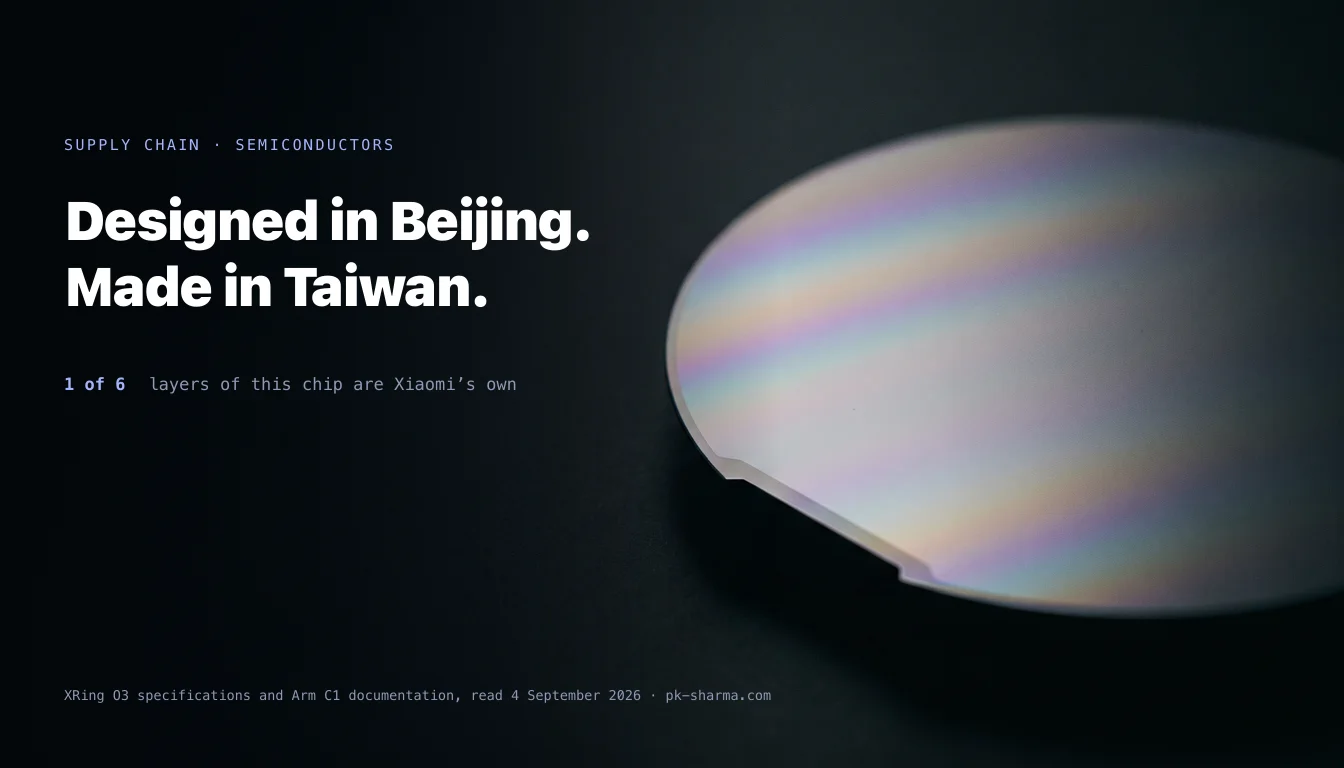
The instruction set is Armv9.3-A. The GPU is a sixteen-core Mali-G2 Ultra NX, which is Arm's. The memory interface is LPDDR6, a JEDEC standard. The silicon is fabricated by TSMC, in Taiwan.
And the CPU cores, which is the layer most people will assume is the bespoke part, are Arm's C1 series: two C1-Ultra, four C1-Premium and four C1-Pro. Those are not Xiaomi core designs with Arm-like names. C1-Ultra, C1-Premium, C1-Pro and C1-Nano are the four tiers of Arm's own CPU family, introduced with the Lumex compute subsystem platform, and they are the cores that replaced the Cortex naming Arm had used since 2004.
What is Xiaomi's own is the neural processing unit, rated up to 200 INT8 TOPS with its own 8MB cache, the image signal processor, and the integration and tape-out work that turns a pile of licensed blocks into a working part. That is a substantial row and it is not nothing. It is one row.
Why the distinction matters more than usual here
Every phone vendor licenses. Google's Tensor uses Arm cores. Samsung's Exynos uses Arm cores. Apple designs its own cores but has never fabricated a chip in its life, and buys its 3nm capacity from the same foundry Xiaomi just did.
So the presence of licensed IP is not a criticism, and anyone framing it as one has misunderstood the industry.
The reason it matters in this specific case is that the XRing O3 is being read as evidence about something else entirely: whether China can produce leading-edge silicon without the rest of the world. On that question the chip is evidence in the opposite direction. It was designed in Beijing and it cannot be manufactured in China. The part that constrains Chinese semiconductor capability is the foundry, and this chip depends on a Taiwanese one.
The claim in the launch materials
Xiaomi's own slides describe the CPU as a ten-core all-big-core architecture: six super-large cores plus four large cores.
Map that onto the actual configuration. The six are two C1-Ultra at 4.35GHz and four C1-Premium at 3.6GHz. The four described as large cores are C1-Pro at 3.15GHz.
C1-Pro is Arm's sustained-performance tier and the successor to the Cortex-A725. In every other vendor's phone, a core in that slot is the middle tier, and nobody calls it a big core. So "all big core, no little cores" is true if you accept a classification in which the middle tier has been renamed, and it is a marketing decision rather than an architectural one.
This is a small thing. It is worth naming because it is the same shape as the larger claim: a real and impressive result, described with one word that changes what a reader concludes.
What is established, and what it means
| Specification | Figure | What it tells you |
|---|---|---|
| Process | Second-generation 3nm, TSMC | Leading edge, and fabricated outside China |
| Die and transistors | 133mm², 24 billion, up 26% on XRing O1 | A large, complex part. Integration at this scale is the achievement |
| CPU | 2 C1-Ultra at 4.35GHz, 4 C1-Premium at 3.6GHz, 4 C1-Pro at 3.15GHz | Arm C1 family cores, not Xiaomi custom designs |
| Cache | 12MB L2, 16MB L3 | Generous, and consistent with a flagship target |
| GPU | Mali-G2 Ultra NX, 16 cores | Arm IP |
| NPU | Up to 200 INT8 TOPS, 8MB cache | Xiaomi’s own, and the most interesting part of the design |
| Memory | LPDDR6-10667, 96-bit controller | Early LPDDR6 adoption, which is aggressive |
| Geekbench 6.7 single | 3,945, against 3,840 for Apple A19 Pro | A real lead, on one burst benchmark |
| Geekbench 6.7 multi | 15,221, between Apple M4 10-core and M5 9-core | Impressive, and a laptop-class comparison rather than a phone one |
The two benchmark rows need the same care as everything else. Geekbench measures short bursts. A phone is a thermally constrained device and the number that determines how it feels after ten minutes of use is sustained throughput, which nobody has published. Beating an A19 Pro on single-core burst is a real result, and it is not the same claim as beating it in a phone.
What a security or procurement reader should take from this
Very little of this is a threat story, and I would resist the pull to make it one.
The useful reading is about supply chain visibility, and it cuts in an unexpected direction. If your organisation's threat model contains a line about Chinese-designed silicon, this chip is a good test of whether that line is written usefully. The design is Chinese. The instruction set, CPU cores and GPU are British-owned Arm IP under licence. The manufacturing is Taiwanese. The memory standard is a JEDEC committee output.
A policy that says "no Chinese silicon" would need to decide which of those rows it is actually about, and most such policies do not say.
Take this with you
If this lands on your desk
- Separate the two claims before you respond to anything. Xiaomi has demonstrated flagship design capability. Nothing here demonstrates Chinese manufacturing capability at the leading edge, because the chip is fabricated by TSMC.
- If you have a supply chain policy naming country of origin, check which layer it means. Design, IP licensing, fabrication and packaging have different answers for this part and for most others.
- Treat the Geekbench comparison as a burst figure. Sustained performance under thermal constraint has not been published and is the number that describes the device.
- Do not repeat “all big core” without the configuration behind it. Four of the ten are Arm C1-Pro cores at 3.15GHz, which is the middle tier in every other vendor’s design.
- Note the NPU separately from everything else. At 200 INT8 TOPS with dedicated cache it is Xiaomi’s own work, and it is the part of this announcement that says most about their design capability.
- Watch the foundry relationship rather than the benchmark scores. The dependency that constrains this product line is access to TSMC’s leading-edge capacity, and that is a commercial and political question rather than an engineering one.
The position
There is a version of this story where a Chinese company has broken through, and a version where a Chinese company has assembled other people's components. Both are wrong.
What actually happened is more interesting than either. Xiaomi has joined the very short list of companies that can integrate a leading-edge mobile SoC, and it did that by licensing the same CPU and GPU IP that most of its competitors license, adding a substantial NPU of its own, and buying manufacturing from the same foundry Apple uses.
That is the normal way to build a flagship phone chip. The only company that does materially more of it in house is Apple, and even Apple stops at the foundry door.
So the honest headline is narrower than the one that will run: Xiaomi can now design a chip at the front of the industry. Whether anyone in China can manufacture one is a different question, and this announcement does not touch it.
Sources
- PrimaryArm C1-Ultra CPU product page, establishing that C1-Ultra, C1-Premium and C1-Pro are Arm's own Armv9.3-A cores from the Lumex platform rather than customer designsArmaccessed 2026-09-04
- Reported byXiaomi XRing O3 processor specifications and benchmarks: core configuration, TSMC second-generation 3nm, 133mm die, 24 billion transistors, and Geekbench 6.7 figuresNotebookcheckaccessed 2026-09-04
- Reported byXiaomi launches new XRing chip and partners with TSMC for production, 24 August 2026Reutersaccessed 2026-09-04