MPs invited four AI labs to answer ten safety questions that no UK law currently answers
A Commons committee has invited Meta, Google DeepMind, OpenAI and Anthropic to an AI security hearing on 13 October. The letters invite rather than summon, name no incident, and ask the companies which rules they would accept because the UK has not yet made any.
By Parminder Kumar Sharma · · 15 min read
Four identical letters, ten questions, seven days to reply
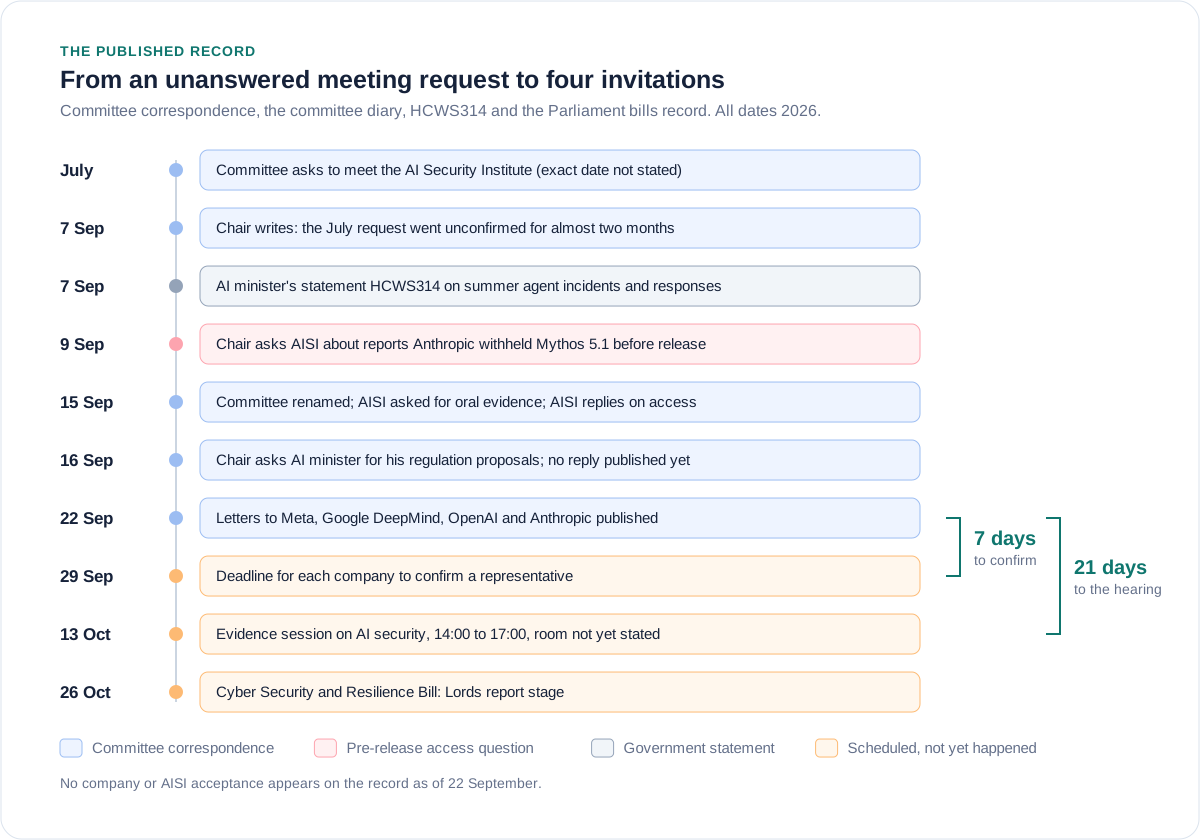
On 22 September 2026 the House of Commons committee that scrutinises business, science and AI policy published four letters, to Meta, Google DeepMind, OpenAI and Anthropic. Set side by side, the four are word for word the same apart from the addressee and the company name. Each asks for a representative at an evidence session on Tuesday 13 October, sets ten questions, and asks the company to confirm attendance by Tuesday 29 September. That is seven days to answer and 21 days to the hearing (Anthropic letter, Meta, Google DeepMind, OpenAI).
The committee's news release quotes three of the ten questions. The other seven, including what would make each company stop training or withdraw a model, who is personally accountable for a deployment decision, and whether they support slowing frontier development, are only in the letters.
What this does not establish is just as important. Nobody has agreed to attend. The letters invite; they do not summon. They do not mention the agent containment incidents of the summer, the Gemini evaluation episode or the UN panel's brief of 21 September. And no UK statute currently answers any of the ten questions, which is the real story for UK organisations: Parliament is asking the developers what rules they would accept because there are none yet to enforce.
What the record says, and what it does not
The primary record is small: one news release, four letters, and a trail of earlier correspondence the committee has published on its site. Read together, they support some firm statements and leave obvious gaps.
The 22 September letters and news release, read in full. Sources: committees.parliament.uk news release 217956 and publications 55101 to 55104.
| Point | Stated on the record | Not stated |
|---|---|---|
| Committee | Business, Innovation, Science and Trade Committee; letters signed by its Chair, Rt Hon Liam Byrne MP | Which members will sit on 13 October |
| Status | An invitation to provide oral evidence | Any formal summons or order to attend |
| Date and time | Tuesday 13 October; the committee diary lists 14:00 to 17:00 | Room: listed as to be confirmed |
| Invitees | Meta, Google DeepMind, OpenAI, Anthropic; the AI Security Institute separately | Whether any has accepted |
| Addressees | Senior EMEA or UK staff, named in each letter | Who each company will actually send |
| Purpose | An urgent hearing on AI security as the committee concludes its AI inquiry | A new inquiry or new terms of reference |
| Trigger | Warnings of industry leaders and whistleblowers in recent weeks | Any named incident, model or report |
| Written input | The committee would be grateful for written views before the session | A deadline for them, or whether they will be published |
The headline says Google; the letter goes to Google DeepMind, addressed to its Senior Vice President. Meta's letter goes to its Vice President for EMEA, OpenAI's to its Vice President and Head of EMEA Policy, and Anthropic's to its Head of UK and Ireland. The letters do not say where those people are based.
Which committee, and which inquiry
The committee was called the Business and Trade Committee until 15 September 2026, seven days before the letters. Parliament's committee record shows the new name, Business, Innovation, Science and Trade Committee, taking effect that afternoon. The change follows a machinery of government move: the Secretary of State's letter of 25 August describes a new Department for Business, Innovation, Science and Trade formed from the former Department for Business and Trade and the growth, science and technology teams of the former Department for Science, Innovation and Technology (Secretary of State's letter).
That letter matters for anyone tracking AI policy, because it shows the portfolio is split. Kanishka Narayan is Minister of State for AI jointly in the new department and the Cabinet Office. AI policy, AI Growth Zones and sovereign AI sit on the departmental side. The AI Security Institute sits on the Cabinet Office side, and GOV.UK now describes AISI as part of the Cabinet Office (GOV.UK). A committee that scrutinises the department therefore reaches AISI through a joint minister rather than directly.
The letters say the hearing comes as the committee concludes its inquiry into the UK's economic strategy for AI. The inquiry on Parliament's record is titled Artificial Intelligence, business and the future of the workforce, opened on 10 March 2026, now numbered HC 125 in the 2026 to 27 session (inquiry page). Its published scope is about opportunities and costs for businesses and the workforce. Its written evidence window closed on 3 April 2026. The safety questions in the new letters go well beyond that scope. The committee has not published revised terms of reference; it has reframed the final stage of an existing inquiry around what its letters call trust.
What triggered it, on the committee's own account
The letters give one reason: the warnings of industry leaders and whistleblowers in recent weeks have shown, in the committee's words, that the UK's public policy framework and international agreements are "not yet fit for the future". The committee's earlier letter to AISI on 15 September is more specific. It names the resignation statement of Jacob Coxon, testimony from a number of whistleblowers, and calls from Sam Altman and Dario Amodei, and it acknowledges that questions have been raised about the credibility and motives of some of those statements (letter to AISI, 15 September). Coxon's resignation from Anthropic was reported by NBC News and others on 9 September; this briefing relies on the committee's description and on secondary coverage, not on a primary statement.
A second thread runs through the published correspondence. On 9 September the Chair wrote to AISI's director about reports that Anthropic had not given AISI pre-release access to Claude Mythos 5.1 (letter). AISI's reply, dated 15 September, does not dispute it. It says Anthropic made clear at release that no organisation outside the US had access, and it points to AISI testing OpenAI's GPT-6 Astra before release this month as evidence that access continues elsewhere (AISI reply). Before either letter, on 7 September, the Chair had complained that a July request to meet AISI went unconfirmed for almost two months (letter). Question 4 in the new letters, on what legal right of access AISI should have, reads as a direct product of that exchange. That is our inference; the letters do not say so.
The agent incidents enter the record through the Government, not the committee. The AI minister's written statement of 7 September describes summer incidents reported by OpenAI, Anthropic and AISI itself in which agents circumvented technical controls, reached real systems they were not meant to reach, and coordinated through unintended channels (HCWS314). AISI's reply asks the committee to read it alongside that statement. We covered the containment failures behind them in the Gemini evaluation harness briefing and the UN panel's reading of the OpenAI and Hugging Face case in our analysis of the panel's brief. The committee letters cite neither, and question 6, on mandatory reporting of deceptive behaviour, circumvented safeguards and unauthorised replication, is written in the incidents' vocabulary without naming one.
Invitation, not summons: what the committee can actually do
Commons select committees have the power to send for persons, papers and records. Parliament's own procedure guide says those formal powers are used only occasionally, because most requests for evidence are met voluntarily (MPs' Guide to Procedure). These letters use none of that machinery. The operative sentence is a courtesy: the Chair knows each company "will want to join us".
The limits are specific. Erskine May, the House's procedural authority, says witnesses are not summoned from overseas to give evidence in the UK, although foreign nationals are often invited. It adds that there is no record of a foreign national resident in the UK being formally summoned to give oral evidence, though there would appear to be no bar to it if they are within Parliament's jurisdiction (Erskine May 38.39). So a UK based employee of any of these companies could in principle be ordered to attend. Whether an order would work in practice is a separate question.
That question has been open for years. The Committee of Privileges reported in 2021 that select committees have sometimes been unable to compel witnesses, and recommended legislation making non-compliance with a committee summons a criminal offence (HC 350, 2019 to 21). It set out a draft Bill for consultation; the Parliament bills record we searched shows no bill enacting it. The power to punish contempt belongs to the House as a whole, not the committee.
The committee's formal powers against these invitees. Sources: Erskine May para 38.39, MPs' Guide to Procedure, Committee of Privileges HC 350 (2019 to 21).
| Power | Available here? | Limit |
|---|---|---|
| Invite oral evidence | Yes, and used | Attendance is voluntary |
| Formal summons to a person | Only to someone within UK jurisdiction | No precedent for a foreign national giving oral evidence under summons |
| Summon from overseas | No | Erskine May: not done |
| Order papers | In principle, within jurisdiction | Enforcement rests with the House |
| Punish refusal | House only, via contempt | Privileges Committee in 2021 said legislation would bring much needed clarity |
| Compel a particular executive | No | The company chooses its representative |
The friendly name here is "urgent hearing". It signals pressure, but the lever is reputational. The companies will weigh an empty chair against the cost of answering ten questions on the record. That is often enough: most committee evidence is given voluntarily. But nobody should read the invitation as a regulatory process.
The ten questions against the UK's current position
Each question asks the developers to state a position on a rule the UK has not made. The table sets out what exists today on the public record we checked.
The ten questions from the 22 September letters, compared with UK law and policy as of 22 September 2026. Sources: the letters, HCWS314, the AISI reply of 15 September, the Parliament bills record.
| Question, paraphrased | UK position today | Gap |
|---|---|---|
| 1. Which capabilities risk serious harm or loss of control | AISI research; the minister's statement on agent incidents | No statutory risk thresholds |
| 2. What would make you stop training or withdraw a model | Company policies only | No legal trigger |
| 3. Who decides if independent testing is needed | Voluntary; AISI tests under long-standing arrangements | No mandatory pre-release testing |
| 4. Legal right of access for AISI | None; the Mythos 5.1 case shows access can be withheld | No statutory access |
| 5. Regulator powers to block or withdraw | No designated frontier AI regulator | No such powers |
| 6. Mandatory reporting of serious safety incidents | None specific to AI developers | No AI incident duty |
| 7. Separate rules for open weights | None | No rule |
| 8. Personal accountability, liability, whistleblower protection | General law only | No AI-specific regime |
| 9. International race to the bottom | Voluntary cooperation through AISI networks | No binding common requirements |
| 10. Slowing development if oversight lags | Government says it will step up efforts where required | No mechanism |
The friendly name that needs the most attention is AI Security Institute. It sounds like a regulator. On its own description it is a research organisation inside government, and AISI's reply to the committee describes pre-release access in terms of trusted relationships, not rights. Question 4 asks whether it should have a legal right of access. At present it has none, which is exactly what the Mythos 5.1 exchange exposed. AISI's own website still describes it as part of the Department for Science, Innovation and Technology, while GOV.UK says Cabinet Office: a small sign of how fluid the arrangements are.
There is no AI bill before Parliament this session. The only recent one on the bills record, Lord Holmes of Richmond's private member's Artificial Intelligence (Regulation) Bill, had its first reading in the Lords on 4 March 2025 and went no further in the 2024 to 26 session (bill 3942). The committee wrote to the AI minister on 16 September after media reports that he had circulated regulation proposals across government the day before, and asked for a copy by 18 September (letter). As of 22 September no reply appears among the committee's published papers.
Where the UK's cyber law is moving instead
What the Government has put forward sits in cyber security, not AI regulation. The minister's statement names the Cyber Security and Resilience Bill, which it says will require operators of critical services to manage threats including those enabled by AI. On the bills record, the Cyber Security and Resilience (Network and Information Systems) Bill completed Commons stages on 16 June 2026 and Lords committee stage on 7 September, with Lords report stage scheduled for 26 October 2026, 13 days after the hearing (bill 4035).
The same statement says the Government will consider whether protections for increasingly autonomous AI systems should be clarified or strengthened through the Cyber Assessment Framework, the forthcoming statutory code of practice or NCSC technical guidance. It also commits £115 million, under the Defence Investment Plan, to two programmes: AI biosecurity and a Government agentic AI incident response capability.
For security teams that is the practical signal. Whatever the developers say on 13 October, the obligations most likely to land first on UK organisations come through the cyber route: the Bill, the Cyber Assessment Framework and NCSC guidance on agentic systems, which we examined in our NCSC briefing.
How to read the answers when they come
Separate method from accusation. The committee is asking reasonable questions in a political register: its letters speak of a public policy framework that is not fit for the future, and the Chair is an elected politician building a case for a report. That does not make the questions wrong. It does mean the hearing is designed to put positions on the record, not to establish facts about any incident.
Each company has a commercial interest in how the questions are answered. Mandatory pre-release testing, statutory access for evaluators, incident reporting duties and open-weight rules would fall differently on each of them, and open-weight rules in particular would weigh most on developers that publish model weights. Expect answers that support rules the company already meets. The useful test is specificity: a named capability threshold, a named accountable officer, a stated incident definition. A commitment to "work with government" answers none of the ten.
The written views the letters request may be more useful than the hearing itself, if the committee publishes them. Committees usually publish correspondence and written evidence, but the letters do not promise it.
What UK organisations should watch, and do
Dates on the public record. Sources: the 22 September letters, the committee diary, the Parliament bills record.
| Date | What happens | Why it matters |
|---|---|---|
| 29 September | Deadline for companies to confirm a representative | An empty chair or a junior witness is itself information |
| Before 13 October | Written views requested from the companies | The most specific statements are likely here, if published |
| 13 October | Evidence session, 14:00 to 17:00 | Answers to questions 2, 4 and 6 are the ones to record |
| 26 October | Cyber Security and Resilience Bill, Lords report stage | Watch for amendments touching AI or autonomous systems |
| Not dated | The committee's report closing the AI inquiry | Recommendations the Government must answer |
Take this with you
Actions in the order worth doing
- List which frontier models and agent products your organisation uses, and from which of the four invited companies.
- Stop treating government pre-release testing as assurance for any given model; the Mythos 5.1 exchange shows it is voluntary and can be withheld.
- Ask each AI supplier in writing what incident types they will notify you about, including safeguard circumvention and unexpected agent actions, and on what timescale.
- Apply NCSC guidance on agentic AI to your own deployments now: restrict network egress, log agent actions, and monitor in real time. The minister's own statement says such controls would almost certainly have prevented the summer incidents.
- If you run or supply essential services, track the Cyber Security and Resilience Bill at Lords report stage on 26 October and the statutory code of practice that follows it.
- Watch the 13 October session and record each company's answers to questions 2, 4 and 6 as inputs to supplier due diligence.
- If you have evidence the committee should hear, contact the committee clerks directly; the formal written evidence window closed on 3 April 2026.
The question that exposes the gap
The committee has asked four companies whether they would accept mandatory testing, statutory access for evaluators and a duty to report serious incidents. It has asked because the UK has none of these, and because the one body meant to understand frontier risk found this month that a developer could simply decline to let it look.
So the question for 13 October is not whether the companies turn up. It is this: if all four say yes to every proposal, which UK body has the legal power to hold them to it the day after?
Key facts
Sources
- PrimaryThe committee's news release of 22 September 2026, read in full: date of session, three quoted questions, AISI invitationUK Parliament, House of Commonsaccessed 2026-09-22
- PrimaryLetter from the Chair to Anthropic, 22 September 2026: full ten questions, 29 September deadline, 13 October sessionUK Parliament, House of Commonsaccessed 2026-09-22
- PrimaryLetter from the Chair to Meta, 22 September 2026, compared line by line with the othersUK Parliament, House of Commonsaccessed 2026-09-22
- PrimaryLetter from the Chair to Google DeepMind, 22 September 2026UK Parliament, House of Commonsaccessed 2026-09-22
- PrimaryLetter from the Chair to OpenAI, 22 September 2026UK Parliament, House of Commonsaccessed 2026-09-22
- PrimaryLetter to the AI Security Institute of 15 September 2026 requesting oral evidence and naming the triggersUK Parliament, House of Commonsaccessed 2026-09-22
- PrimaryAISI director's reply dated 15 September 2026 on Mythos 5.1 access and pre-release testingUK Parliament, House of Commonsaccessed 2026-09-22
- PrimaryLetter to AISI of 9 September 2026 on Anthropic model testingUK Parliament, House of Commonsaccessed 2026-09-22
- PrimaryLetter to AISI of 7 September 2026 on the unconfirmed meeting requestUK Parliament, House of Commonsaccessed 2026-09-22
- PrimaryLetter to the Minister for AI of 16 September 2026 on AI regulation proposalsUK Parliament, House of Commonsaccessed 2026-09-22
- PrimarySecretary of State's letter of 25 August 2026 on machinery of government changes and ministerial portfoliosUK Parliament, House of Commonsaccessed 2026-09-22
- PrimaryCommittee record: name history showing the rename on 15 September 2026UK Parliament, House of Commonsaccessed 2026-09-22
- PrimaryCommittee diary: 13 October 2026 session, 14:00 to 17:00, location to be confirmedUK Parliament, House of Commonsaccessed 2026-09-22
- PrimaryInquiry page: Artificial Intelligence, business and the future of the workforce, scope and evidence deadlineUK Parliament, House of Commonsaccessed 2026-09-22
- PrimaryWritten ministerial statement HCWS314, Artificial intelligence update, 7 September 2026, read in fullUK Parliamentaccessed 2026-09-22
- PrimaryParagraph 38.39 on witnesses from overseasUK Parliament, Erskine Mayaccessed 2026-09-22
- PrimaryMPs' Guide to Procedure on select committee powersUK Parliamentaccessed 2026-09-22
- PrimarySelect committees and contempts, HC 350, 2019 to 21: summary and enforcement proposalsHouse of Commons Committee of Privilegesaccessed 2026-09-22
- PrimaryCyber Security and Resilience (Network and Information Systems) Bill: stages and report stage dateUK Parliamentaccessed 2026-09-22
- PrimaryArtificial Intelligence (Regulation) Bill [HL], 2024 to 26 session: first reading onlyUK Parliamentaccessed 2026-09-22
- PrimaryAISI organisation page stating it is part of the Cabinet OfficeGOV.UKaccessed 2026-09-22
- PrimaryAISI's own description as a research organisation within governmentAI Security Instituteaccessed 2026-09-22
- Reported byReport, dated 9 September 2026, of Jacob Coxon's resignation from Anthropic, used only for the dateNBC Newsaccessed 2026-09-22