Free local AI models passed 463 of 500 reCAPTCHA sessions: the image puzzle is no longer the control
A new paper shows free, openly available vision models on a laptop passed reCAPTCHA's image challenges in 92.6% of 500 live sessions. It tests the puzzle, not the scoring, token checks or login controls behind it, which is where UK teams should now look.
By Parminder Kumar Sharma · · 16 min read

463 of 500, and what that number measures
An automated solver built on two free, openly available vision models passed Google reCAPTCHA in 463 of 500 live sessions, a session success rate of 92.6%, working through 2,931 image challenges on a consumer laptop with no dedicated graphics card and no paid API. That is the headline measurement in Robot Visions: Breaking reCAPTCHA at Zero Cost and Zero Shot, a paper by independent researchers Suphannee Sivakorn and Samantha Gottlieb, posted to arXiv on 16 September 2026 and accepted for the 29th Information Security Conference (ISC 2026).
The number is checkable against the paper's own tables. Table 6 splits the 500 sessions by how many Type B challenges (one photograph cut into a 4x4 grid) each session received. Back-calculating from the published rates gives 217, 21, 187 and 38 successes, which sum to 463. Of the 37 failures, 36 were in sessions where at least half the challenges were Type B.
That distinction is the whole story for defenders. Plenty of organisations describe a CAPTCHA widget as "bot protection" in risk registers and supplier questionnaires. If the widget's hardest step can be passed by a laptop, the question is what else is standing, and whether anyone has checked.
What the researchers actually built
The paper describes two separate solvers, and the difference between them matters because the abstract's two biggest claims come from different ones.
Solver one: local vision models. For Type A challenges (a 3x3 grid of independent images, "Select all images with" a keyword), the researchers use CLIP, an openly available model that scores how well an image matches a text phrase. Each tile is compared against a positive prompt naming the keyword and a negative prompt meaning "something else", and selected if the difference clears a threshold. For Type B (one photograph cut into 16 tiles), they use OWLv2, an openly available object detector that finds objects named in plain text, then map its bounding boxes onto the grid and select tiles with at least 10% coverage. Browser control is Selenium with ChromeDriver, plus what the paper calls standard anti-detection measures: hiding the navigator.webdriver flag, removing automation indicators and adding small random offsets to mouse movements.
Solver two: a prompt-only skill. A structured markdown file of natural-language instructions, run inside Anthropic's Claude Code using Claude Sonnet 5, reads the tile images and picks the answer. This is the basis for the claim that a "non-technical adversary" can defeat reCAPTCHA. It is a commercial, paid model, not a free local one.
The two solvers compared, from Tables 2, 3, 5 and 8 of arXiv 2609.18518
| Measure | Local models (CLIP, OWLv2) | Prompt-only skill (Claude Sonnet 5) |
|---|---|---|
| Model access | Open weights, run locally | Commercial, paid subscription |
| Offline Type A, exact match | 58% (387 of 662) | 95.5% (191 of 200) |
| Offline Type B, exact match | 43.5% (147 of 338) | 50.5% (101 of 200) |
| Cost per challenge | No per-query charge | Mean $0.150 (A), $0.268 (B) |
| Time per challenge | Under one second with integrated GPU | Mean 38.4 s (A), 83.7 s (B) |
| Live session success rate | 92.6% (463 of 500) | Not reported |
The last row is the important one. The paper says single static challenges on Google's demo page "succeeded consistently" with the prompt-only skill, but sessions with dynamic or repeated challenges timed out against reCAPTCHA's two-minute window, and the authors decline to report a formal online success rate "given this latency sensitivity and the small scale of verification conducted". So the free solver has a measured live result, and the no-code solver does not. The skill-floor argument is plausible, and the offline accuracy supports it, but it is the least-measured claim in the paper.
Zero cost and zero shot, defined precisely
Both phrases in the title are accurate within the paper's own definitions, and both are narrower than they sound.
What the title's terms mean in arXiv 2609.18518, sections 1, 3.3 and 4.3
| Term | What the paper means | What it does not mean |
|---|---|---|
| Zero shot | No training or fine-tuning of model weights on CAPTCHA images; any keyword accepted | No labelled data used: thresholds were tuned on 1,000 human-labelled challenges |
| Zero cost | No API or per-query charge; runs on a laptop without a dedicated GPU, CPU-only possible | No effort: browser automation, anti-detection and retry logic still had to be built |
| Locally run | Open models: CLIP ViT-H/14 (632M parameters) and OWLv2 | Covers the Claude skill: that runs on a paid commercial service |
| Zero code | The prompt-only classifier is natural-language instructions | No code at all: the online version wraps it in a Selenium script |
The resource figures are modest. The paper's Table 7 gives CLIP ViT-H/14 at 3.7 GB of storage and 4.3 GB peak memory, OWLv2 at 591 MB and 1.2 GB, with CPU-only latency of 2.6 seconds and 1.0 second per challenge respectively. The authors estimate 10 to 15 joules per challenge. At the upper figure, a thousand challenges is 15 kilojoules, about 0.004 kWh.
The paper also notes that its end-to-end pipeline "was generated via AI-assisted coding". That supports the lower skill floor, but a working automation stack still had to be assembled around the models. The authors did not release that online solver.
What was tested, and what was not
Every experiment ran in a fresh browser with no Google sign-in, no browsing history and a new browser instance per session. The authors call this the hardest case for a solver because reCAPTCHA then consistently serves image challenges rather than waving the session through on reputation. That is a sound way to isolate the vision problem. It also means the study measures the puzzle, not the scoring system around it.
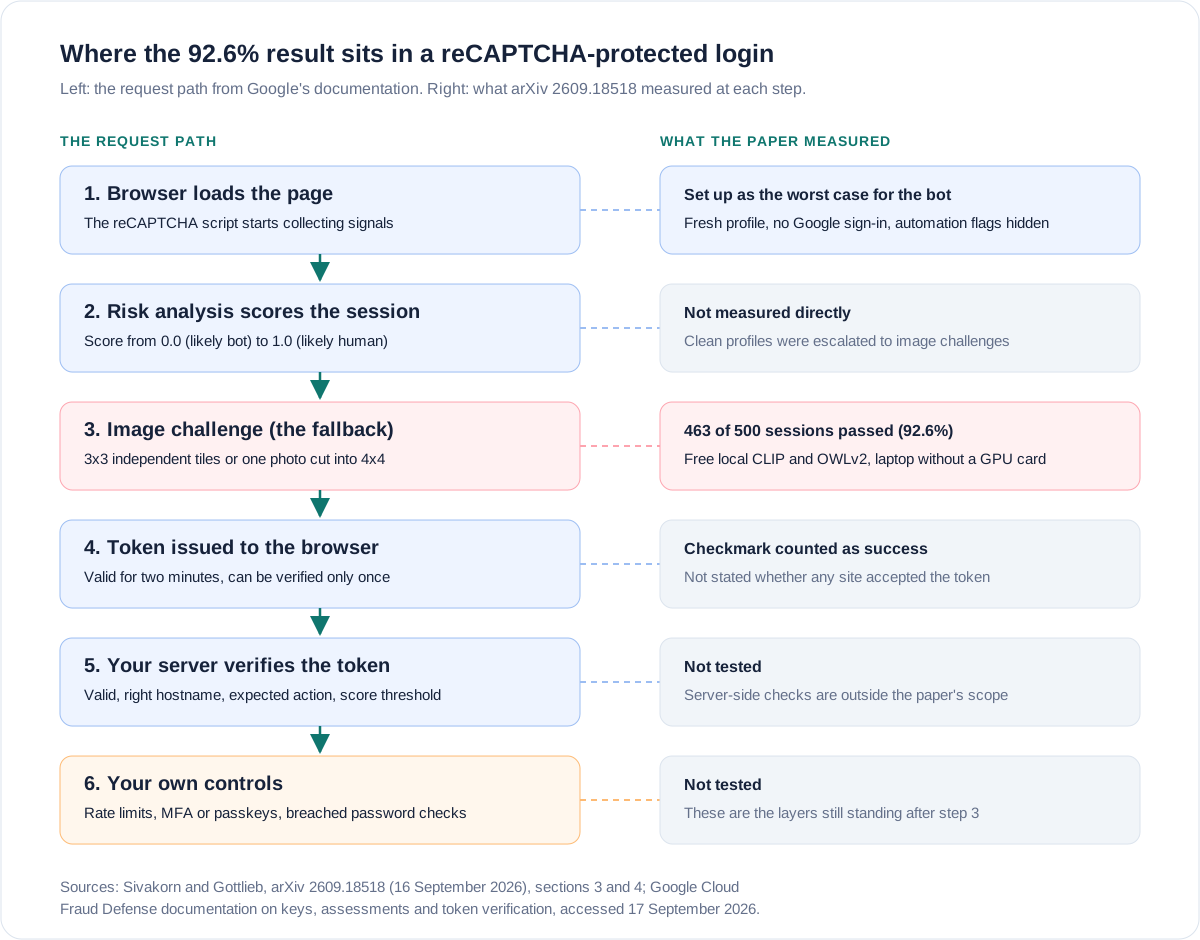
Scope of arXiv 2609.18518: what the paper states and what it does not
| Question | Stated in the paper | Not stated |
|---|---|---|
| reCAPTCHA version | v2 checkbox flow with image challenges | Any separate test of v3 scores, Enterprise or Fraud Defense keys |
| Challenge types | Type A static and dynamic, Type B | Audio challenge; Google's newer QR code challenge |
| Where it ran | Official demo page, third-party demo sites, live production login pages | Which sites, how many of each, or which key types they used |
| Definition of success | Checkmark granted within 20 challenges | Whether the token then passed the site's server-side verification |
| Network conditions | New browser instance per session | IP addresses, proxies, request rate or geography |
| Comparison | Prior research: 70.78% (2016), 60.7% across 26 CAPTCHA types (2025) | Human pass rates or paid human solving services |
The v3 point needs care. The paper's background section says that when v3 cannot confirm a user, "a visual challenge is deployed as a fallback", and cites a blog post by Friendly Captcha, a company that sells an alternative to reCAPTCHA. Google's own v3 guide describes something different: v3 "will never interrupt your users", returns a score, and leaves the response to the site, for example requiring two-factor authentication or email verification on a low-scoring login. A visual fallback exists only where a site or a key type puts one there. The paper's warning about the fallback is fair for those integrations. It is not a finding about v3 scoring itself.
What Google's documentation already says
Since 22 April 2026, reCAPTCHA has been part of Google Cloud Fraud Defense. Google says existing customers need no migration and keep their site keys. The classic developer pages for v2 and v3 now carry a banner marking them deprecated.
The current key type guidance sets out three web options:
- Score-based keys (Google's recommended option) return a risk score and never show a challenge.
- Checkbox keys show "I'm not a robot" and might show image challenges. Google says it does not recommend them because they increase friction "and don't significantly improve accuracy".
- Policy-based challenge keys trigger image challenges whenever the score falls below a threshold you set.
The same page lists caveats about challenges that read like a summary of the new paper. Google writes that, due to advances in computer vision, CAPTCHAs "are becoming less useful to distinguish between humans and bots", and that they are under threat from paid attackers who can solve all types of challenges.
Two further details from Google's documentation matter more to most UK teams than the paper does.
First, the value of any key type depends on your server checking the token. Google's verification guide says each token is valid for two minutes and can be verified only once, and the assessment guide says to confirm that the returned action matches the action you expected, because a mismatch suggests an attacker falsifying actions. A site that renders the widget but never verifies the token server-side has no protection from it at all, whether or not the image puzzle is solvable.
Second, the classic reCAPTCHA FAQ (now marked deprecated) says that a v3 site key which exceeds its free monthly quota may fail open by returning a static score of 0.9 with the message "Over free quota.", with "no user-visible indications". The quota it describes is 1,000,000 calls per month per domain. A high-traffic site in that state would read every visitor as low risk.
Reading the numbers carefully
The online result is higher than the offline accuracy, which looks odd at first: 92.6% of sessions passed although the local models got only 58% of Type A and 43.5% of Type B challenges exactly right. The paper gives two reasons. reCAPTCHA keeps serving new challenges rather than failing a session on one wrong answer, and it accepts near-miss selections that a strict exact-match test would count as wrong. Successful sessions needed a median of 3 challenges and 57 seconds. Failed sessions are reported as running into the authors' cap of 20 challenges.
Session success by share of Type B challenges, from Table 6 of arXiv 2609.18518; failure counts computed from the published rates
| Type B share of session | Sessions | Success rate | Failures (computed) |
|---|---|---|---|
| 0% (all Type A) | 218 | 99.5% | 1 |
| 1 to 49% | 21 | 100.0% | 0 |
| 50 to 99% | 218 | 85.8% | 31 |
| 100% (all Type B) | 43 | 88.4% | 5 |
| Total | 500 | 92.6% | 37 |
Three internal tensions are worth flagging, none of which changes the central result.
- Why sessions failed. Section 4.2 says failures are "not caused by misclassification" but by reCAPTCHA's risk model sustaining suspicion. The next paragraph calls Type B, the challenge the solver is worst at, "the primary failure driver". The table above cannot separate those explanations. If the risk model is the cause, the scoring layer did some useful work against a clean automated browser in 37 cases.
- Table 5 arithmetic. Failed sessions are listed with a minimum, median and maximum of 20 challenges but an average of 19.4, which cannot all be true.
- Keyword count. The dataset is said to span 13 distinct keywords, but only 11 are named.
The result is also less novel than the headline suggests. A 2024 paper by Plesner, Vontobel and Wattenhofer, Breaking reCAPTCHAv2, reported solving 100% of reCAPTCHA v2 captchas with YOLO models. According to the new paper, the tile classifier in that work was fine-tuned on about 14,000 labelled images covering a fixed set of 13 object classes. The new work's contribution is that no training, no graphics card and no API are needed, and that any keyword works. That is a lower cost and skill floor, not the first break.
The paid route is not cheaper than earlier work either. The Claude skill averaged $0.150 per Type A challenge, 6.25 times the $0.024 per challenge that the paper cites for the 2025 Halligan study using GPT-4o. The authors estimate that a session running to 20 challenges could cost approximately $2 to $13 in tokens.
The friendly-name fallacy: a "bot protection" label on a form
The checkbox says "I'm not a robot". Supplier documentation says "bot protection". Neither phrase is a control. The control is whatever your application does with the verdict, and the paper is a useful prompt to write that down honestly.
The common failure pattern is a policy that turns a low risk score into a picture puzzle, and a passed puzzle into full trust. On the evidence of this paper, that design converts "this session looks automated" into "let it in" for roughly nine automated sessions in ten under the paper's test conditions, at no marginal cost to the attacker. Google's own login advice for low scores is multi-factor authentication or email verification, not a harder puzzle.
Controls on public forms and login pages if the image challenge is assumed solvable. Analysis by pk-sharma.com drawing on Google and OWASP guidance
| Control | Still stands | Does not stand |
|---|---|---|
| Image challenge as the gate | Adds some delay and friction | As proof that a human is present |
| Risk score | Not defeated by this paper; still a signal | As a pass if low scores route to a solvable puzzle |
| Server-side token check | Blocks forged, reused, expired and off-site tokens | Against a genuinely solved challenge |
| Rate limits and velocity rules | Untouched: a successful solved session took a median of 57 seconds | If limits are per IP only and attackers rotate addresses |
| MFA, passkeys, breached password checks | Untouched: solving a puzzle does not supply a second factor | Where MFA is optional and most users skip it |
| Contact and sign-up forms | Moderation, email verification, volume alerts | Any automatic action triggered by a passed checkbox alone |
The OWASP Credential Stuffing Prevention Cheat Sheet already treats CAPTCHA as one layer among many, notes that tools and services exist to break them "with a reasonably high success rate", and suggests monitoring solve rates, since abnormally high rates can indicate automated breaking. It ranks multi-factor authentication as by far the best defence against credential stuffing and password spraying. In April 2026 the NCSC announced that passkeys should be the default authentication option businesses offer consumers.
There is also an accessibility cost to answering this paper with harder puzzles. WCAG 2.2 success criterion 3.3.8 treats object-recognition CAPTCHAs as an allowed exception at level AA but not at AAA. Making the puzzle harder would burden people with disabilities and do little against an attacker who retries for free.
Method, disclosure and interests
The authors reported the findings to Google through its Bug Hunters programme on 6 September 2026 (issue 557908167), ten days before the arXiv submission on 16 September. The paper does not record any response from Google, and no public Google response was found for this briefing. The authors did not release the end-to-end online solver. They have published the labelled challenge dataset and the classification prompt used by the Claude skill; this briefing does not link to them.
The researchers list themselves as independent and declare no competing interests. Suphannee Sivakorn is also first author of the 2016 study that reached 70.78% against reCAPTCHA with deep learning, so this is a return to earlier work rather than a new entrant. The experiments included "live production login pages" that the paper does not name. The authors say no user account was targeted and no user data involved.
Commercial interests sit around the paper rather than in it. Its description of the v3 fallback relies on a blog post by a reCAPTCHA competitor. The no-code solver is built on Anthropic's commercial model, and its per-challenge costs are Anthropic's pricing. Google, for its part, is now marketing a QR code challenge as the AI-resistant answer to exactly this kind of attack. None of that undermines the measurement. It is a reason to test claims from any of them, including Google's, before relying on them.
What UK teams running public forms and logins should do
Take this with you
In the order worth doing
- List every public login, sign-up, password reset and contact form, the CAPTCHA product on each, the key type (classic v2 checkbox, v3, score-based, checkbox or policy-based) and who owns it.
- Confirm every form verifies the token on the server, rejects invalid or reused tokens, checks the hostname and the expected action, and fails closed if the verification call errors.
- On any classic v3 key, look for the Over free quota message in verification responses, since Google documents a fail-open static score of 0.9 in that state.
- Find any rule that sends low-score sessions to an image challenge and then treats a pass as full trust. Replace the pass with a step-up: MFA, email verification or a moderation queue.
- On logins, make MFA or passkeys available and prompt for them on risky sign-ins, check passwords against breach corpuses, and rate-limit per account as well as per IP address.
- On contact and sign-up forms, cap volume per address and per time window, verify email before anything is sent or created, and never trigger outbound messages from a passed checkbox alone.
- Start logging challenge serve and pass rates, score distributions and failed-login ratios, and alert on sudden rises in pass rate, which OWASP notes can signal automated solving.
- Update risk registers and supplier questionnaire answers so that CAPTCHA is described as friction, not as authentication or a bot control in its own right.
- Before buying a replacement challenge, including Google's QR code option, ask for independent test evidence and check it against your accessibility obligations.
The question that exposes the gap
The paper's honest conclusion is narrow: the image puzzle no longer separates people from software, and it has not for some time. What it cannot tell you is how much of your own defence rested on that puzzle.
So ask the person who owns your login page one question: if every image challenge on this site were passed by software from tomorrow morning, which control would stop the next credential stuffing run, and who would receive the alert?
Key facts
Sources
- PrimaryAbstract page for Robot Visions: Breaking reCAPTCHA at Zero Cost and Zero Shot (submission date, authors, ISC 2026 acceptance)arXivaccessed 2026-09-17
- PrimaryFull HTML text of arXiv 2609.18518, read in full: method, Tables 2 to 8, disclosure and reproducibility sectionsarXivaccessed 2026-09-17
- PrimaryreCAPTCHA v3 developer guide (deprecated banner): score-based, never interrupts users, login advice for low scores, action verificationGoogleaccessed 2026-09-17
- PrimaryVerifying the user's response: token valid two minutes, single use, siteverify response fieldsGoogleaccessed 2026-09-17
- PrimaryClassic reCAPTCHA FAQ (deprecated banner): v3 over-quota fail-open with static score 0.9, quota limitsGoogleaccessed 2026-09-17
- PrimaryChoose the appropriate key type: score-based, checkbox and policy-based challenge keys, and caveats with CAPTCHA challengesGoogle Cloudaccessed 2026-09-17
- PrimaryreCAPTCHA keys overview: integration types SCORE, CHECKBOX, POLICY_BASED_CHALLENGE, INVISIBLEGoogle Cloudaccessed 2026-09-17
- PrimaryInterpret assessments for websites: valid, action and expectedAction, score levels and reason codesGoogle Cloudaccessed 2026-09-17
- PrimaryChallenge types: visual, audio and Preview QR code challenge described as AI-resistantGoogle Cloudaccessed 2026-09-17
- PrimaryInstall policy-based challenge keys: challenges triggered below a configured score thresholdGoogle Cloudaccessed 2026-09-17
- PrimaryIntroducing Google Cloud Fraud Defense, 22 April 2026: reCAPTCHA folded into Fraud Defense, QR code challengeGoogle Cloud Blogaccessed 2026-09-17
- PrimaryFraud Defense release notes: 22 April 2026 rebrand, July 2026 Policy Engine and challenge policies PreviewGoogle Cloudaccessed 2026-09-17
- PrimaryPlesner, Vontobel and Wattenhofer, Breaking reCAPTCHAv2 (2024): prior claim of solving 100% of captchasarXivaccessed 2026-09-17
- PrimaryCredential Stuffing Prevention Cheat Sheet: MFA first, CAPTCHA limits, monitoring solve rates, IP mitigationOWASPaccessed 2026-09-17
- PrimaryNCSC news, 23 April 2026: passkeys as the default authentication option for consumersNCSCaccessed 2026-09-17
- PrimaryAuthentication methods: choosing the right type, guidance for customer-facing services and credential stuffingNCSCaccessed 2026-09-17
- PrimaryUnderstanding WCAG 2.2 SC 3.3.8 Accessible Authentication (Minimum): object recognition exception at AA, not AAAW3Caccessed 2026-09-17
- Reported byTeoh et al., Are CAPTCHAs Still Bot-hard? (Halligan), USENIX Security 2025, cited for prior resultsUSENIXaccessed 2026-09-17