PaperCut’s two-flaw chain: Release 3 supersedes the emergency patch guidance
Updated 9 September: Emergency Patch Release 3 is the current recommendation. The original chain analysis remains below as a dated record; maintenance builds are scheduled for 10 September.
By Parminder Kumar Sharma · · 8 min read
Original analysis, 29 August 2026
The following records the information available on 29 August. Its Release 2 guidance, unresolved regression discussion and installed-base estimate are historical. Use the dated update above for the current vendor position.
What is happening
PaperCut is investigating active exploitation of its print-management software. In its own words: "We are aware of confirmed customer incidents and are treating this matter with the highest priority."
Two things make this worse than a normal zero-day. The vulnerability is two flaws chained, and neither score on its own describes the risk. And for roughly half the installed base, there is no patch to apply at all.
The vendor found the flaw the hard way. Its bulletin says it reproduced the vulnerability using information from "a university customer’s security team and digital forensics and incident response team". This was discovered from a victim, not through coordinated disclosure.
Two scores that each understate the risk
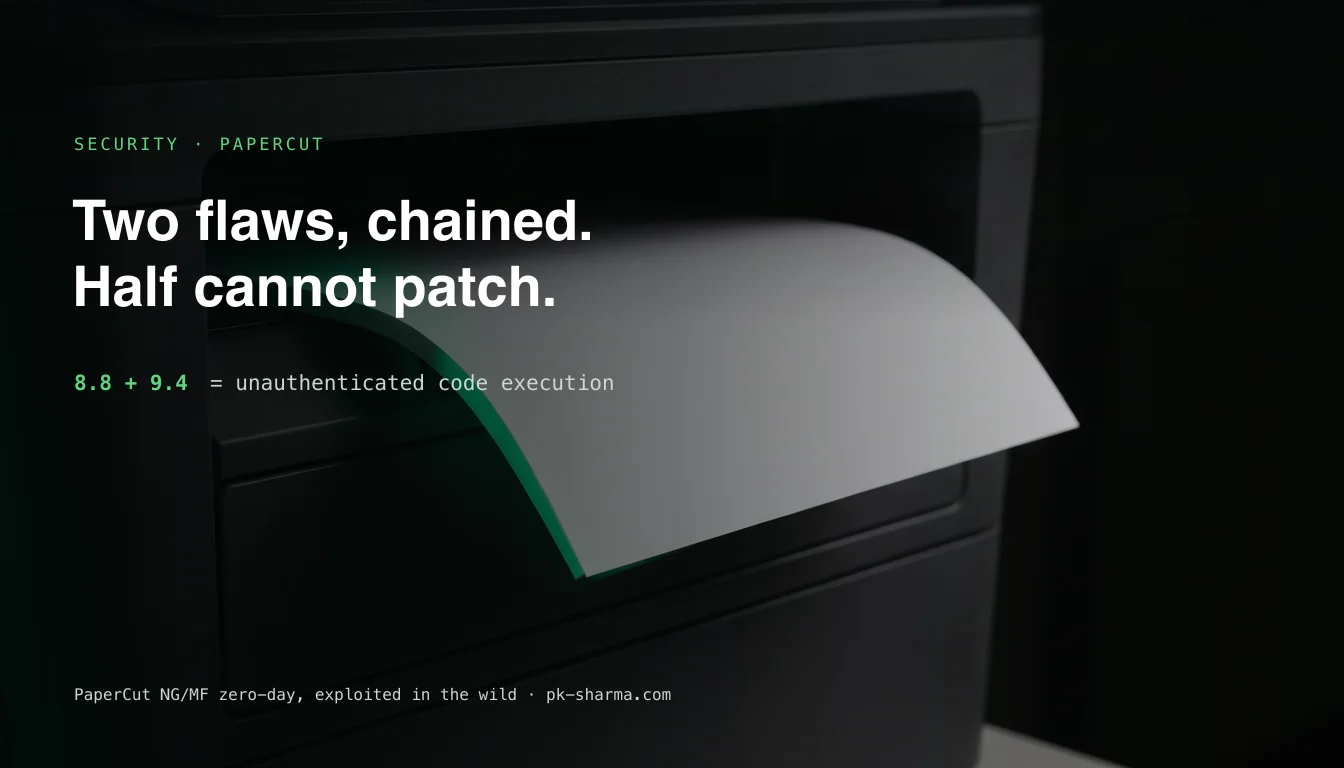
PR:N with limited impact, CVE-2026-82078 is PR:H with total impact and a changed scope. Both scores are PaperCut’s own; at the time of writing NVD lists both as “Received”, so neither has been independently analysed.CVE-2026-81578 is an authentication bypass in the web management interface, scored 8.8. Its vector is PR:N, no credentials, but its impact is limited: an unauthenticated request can reach administrative functions before access validation completes, which lets an attacker modify certain system configurations. On its own that is bad but bounded.
CVE-2026-82078 is unsafe dynamic class loading in the database connection utilities, scored 9.4. It instantiates database driver classes from configurable names without checking them against an allowlist, so arbitrary Java bytecode on the classpath runs as the PaperCut server process. But its vector is PR:H: it needs high privilege, specifically the ability to manipulate system configuration parameters.
Which is precisely what the first flaw grants. Chained, they are unauthenticated remote code execution, and no single number in the advisory says so. A team triaging by highest CVSS alone sees a 9.4 that appears to require privilege, and misjudges the urgency.
Half the estate cannot patch
This is the part that should change what you do this afternoon.
PaperCut’s advisory applies to all versions of PaperCut NG and MF, with fixes in 24.1.10, 25.0.13 and 26.0.5. For anything older, the bulletin’s own FAQ is blunt: asked whether there will be a release for NG/MF 23 and earlier, the answer is that "the recommended path for all customers prior to PaperCut NG/MF v24 is to upgrade to the latest version."
Huntress telemetry puts roughly 47% of the approximately 2,500 PaperCut installations it tracks on v23 or older. For that half, the guidance during an actively exploited zero-day is a major-version migration. That is a project, not a patch.
The first patch was bypassed
Anyone who patched promptly needs to check they patched twice.
The vendor is also explicit that this is not a normal release: "This is an emergency patch... We have not gone through our usual release process." Two regressions are acknowledged and unresolved at the time of writing, affecting SAML and the external database card and ID lookup. The lookup regression fails silently: the feature is disabled by default in Release 2, and the bulletin warns PaperCut "will silently ignore any external user lookup calls even though the Admin UI may still show the feature as configured." A control that reports itself as on while doing nothing is its own hazard.
What the attacks actually look like
The observed activity is narrower than the severity suggests, and worth stating precisely.
The two documented incidents
| Date | What the attacker ran | Duration |
|---|---|---|
| 26 August 2026 | whoami and ver, via a base64-encoded command | Under two minutes |
| 27 August 2026 | whoami, ver and tasklist, before Release 2 shipped | Short session |
In both cases attackers dropped Java class files into the PaperCut library directory to fingerprint the host and list directories, wrote output to a file, then deleted logs. No ransomware has been observed, and no threat actor has been named. Given PaperCut’s history that restraint matters: the 2023 flaw CVE-2023-27350 was used by multiple ransomware operations and is still in CISA’s catalogue with known ransomware use. Nobody has shown that here, and this site is not going to imply it.
The structural parallel is the sharper one anyway. In 2023 it was improper access control in a setup class, giving auth bypass and code execution as SYSTEM. In 2026 it is improper access control in a request-routing path, giving auth bypass chained into class loading and code execution as the server process. Same weakness class, same product, same outcome, three years apart.
Indicators, and the honest caveat attached to them
PaperCut publishes a short list: suspicious post-exploitation activity from pc-app.exe; missing, truncated or deleted server.log files; and two specific log entries, ERROR No suitable driver found for jdbc:no:x and ERROR DatabaseUtils - Database error looking up cardID: VALUES CAST.
It attaches a caveat that deserves repeating verbatim: "The absence of the above indicators is not confirmation that a system has not been affected." No IP addresses and no file hashes have been published by anyone.
Neither CVE is in CISA’s Known Exploited Vulnerabilities catalogue at the time of writing, which is a gap rather than a reassurance given the vendor has confirmed exploitation. More oddly, CISA’s own machine-readable enrichment of both records still says Exploitation: none. Both scores are PaperCut’s own, and both CVEs sit in NVD with status "Received", so NIST has not analysed either.
What to do
Take this with you
For anyone running PaperCut NG or MF
- Restrict the web interface to trusted addresses now, before anything else. This is the vendor first instruction and it applies whether or not you can patch. For the half of the estate with no patch available, it is not a stopgap, it is the entire defence.
- Install Emergency Patch Release 2, even if you already applied the first one. Researchers bypassed Release 1, and PaperCut explicitly asks customers who already patched to patch again.
- Patch Site Servers and secondary print servers too, not just the primary Application Server. Print Deploy and Mobility Print are unaffected.
- If you are on v23 or older, accept that there is no fix coming and plan accordingly. Treat network isolation as permanent until you complete a major-version upgrade, and start that upgrade now rather than after the next disclosure.
- Hunt before you assume you are clear, and expect the indicators to be weak. Look for truncated or missing server.log files and the two named error strings, but note the vendor own warning that their absence proves nothing. If you suspect compromise, PaperCut advice is to rebuild the Application Server and restore a clean pre-incident backup.
- Re-check your SAML and external card lookup after patching. Release 2 disables the lookup by default and can silently ignore it while the admin interface still shows it as configured.
The position
The useful lesson here is about how severity is communicated. Two CVEs were published with two accurate scores, 8.8 and 9.4, and the real risk is a third thing that neither number expresses: chained, they are unauthenticated code execution. CVSS scores a vulnerability, not a path, and attackers work in paths. This is the same shape as the MCP fragments that are each benign and only compose into an attack: every component measurement is correct and the composition is where the damage lives.
The operational lesson is harder and less satisfying. For roughly half of PaperCut’s installed base the answer to an actively exploited zero-day is not a patch but a migration, which means the real control is the network, applied today. It is worth noticing how often that is where these stories end: the fix is a project, the mitigation is a firewall rule, and the organisations that survive the week are the ones that never had the management interface facing the internet in the first place.
Sources
- PrimaryUrgent security advisory, checked 9 September 2026PaperCutaccessed 2026-09-09
- PrimaryCVE-2026-82078: PaperCut MF/NG Unsafe Dynamic Class Loading in Database ConnectorCVE.orgaccessed 2026-08-29
- PrimaryPaperCut actively exploited, John Hammond and Andrew BrandtHuntressaccessed 2026-08-29