Meta's 30 October crawler clause exists in two texts; the UK edition contained 'train' on 19 October
Meta's updated terms take effect on 30 October with a clause letting it crawl sites tied to business accounts. The UK-edition preview, read on 19 October, still says the content may be used to train its products; the US-English capture does not.
By Parminder Kumar Sharma · · 28 min read
One crawler clause in two texts, 11 days before it binds
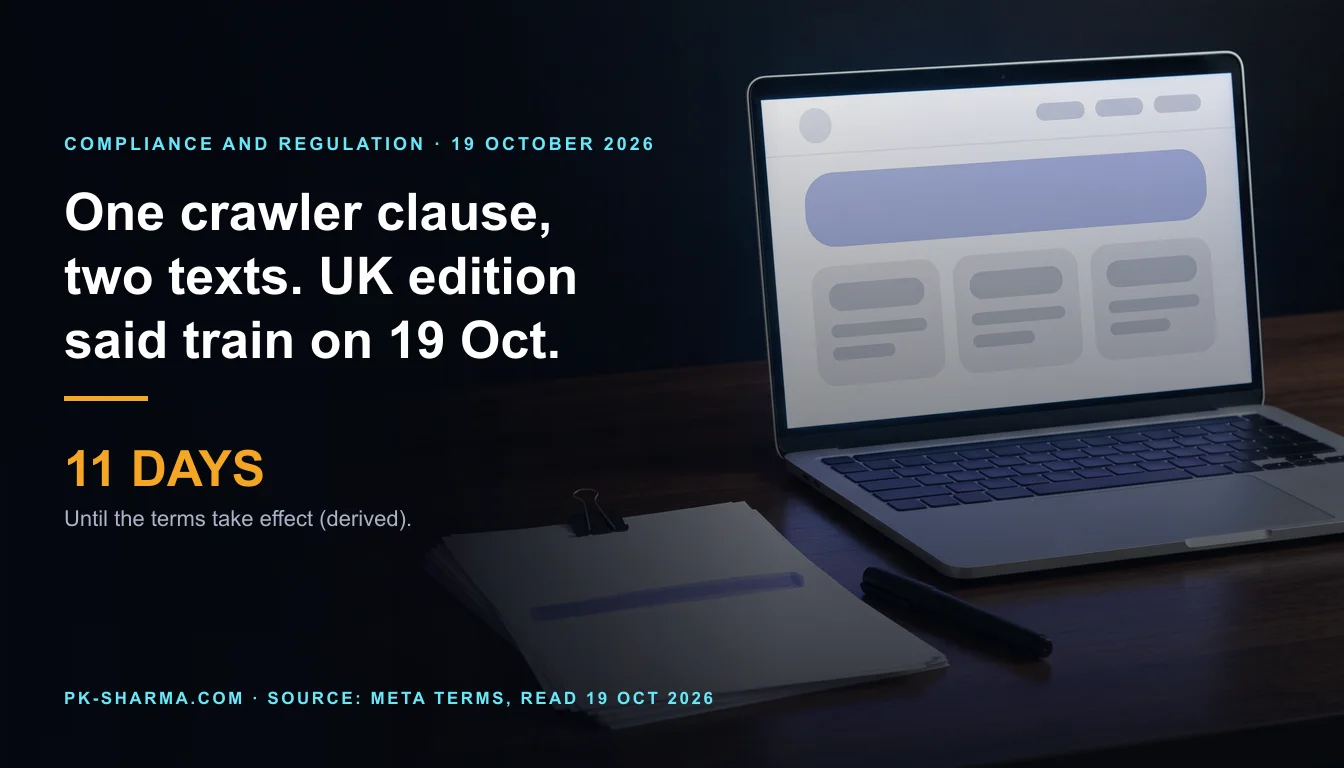
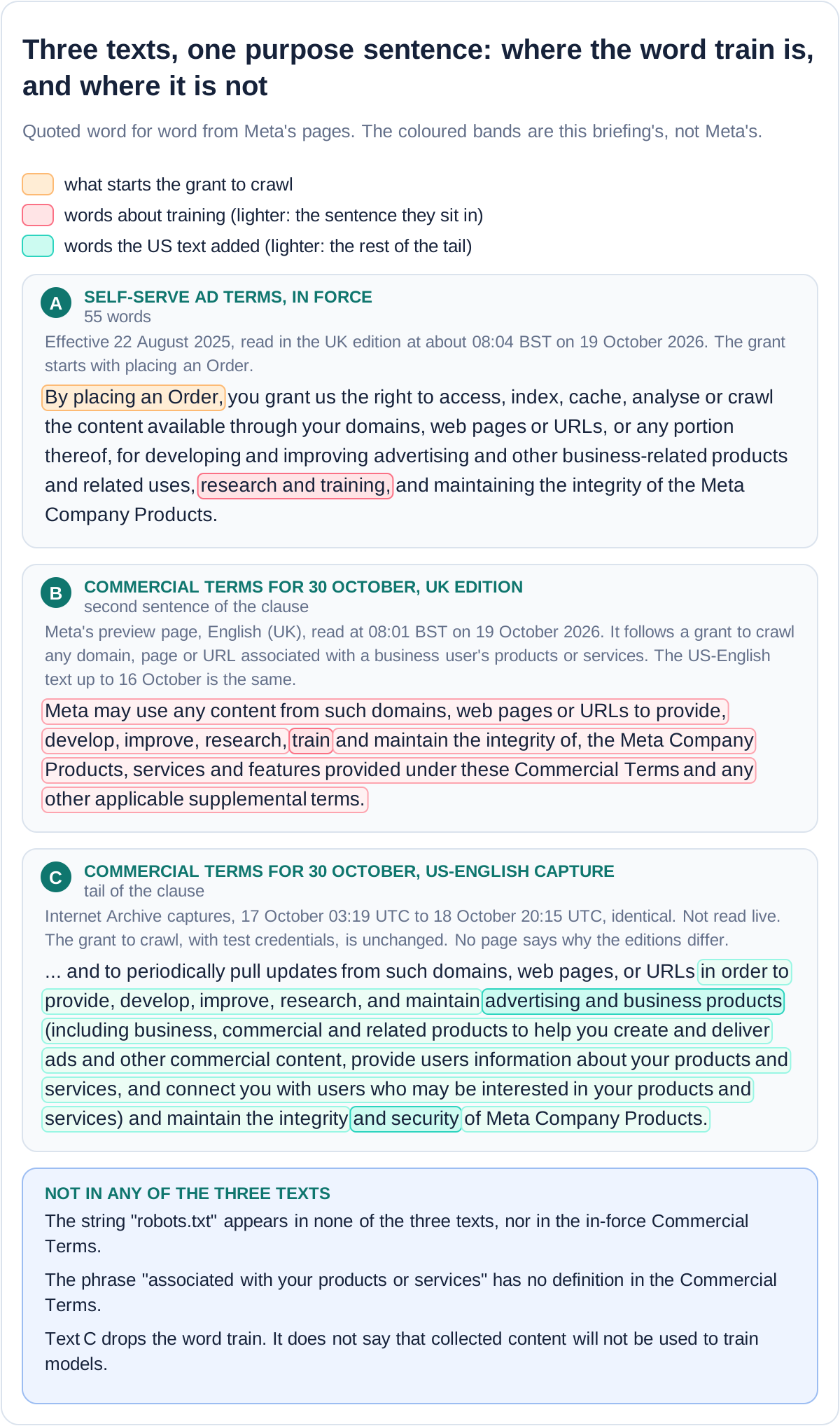
Meta's updated Commercial Terms take effect on 30 October 2026, which is 11 days after the Monday 19 October on which this briefing was read (derived). Meta's preview page, in its English (UK) edition, read at 08:01 BST on 19 October, carries a crawler clause of 127 words in two sentences (derived). In the first, the business authorises Meta, "or any entity acting on our behalf", to use automated software and "create test credentials" to crawl "the domains, web pages or URLs" associated with its products or services. In the second, "Meta may use any content" from them to "provide, develop, improve, research, train and maintain the integrity of" Meta Company Products, services and features. The Commercial Terms now in force, effective 6 March 2024, have no crawl wording: the words crawl and scrape do not occur in their 2,773 words (derived).
That is one text. A second exists. Internet Archive captures of the same preview page in its US-English edition, from 03:19 UTC on 17 October to 20:15 UTC on 18 October, do not contain the word "train" anywhere. In them the clause is a single sentence of 148 words (derived), and its purposes are narrowed to "advertising and business products" and the "integrity and security" of Meta Company Products. The change fell in an 11 hour window between two captures, 16:20 UTC on 16 October and 03:19 UTC on 17 October (derived). A Meta spokesperson told The Verge that Meta had "clarified that in the terms themselves". The UK edition read on 19 October still has the 16 October wording, and PPC Land reported the same of it on 18 October.
What this does not establish. The text is a grant of permission, not evidence of use: nothing read shows Meta crawling any particular site to train a model under it. It does not establish which edition a UK business will be shown on 30 October, whether Meta will edit the UK edition before then, or whether a court would enforce either wording. Meta says the update "does not change how Meta uses web crawlers". A site owner can test that against its own access logs.
How this was read. Meta's terms pages answer a command-line fetch with an error page, so the in-force Commercial Terms, the preview, the Self-Serve Ad Terms, the other Meta terms named below and Meta's developer page on its crawlers were read in a browser tab between 08:01 and about 08:12 BST on 19 October 2026 and saved as text. Nieman Lab's article answers a command-line fetch with a block page and was also read in a browser tab. The Verge, The Register, Search Engine Journal, PPC Land, the News/Media Alliance and the European Publishers Council were fetched directly, as were the UK legislation, gov.uk and ICO pages. The US-English edition could not be read live, so the archive's own captures, fetched directly, are the evidence for it. The UK preview was read again at 08:29 BST and was unchanged. Nothing was filled in, submitted or accepted, and the cookie notice on Meta's pages was left alone.
What the clause says, word for word, and what it leaves undefined
The clause is its own paragraph inside the first numbered section, "Licences and rights you provide Meta", straight after the licence over content a business uploads. In that licence paragraph the business already warrants that it owns or has secured all the rights needed to grant what it grants Meta under the Commercial Terms and supplemental terms, and the list of those rights now includes permission to "create derivative works".
The clause as read in Meta's English (UK) preview on 19 October 2026 at 08:01 BST, phrase by phrase. The right-hand column is what the text does not say.
| Wording in the clause | What the text says | What it leaves open |
|---|---|---|
| "you authorise us (or any entity acting on our behalf)" | Meta, or anyone acting for it, may do the crawling. | Who those agents are. No list. |
| "automated software" and "create test credentials" | The clause names web scrapers, bots, robots, spiders, crawlers and user agents, and lets Meta create "test credentials". | What test credentials are, and whether they reach content behind a login or a paywall. Meta declined to tell Nieman Lab. |
| "access, index, cache, analyse, collect, retrieve or crawl" | Seven verbs (derived). The Self-Serve Ad Terms sentence in force has five. | Any limit on volume, frequency or how long copies are kept. |
| "associated with your products or services, or ... made available through your or users' use of Meta Company Products and services" | Two prongs. The first is not tied to a domain the business owns. The second reaches what users make available. | A definition of "associated". The European Publishers Council reads the second prong as reaching an article a reader shares. |
| "periodically pull updates" | The permission is recurring. | How often, and for how long. |
| "Meta Company Products" | Defined on a separate page, not in the Commercial Terms. Meta's page on the Meta Products lists "AI at Meta". | The clause never says AI. The path to it is two links on Meta's own pages. |
| "train" (UK edition only) | One of six purposes (derived): provide, develop, improve, research, train, maintain the integrity of. | Which models, and any limit on the training. |
| Silence | No mention of robots.txt, an opt-out, paywalled content or personal data. | Whether any of those is carved out. |
Who is bound. The terms apply to anyone using Meta Company Products "for a business or commercial purpose". The listed purposes grew from six in the in-force text to eight (derived) and now include "marketing messages", "listing products", "creating or using a product catalogue" and "using any business product, such as Ads Manager or Meta Business Suite", beside "managing a Page" and the unchanged "regardless of the entity type". Consent is by use: continuing business use after notice of an update means agreeing to be bound by it. The exit sentence now reads "you may stop all access or use of our Products for business or commercial purposes"; in the in-force text the same sentence began "please stop". The only opt-out in the document is from the US arbitration provision, within 30 days of first accepting it. There is none for the crawl clause.
Where "AI at Meta" comes in. Nieman Lab reported that, elsewhere in Meta's terms, "AI at Meta" is defined as one of the products the crawled content may be used for. The path is this. The clause says "Meta Company Products". Meta's definitions page describes those as "the Meta Products and other websites, products or apps by the Meta Companies" that have their own terms, including WhatsApp. Meta's separate page headed "What are the Meta Products" lists "AI at Meta" among them, and lists "Business products, such as ads, Meta Business Tools and Meta Business Suite" as a separate line. The in-force text used the narrower defined term "Meta Products" 25 times; the 30 October text replaces it with "Meta Company Products" 34 times (derived), a set that takes in products under their own terms.
Counted against the 6 March 2024 text: 846 more words, and the crawl clause is the largest new paragraph
Both texts were read in the same edition, English (UK), a minute apart, so spelling does not distort the count. The in-force text is 2,773 words and the 30 October text is 3,619, an increase of 846 words or 30.5 per cent (derived). Compared word by word, 75.0 per cent of the new text is the old text kept in order; 905 words are new or reworded and 59 old words are gone (derived). Of the new text's 50 blocks, 20 are word for word unchanged, 19 are reworded and 11 are new (derived). No block of the old text is dropped.
What changed between the in-force Commercial Terms (effective 6 March 2024) and the 30 October preview, both English (UK) as read on 19 October 2026. Word counts are derived.
| Kind of change | What the text does | Words (derived) |
|---|---|---|
| New: the crawl clause | The authorisation to crawl, with test credentials, and the purposes. | 127: the largest new block, 14.0% of the 905 words added or reworded |
| New: AI features | Meta may offer AI features that "may make mistakes"; the business is "solely responsible for" the risks of those features and any resulting Content. A further new block makes the business "solely responsible for" third-party software it uses. | 113 and 36 |
| New: warranties disclaimed | Products are provided "AS IS" and all warranties are disclaimed "to the extent permitted by law". | 84 |
| New: supplemental terms listed | Five supplemental terms incorporated by reference: Self-serve Ad, Business Tools, Seller, Business Agents and Platform, and Meta AI Business Assistant. | 274 across six blocks |
| New: right to withdraw | Meta may "modify, limit, suspend or discontinue" commercial products, services and features "without prior notice or liability". | 28 |
| Reworded: scope and consent | Six business purposes become eight. "Meta Products" becomes "Meta Company Products". "Please stop" becomes "you may stop". | Throughout |
| Moved or renamed | "Third-party claims" becomes "Indemnification", with "to the extent permitted by law" added. A sentence on third parties moves out of the liability paragraph. Disputes move from Section 5 to 6, and Updates from 6 to 7. | Not counted |
The crawl clause is the longest new block, and it is not the only one that moves risk to the business: the AI features, "AS IS" and indemnity wording is new or reworded too. Meta's Business Help Centre notice is headed "Streamlining Meta's Commercial Terms, Product Catalogue Terms, Self-serve Ad Terms and Ad Creative Generative AI Terms". It says the Product Catalogue Terms are incorporated into the Commercial Terms and the Ad Creative Generative AI Terms into the Self-serve Ad Terms, and that the changes "reduce overlap between our agreements". The notice, read in full, does not mention crawling, scraping or training.
Meta says the crawl wording was already scattered across its terms. The text partly agrees
In Nieman Lab's paraphrase, a Meta public affairs spokesperson said crawling language had been scattered across different terms, including those on generative AI in ads, and that the update consolidates it in one place. The table tests that against each Meta document that mentions crawling, all read on 19 October 2026 in the UK edition.
Crawl wording in Meta's terms as read on 19 October 2026 (UK edition). Quotations are exact. The last row is the 30 October preview.
| Document and date shown | What triggers it and what it reaches | What Meta may do with the content |
|---|---|---|
| Commercial Terms in force, effective 6 March 2024 | No crawl wording. | Not applicable. |
| Self-Serve Ad Terms, effective 22 August 2025 | "By placing an Order": content "available through your domains, web pages or URLs". | "developing and improving advertising and other business-related products and related uses, research and training", and integrity. |
| Ad Creative Generative AI Terms, effective 6 May 2024 | URLs and domains "provided by you" for your ads. | "for your use in connection with your ads or for the purpose set forth in these Terms". |
| Product Catalogue Terms, no date shown | "If you provide a URL for product catalogue content". | "periodically pull updates from the URL to update the product catalogue content". |
| Seller Agreement, page shows "Last updated: 30 July 2021" | URLs "you provide" with Seller Content; "create test credentials" for URLs you provide. | Commerce Features and enforcement of Commerce Policies; update your Seller Content. |
| Meta Business Agents and Platform Terms, last updated 16 July 2026 | Domains "associated with your products or services"; crawled content "deemed Input". | Used for the Business Agents terms, your ads or your marketing messages; Content may improve "our artificial intelligence models and algorithms, including Business Agents". |
| Commercial Terms preview, effective 30 October 2026 | Any business or commercial use, including managing a Page. Domains "associated with" products or services, or "made available through your or users' use". | UK edition: "provide, develop, improve, research, train" and integrity of Meta Company Products, services and features. |
Reading the table. Meta is right that crawl wording existed: five documents carry crawl or pull-from-URL wording, and the Self-Serve Ad Terms name "research and training". The Business Agents terms deem crawled content to be "Input", define Input and Output together as "Content", and say Meta may use Content to improve its AI models. What differs is the trigger. Every earlier clause attaches to something a business chose: placing an ad Order, using an ad generative AI tool, supplying a catalogue URL, selling through Commerce, or using Business Agents. Most reach URLs the business provides. The new clause attaches to any business use, including managing a Page, and reaches domains merely "associated with" a business's products or services, or "made available through your or users' use" of Meta's products. On the documents read, a business that only manages a Page, and uses none of the products behind the other documents, had no crawl clause to accept before 30 October (inference). The revised Self-serve Ad Terms preview, in the UK edition, replaces the Order-based sentence with the same long clause, including "train".
Two editions, one effective date: what changed on 17 October and what did not
Meta's Commercial Terms preview in two editions. UK: read live at 08:01 BST on 19 October 2026. US-English: Internet Archive captures from 03:19 UTC on 17 October to 20:15 UTC on 18 October, identical to each other, not read live.
| Item | English (UK), 19 October | US-English, 17 and 18 October |
|---|---|---|
| The word "train" | Present, one of six purposes. | Absent from the whole text. |
| Purposes for crawled content | "provide, develop, improve, research, train and maintain the integrity of" Meta Company Products, services and features. | "provide, develop, improve, research, and maintain advertising and business products" and "maintain the integrity and security of Meta Company Products". |
| Shape of the clause | Two sentences, 127 words (derived). | One sentence, 148 words (derived). |
| Reach and method | Domains "associated with" products or services, or "made available through" use; test credentials; periodic pulls. | The same 86 words of grant, word for word apart from spelling and commas (derived). |
| The Section 1 licence paragraph | Meta may use Content to "provide, develop, improve, research and maintain" products, "services and features", with a sentence on business and commercial services. | Shortened to maintaining Meta Company Products; the services sentence is gone (192 words against 246 in the US text of 16 October, derived). |
| Self-Serve Ad Terms preview | The same long clause with "train". | Capture of 18 October 20:19 UTC: purposes narrowed, no "train". |
| "robots.txt" | Not mentioned. | Not mentioned. |
The sequence on the record, in UTC unless stated. 5 October 01:46: the earliest archive capture found of the preview page, already carrying the original wording, 10 days before the first report (derived). 15 October: Nieman Lab reports the clause. 16 October: a Meta spokesperson, in a post on X that PPC Land and Search Engine Journal report and this briefing did not read, calls the reports false and says the update is meant to "pull accurate information about products for sale on third-party websites". 16 October 16:20: the last archive capture with "train". 17 October 03:19: the first without it. 17 October 15:04: The Verge reports the sentence removed and quotes a Meta spokesperson. 18 October 20:15: the archive's last capture, unchanged. 18 October 20:44: PPC Land reads the UK edition and finds the sentence. 19 October 07:01 (08:01 BST): the same read here.
What the US-English text changes, and what it does not. It narrows the stated purposes. It leaves the reach and the method alone: the same domains, the same test credentials, the same recurring pulls. It drops "train", and it does not say that content collected under it will not be used to train models. "Develop, improve, research" remain, and "business products" is a class in which Meta's own supplemental terms place AI features it offers businesses, such as the Meta Business Agent and the Meta AI business assistant (inference from those terms). Whether developing those counts as training is not stated. The new purposes read close to Meta's own description, on its crawler page, of its ads crawler: improving "advertising and other business-related products and services" (inference). Meta's statement says the crawling terms "only applied to our ads and business products". As far as its purposes go, the US-English text matches that statement and the UK edition read on 19 October does not.
No page read explains why the editions differ. A staged rollout, an edit not yet carried across, or a cached edition are possible; none is established. The practical point is narrower. What a UK business accepts by continuing business use after 30 October is the text its account shows then, and until then two texts have been on Meta's preview pages in the same week.
Stated and not stated: the record, line by line
"Not stated" means not found in the primary pages read. It does not mean the information does not exist. Legal experts' views are views, not rulings.
What Meta's terms and statements put on the record, and what they do not. Sources: Meta's terms pages, Meta's crawler page, The Verge, Nieman Lab and The Register, as read on 16 to 19 October 2026.
| The question | Stated | Not stated |
|---|---|---|
| Who is bound? | Anyone using Meta Company Products "for a business or commercial purpose", including managing a Page, "regardless of the entity type". Continued use after notice means agreement. | Which Meta entity a UK business contracts with: the text names two for disputes and no UK court or law. How Meta decides which edition an account sees. |
| Can a business opt out? | No partial opt-out. "You may stop all access or use of our Products for business or commercial purposes." | Any way to exclude a site, a page or a class of content. |
| Does robots.txt govern? | Meta says content owners "can use robots.txt to signal their preferences" and its crawler page explains how to disallow crawlers. | Any mention of robots.txt in the terms. Whether the terms would prevail over a block. The spokesperson's "don't give us new rights that supersede those preferences" is a statement, not a clause. |
| Does Meta crawl for training today? | Meta's crawler page describes one crawler as used for "training foundation AI models or improving products by indexing content directly". | Which sites, how often, which models, and whether this clause changes any of it. |
| What are test credentials? | Meta may create them. | What they are, whether they pass a login or paywall. Meta declined to answer Nieman Lab. |
| What happens to content already collected? | Meta's crawler page says robots.txt changes can take up to 24 hours to apply. | Any wording on deletion, retention or removal from models if a crawler is blocked or a business leaves. |
| Which text applies on 30 October? | Both editions' preview pages give 30 October 2026 as the effective date. | Whether the UK edition will change first; any change notice; why the editions differ. |
| Is personal data covered? | A "Data restrictions" paragraph bars sending Meta data on children under 13 and sensitive categories. | Whether the clause reaches personal data on crawled pages. It is silent. |
| Would a court enforce it? | An attorney quoted by Nieman Lab: "It's not clear whether a court would enforce this, but publishers should assume that it would be enforceable." | Any ruling, and any regulator's statement. None was found. |
| Who owns the content crawled? | The business warrants it owns or has secured the rights it grants Meta. | How that works for contributors', agencies' and users' content on a site. |
robots.txt: what Meta's crawler page says, and what the terms leave open
Meta's developer page on its web crawlers, updated 21 May 2026 on the page and read on 19 October, lists five crawlers and says what each is for. It says Meta prefers robots.txt to non-standard formats such as NoAI tags. Crawlers are described here by purpose, as Meta describes them; the page gives the exact names, user agent strings and example rules.
The five crawlers on Meta's developer page, described by Meta's stated purpose. Quotations are exact.
| Crawler, by Meta's description | What the page says it is for | robots.txt on the page |
|---|---|---|
| The link-preview crawler | Fetches a page shared on Meta's apps to show its title, description and thumbnail. | "might bypass robots.txt when performing security or integrity checks". |
| The Meta AI search crawler | Improves Meta AI search result quality; allowing it "helps us cite and link to your content in Meta AI's responses". | No bypass stated. No block example shown. |
| The ads crawler | "improving advertising and other business-related products and services". | A block example is shown. |
| The training and indexing crawler | "training foundation AI models or improving products by indexing content directly". | A block example is shown. One crawler carries both purposes, so a site owner has one switch for both (derived reading). |
| The user-requested fetcher | Fetches single links at a user's request, including "evaluating and improving agentic AI capabilities". | "may bypass robots.txt rules". |
Three points, each on the page's own wording. Two of the five crawlers may bypass robots.txt. A block example is shown for two. Changes can take up to 24 hours to apply. And the page is about crawlers while the terms are about authority: the contract does not mention robots.txt. A law professor quoted by The Register said the language "doesn't expressly say that Meta will respect those robots.txt instructions". The UK government's March 2026 report, read below, calls the robots exclusion standard "voluntary".
Four friendly names, and whose interest they serve
A label that sounds like a safeguard is not one. Four appear in this story.
Labels in the story, where each appears and what the record shows.
| The label | Where it appears | What the record shows |
|---|---|---|
| "Consolidated" and "streamlining" | A Meta spokesperson, in Nieman Lab's paraphrase; Meta's Business Help Centre notice. | Crawl wording existed in five documents, each tied to a feature a business chose. The new clause is tied to any business use. The notice does not mention crawling. |
| "Clarified in the terms themselves" | A Meta spokesperson to The Verge, 17 October. | The US-English text narrows the purposes. The UK edition read on 19 October still says "train". The reach and test credentials are unchanged in both. |
| "Content owners can use robots.txt" | Meta spokespeople; Meta's crawler page. | Not in the contract. Two of five crawlers may bypass it by Meta's own wording. The UK government's report calls the standard voluntary. |
| "Test credentials" | The clause; also the Seller Agreement. | Not defined. A law professor told Nieman Lab it could let Meta "sign up as a fake user". Meta declined to say whether it would pass paywalls. In the Seller Agreement they apply to URLs the seller provides. |
Interests, one plain sentence each. Meta writes the terms, sells the advertising they govern and trains AI models, so it gains from a broad reading of its rights and from a narrow reading of its intent. The News/Media Alliance has said the terms "cannot be allowed to be implemented on October 30", and the European Publishers Council says it is writing formally to the European Commission; both represent publishers. The legal experts quoted by Nieman Lab reviewed the terms at Nieman Lab's request, and Nieman Lab says it holds a Meta business account itself. Method is separate from accusation: a company consolidating terms and a company enlarging its rights can write the same sentence, and the text, not either account, shows which.
The UK: what the pages say, and where each stops
This section says only what each page says. It is not legal advice. The Commercial Terms name California and Irish courts and laws for disputes outside the United States, and no UK court or law; what that means for a UK business is a question for a lawyer. The pages were read on 19 October 2026: section 29A of the 1988 Act, section 135 and section 136 of the 2025 Act, UK GDPR Article 5, Article 6 and Article 14, the government report and the ICO response.
UK pages as read on 19 October 2026, with where each stops. Quotations are short and exact.
| Page | What it says | Where it stops |
|---|---|---|
| Copyright, Designs and Patents Act 1988, section 29A (legislation.gov.uk; no known outstanding effects) | A copy made by a person with lawful access does not infringe if made for computational analysis "for the sole purpose of research for a non-commercial purpose". Using the copy for another purpose infringes "except where the use is authorised by the copyright owner". A contract term that restricts a copy the section allows is unenforceable "to the extent" it does so. | It is not about commercial AI development and gives Meta no commercial exception. It does not address a business authorising a crawler in a platform contract, or what a business can authorise for content it does not own. |
| Data (Use and Access) Act 2025, sections 135 and 136, and the government report of 18 March 2026 (gov.uk) | The Act required an impact assessment and a report within nine months of 19 June 2025, covering "the accessing of copyright works for that purpose (for example, by web crawlers)". The report came 272 days after Royal Assent (derived). It says a broad exception with opt-out is "no longer the government's preferred way forward", that reform will wait "until we are confident", and that technical standards stay "under review". It calls robots.txt "a voluntary standard but has been widely adopted by industry", and records Meta saying it supports robots.txt "as a widely used and understood standard". | A report and proposals, not a rule. It does not mention Meta's October terms. None of the statute pages read requires a crawler to obey robots.txt. |
| UK GDPR Articles 5, 6 and 14 (legislation.gov.uk, as amended) | Personal data must be "processed lawfully, fairly and in a transparent manner" and collected "for specified, explicit and legitimate purposes". Legitimate interests applies "except where such interests are overridden by the interests or fundamental rights and freedoms of the data subject". Where data "have not been obtained from the data subject" the controller must give the purposes, the source and the person's rights, unless that "is impossible or would involve a disproportionate effort". | These bind whoever decides why and how personal data on a crawled page is processed. They do not mention crawlers, and they do not say whether a website owner's authorisation changes the owner's own duties. |
| ICO response to its generative AI consultation series (ico.org.uk; page metadata 22 May 2026; scraping chapter 1 September 2025) | Legitimate interests "remains the sole available lawful basis for training generative AI models using web-scraped personal data based on current practices", and only if the developer passes the three-part test, including necessity. Web scraping for training is "a high-risk, invisible processing activity". The ICO is "aware that many controllers are not meeting their basic transparency obligations under article 14". Data protection applies to creative content only if it is personal data. The purposes of training and deploying a model "must be explicit and specific". Licences and terms of use help only if they hold data protection requirements that are met. | Addressed to developers, not website owners. It does not mention Meta's terms. A separate ICO page, with metadata dated 13 October 2026, repeats that model developers must identify a lawful basis, give transparency and enable rights. |
Reading these together (inference). The UK pages describe the position of the party that collects and of the rights holder. None describes a business signing a blanket authorisation inside a platform contract. For a UK business the practical exposure therefore looks contractual: what it agreed to, what it warranted, and what it promised to indemnify. The indemnity covers claims by "anyone" against Meta related to a business's "content or information on Facebook or other Meta Company Products or your use of any Meta Company Products". Whether a claim about content crawled from the business's own site falls inside those words is not stated, and is the kind of point to put to a lawyer. Not covered here: database rights, unfair contract terms law for business contracts and UK competition law. The US "tying" comparison in Nieman Lab is American. No CMA page read bears directly on this clause.
The ICO's wider scrutiny of AI developers is covered in this site's briefing on its 8 October 2026 report on ten AI developers, Meta among them. That report is about developers' data protection changes. It is not about this clause.
What to do before 30 October, in the order worth doing
Each step follows from something a source above says. None tells a business to stay or to leave; that is a decision for the people who run it, with advice.
Take this with you
Actions before 30 October 2026, in order
- Find every Meta business account the organisation holds (Pages, Groups, ad accounts, Business Suite, Instagram professional accounts, WhatsApp business accounts), who administers each, and who has authority to accept contract terms. Meta gave notice in Business Suite, and continued business use after notice counts as agreement.
- Save dated copies of the text your accounts show: the Commercial Terms and Self-serve Ad Terms, current and preview, in the edition your accounts use. Do it today, on 30 October and after any later change notice. Two editions already differ.
- List every site, subdomain, microsite, catalogue feed and URL associated with the business's products or services. The clause reaches anything "associated with" them or "made available through" use of Meta's products, and neither phrase is defined.
- Mark content on those sites that the business does not own or cannot license: contributors' work, wire copy, agency images, user comments and licensed archives. In the terms the business warrants that it owns or has secured the rights it grants, and its contracts with third parties may restrict what it can authorise.
- Check robots.txt against Meta's crawler page: which of the five crawlers are allowed or blocked, and what the page says each is for. Two may bypass robots.txt on Meta's own wording, and changes can take up to 24 hours. Keep a dated copy of the file.
- Ask what a free test account could reach: registration-walled, subscriber-only and paid content, and pages holding personal data such as comments, testimonials, staff and member pages. Meta declined to say whether test credentials would pass paywalls, and the ICO pages apply data protection where content is personal data.
- Decide and record: accept, narrow what Meta business use the organisation relies on, or stop business use before 30 October. The text offers no partial opt-out. Record who decided, when, on what advice, and what replaces the audience if accounts are closed.
- Write to Meta, through the webmasters contact on its crawler page and the business support route, asking which text applies to your account on 30 October, whether the 17 October purpose wording applies to the UK edition, and whether robots.txt overrides the clause. Keep the reply. Meta declined to answer Nieman Lab's questions.
- Publishers, agencies and rights holders: take legal advice before 30 October on enforceability, third-party rights, the indemnity wording and the California and Irish choice of law and courts. The experts quoted disagree about how far a court would go, and none has tested the text.
- Baseline your own access logs: count requests per week from the crawlers Meta's page lists, for four weeks before and after 30 October. Meta says the update does not change how it uses crawlers, and a site's own logs can check that.
What could not be verified, and how each source was read
- US-English edition. Not read live. Its wording rests on Internet Archive captures from 17 October 03:19 UTC to 18 October 20:15 UTC, taken from the archive's raw copies. The archive's timestamps are UTC. Which edition a given account is shown, and why the two differ, are not stated anywhere read.
- Meta's spokesperson on 16 October. The post on X was not read; it is known through PPC Land and Search Engine Journal. The 17 October statements were read in The Verge's own article.
- Meta's early October blog post. Nieman Lab says Meta alerted users in a blog post and in Business Suite. No such post was found. The Business Help Centre notice was read in full.
- Legal experts. Their views are reported by Nieman Lab and The Register and were not put to them. They are views, not rulings.
- Not read. MLex, Editor and Publisher, Windows Report and AI Weekly appeared in search results only. The ICO's 8 October report was not read directly; this site's earlier briefing on it was. No statement on this clause from a UK regulator, the News Media Association or the PPA was found in a limited search.
- Seller Agreement date. The UK page read shows "Last updated: 30 July 2021"; Search Engine Journal and a US-edition capture of 18 October give 26 May 2026. Not reconciled. The crawl wording is on the UK page.
- Word counts. Derived by counting runs of letters, digits, dollar signs and apostrophes in each text, lower-cased, with one stray two-word fragment on the UK in-force page ignored. Another method gives slightly different totals; the direction and the shares do not change.
- Time-stamped. UK pages read between 08:01 and about 08:12 BST on Monday 19 October 2026, and the preview re-read unchanged at 08:29 BST. Meta can change either edition at any hour, and a change notice before 30 October would overtake the UK-edition statements here.
The question that exposes the gap
On 30 October, will the text your business account shows say, in its own words, that Meta may not use content crawled from your sites to train its models, and has anyone in your organisation read that text rather than a spokesperson's description of it?
Key facts
Sources
- PrimaryMeta Commercial Terms preview, English (UK) edition, effective 30 October 2026, read in a browser tab at 08:01 BST on 19 October 2026: the crawler clause, the 'train' wording, the definitions, Section 7 on updates and consent. The vendor's own pageMeta Platformsaccessed 2026-10-19
- PrimaryMeta Commercial Terms in force, effective 6 March 2024, English (UK), read at 08:02 BST on 19 October 2026 with the notice of the update: the baseline with no crawl wordingMeta Platformsaccessed 2026-10-19
- PrimaryArchive capture of Meta's Commercial Terms preview, US-English, 17 October 2026 03:19 UTC: the first capture without the word 'train'. Identical to the capture of 18 October 20:15 UTCInternet Archiveaccessed 2026-10-19
- PrimaryArchive capture of Meta's Commercial Terms preview, US-English, 16 October 2026 16:20 UTC: the last capture with the original wording, the same as the 5 October captureInternet Archiveaccessed 2026-10-19
- PrimaryArchive capture of Meta's Commercial Terms preview, US-English, 18 October 2026 20:15 UTC: the last capture, unchanged from 17 OctoberInternet Archiveaccessed 2026-10-19
- PrimaryMeta Self-Serve Ad Terms in force, effective 22 August 2025, read on 19 October 2026: the 'By placing an Order' crawl sentence naming research and trainingMeta Platformsaccessed 2026-10-19
- PrimaryMeta Self-serve Ad Terms preview, effective 30 October 2026, English (UK), read on 19 October 2026: the same long crawl clause with 'train' in place of the Order sentenceMeta Platformsaccessed 2026-10-19
- PrimaryArchive capture of the Self-serve Ad Terms preview, US-English, 18 October 2026 20:19 UTC: the narrowed wording without 'train'Internet Archiveaccessed 2026-10-19
- PrimaryMeta Ad Creative Generative AI Terms, effective 6 May 2024, read on 19 October 2026: crawl wording for URLs the advertiser provides; to be incorporated into the Self-serve Ad TermsMeta Platformsaccessed 2026-10-19
- PrimaryMeta Product Catalogue Terms, read on 19 October 2026: periodic pulls from a catalogue URL the business provides; to be incorporated into the Commercial TermsMeta Platformsaccessed 2026-10-19
- PrimaryMeta Seller Agreement, UK page showing 'Last updated: 30 July 2021', read on 19 October 2026: crawl wording and test credentials for URLs the seller providesMeta Platformsaccessed 2026-10-19
- PrimaryMeta Business Agents and Platform Terms of Service, last updated 16 July 2026, read on 19 October 2026: domains associated with your products or services, crawled content deemed Input, Content used to improve AI modelsMeta Platformsaccessed 2026-10-19
- PrimaryMeta's page 'What are the Meta Products', read on 19 October 2026: lists 'AI at Meta' and business products as separate linesMeta Platformsaccessed 2026-10-19
- PrimaryMeta's page 'The Meta Company Products', read on 19 October 2026: the defined term used in the clauseMeta Platformsaccessed 2026-10-19
- PrimaryMeta Business Help Centre notice 'Streamlining Meta's Commercial Terms, Product Catalogue Terms, Self-serve Ad Terms and Ad Creative Generative AI Terms', read in full on 19 October 2026: no mention of crawling or trainingMeta Platformsaccessed 2026-10-19
- PrimaryMeta Web Crawlers developer page, updated 21 May 2026 on the page, read on 19 October 2026: five crawlers by purpose, which may bypass robots.txt, the 24 hour note. No agent strings are reproduced hereMeta Platformsaccessed 2026-10-19
- PrimaryNews/Media Alliance statement, 16 October 2026: 'outrageous and probably illegal'; no opt-out for business accounts. A publishers' trade body's own statementNews/Media Allianceaccessed 2026-10-19
- PrimaryEuropean Publishers Council statement, 16 October 2026: concern about content 'made available through your or users' use' and a formal letter to the European Commission. A publishers' trade body's own statementEuropean Publishers Councilaccessed 2026-10-19
- PrimaryCopyright, Designs and Patents Act 1988, section 29A: copies for text and data analysis for non-commercial research. No known outstanding effectslegislation.gov.ukaccessed 2026-10-19
- PrimaryData (Use and Access) Act 2025, section 135: the economic impact assessment duty, in force 20 August 2025legislation.gov.ukaccessed 2026-10-19
- PrimaryData (Use and Access) Act 2025, section 136: the report on copyright works in the development of AI systems, including web crawlerslegislation.gov.ukaccessed 2026-10-19
- PrimaryUK GDPR Article 5, principles, as amended: lawfulness, fairness and transparency and purpose limitationlegislation.gov.ukaccessed 2026-10-19
- PrimaryUK GDPR Article 6, lawfulness of processing, as amended: legitimate interests at 6(1)(f)legislation.gov.ukaccessed 2026-10-19
- PrimaryUK GDPR Article 14, information to be provided where data are not obtained from the data subject, as amendedlegislation.gov.ukaccessed 2026-10-19
- PrimaryReport on Copyright and Artificial Intelligence, March 2026, presented under section 136 of the Data (Use and Access) Act 2025: the government's approach, robots.txt as a voluntary standard, Meta's consultation responseDepartment for Science, Innovation and Technology, DCMS and the IPOaccessed 2026-10-19
- PrimaryPublication page for the report and impact assessment, published 18 March 2026GOV.UKaccessed 2026-10-19
- PrimaryICO response to its consultation series on generative AI, page metadata 22 May 2026: the overview and links to the chaptersInformation Commissioner's Officeaccessed 2026-10-19
- PrimaryICO chapter 'The lawful basis for web scraping to train generative AI models': legitimate interests as the sole available lawful basis, necessity, balancing, transparency. Read in fullInformation Commissioner's Officeaccessed 2026-10-19
- PrimaryICO chapter 'Purpose limitation in the generative AI lifecycle': purposes must be explicit and specific; contracts and terms of use. Read in fullInformation Commissioner's Officeaccessed 2026-10-19
- PrimaryICO 'Building trust and transparency into generative AI development', page metadata 13 October 2026: the ICO's message to foundation model developersInformation Commissioner's Officeaccessed 2026-10-19
- Reported byNieman Lab, 15 October 2026: the first report, three legal experts' views, the clause in full, Meta's emailed response and its declining to answer questions. Read in full in a browser tab; a command-line fetch is blockedNieman Labaccessed 2026-10-19
- Reported byThe Verge, 17 October 2026 15:04 UTC: reports the 'train' sentence removed and quotes a Meta spokesperson's statement that the terms were clarified. Read in fullThe Vergeaccessed 2026-10-19
- Reported byThe Register, 16 October 2026: the clause, a trade body's statement, a law professor's comments on procedure and on robots.txt; Meta did not respond to it. Read in fullThe Registeraccessed 2026-10-19
- Reported bySearch Engine Journal, 16 October 2026: the comparison with the Self-Serve Ad Terms, the Ad Creative Generative AI Terms and the Seller Agreement; reports a Meta spokesperson's post on X. Read in fullSearch Engine Journalaccessed 2026-10-19
- Reported byPPC Land, 16 October 2026: the clause in the UK edition, the in-force baseline, Meta's first statement. Read in fullPPC Landaccessed 2026-10-19
- Reported byPPC Land, 18 October 2026: reports the UK-edition preview still holding the sentence at 20:44 UTC. Read in fullPPC Landaccessed 2026-10-19