Intel D270 brings up to 480GB to a 350W PCIe design. Can it change local AI economics?
Intel’s memory-rich inference card could widen the options for small AI labs. But the Intel-branded board has 160GB, 480GB depends on partner designs, and UK pricing and desktop support remain unresolved.
By Parminder Kumar Sharma · · 10 min read
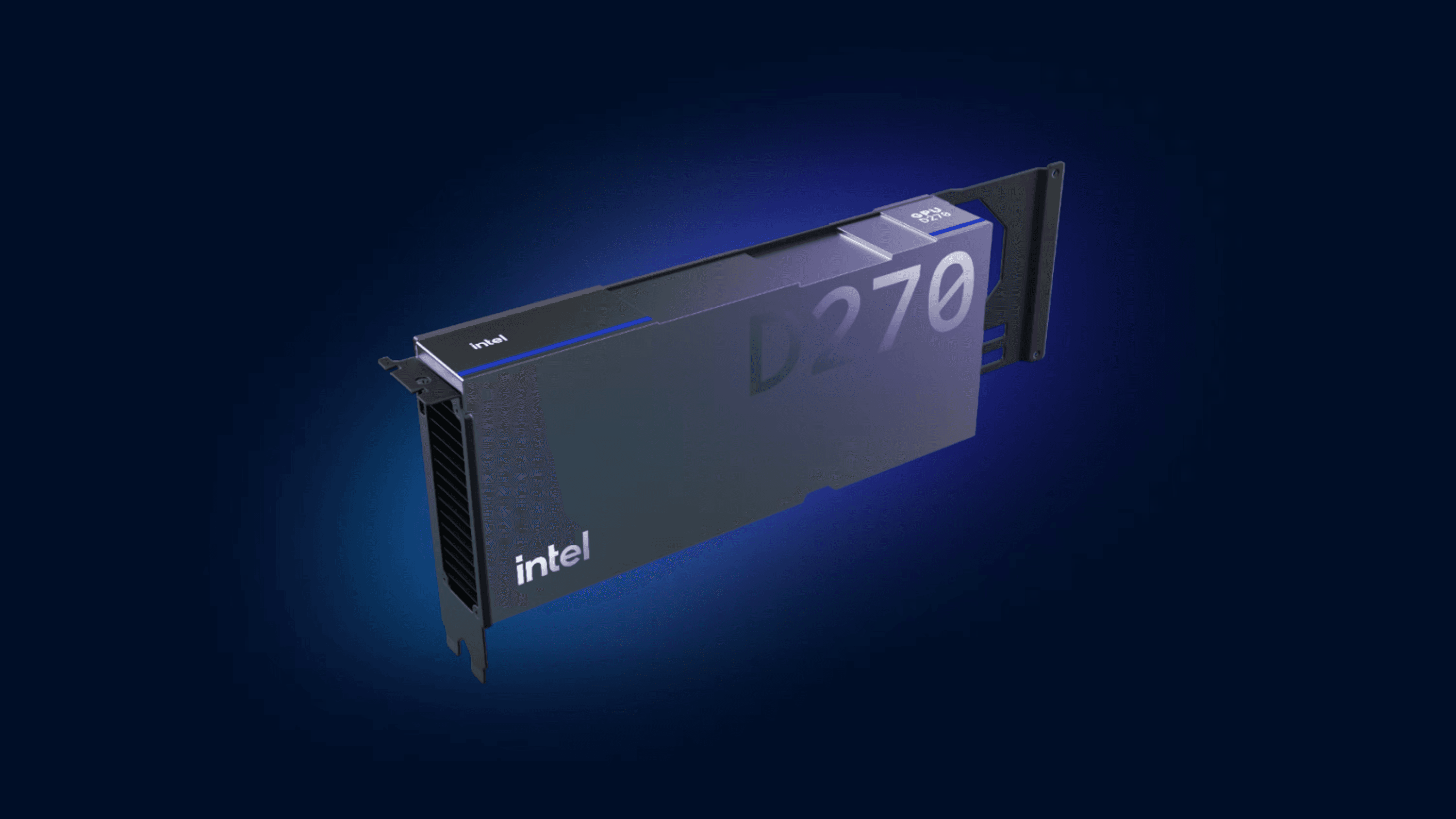
A capacity-first challenge to local AI costs
Intel disclosed new D-series inference GPU details at the OCP Global Summit on 13 October 2026. The D270 product page describes a PCIe 5.0, 350W accelerator with partner memory options up to 480GB. Customer sampling is underway. No UK retail price or retail delivery date was disclosed in the material checked. Intel OCP announcement and memory footnote. Intel D270 product specifications.
The opportunity for small labs is compelling: a model that fits in one accelerator can be easier to operate than one split across several devices. Whether that becomes a practical home-lab purchase depends on the finished board, its price, cooling and working software. This briefing assesses that possibility; it is not a test of a retail D270.
Main image credit: Intel Corporation. Promotional D270 card image supplied by the reader; not a photograph of newsroom testing.
Read the memory footnote before the headline
Manufacturer specifications and disclosed status, checked 13 October 2026. Maximum figures are not independent benchmarks.
| Item | Intel disclosure |
|---|---|
| Architecture | Xe3P; formerly code-named Crescent Island |
| Memory | Intel-branded: 160GB LPDDR5X. Partner designs: up to 480GB. |
| Memory bandwidth / compute | 1.5TB/s; 1.3 petaflops FP8, as advertised |
| Execution resources | 32 Xe3P cores; 256 XMX matrix engines |
| Interface / power | PCIe 5.0; 350W envelope |
| Cooling | Passive card cooling using server airflow |
| Commercial status | Customer sampling; UK price and retail date not disclosed |
Specification sources: Intel OCP announcement and memory footnote and Intel D270 product specifications. The product page identifies inference as its focus. Large memory alone does not establish suitability for full model training.
UK comparison: a £14,740.99 GPU and a £5,499 complete Mac
The reader’s concern about expensive 96GB alternatives is supported by current listings. Scan’s PNY retail RTX PRO 6000 Blackwell Workstation Edition, code LN157903, is £14,740.99 including VAT, with pre-order status and no ETA. Apple’s selected M5 Ultra Mac Studio with 96GB unified memory and 1TB SSD starts at £5,499. These were checked on 13 October; prices and stock can change. PNY RTX PRO 6000 retail price, LN157903. Mac Studio M5 Ultra, 96GB and 1TB configuration.
Purchases with different scopes. Dedicated GPU memory and whole-system unified memory are not interchangeable capacity guarantees.
| Product | Memory / scope | UK price checked | Comparison limit |
|---|---|---|---|
| Intel D270, Intel-branded | 160GB card | Not disclosed | Add host, cooling and integration costs. |
| D270 partner design maximum | Up to 480GB card | No priced UK SKU verified | Maximum option, not confirmed retail stock. |
| PNY RTX PRO 6000 Blackwell Workstation Edition | 96GB GDDR7 ECC card | £14,740.99 inc VAT | Card only; host required; pre-order, ETA unknown. |
| Mac Studio M5 Ultra, 30-core CPU / 64-core GPU | 96GB unified memory; 1TB SSD; complete computer | From £5,499 | Memory shared with macOS and applications. |
NVIDIA’s workstation datasheet specifies 1,792GB/s bandwidth and 600W board power, plus CUDA and display outputs. Intel’s advertised memory maximum is five times 96GB, but that is a capacity ratio, not a speed result. The Intel-branded 160GB option is about 1.67 times 96GB. RTX PRO 6000 Blackwell Workstation Edition datasheet.
A capacity-first buyer wants the required model to fit. A latency-first buyer wants an answer quickly. A production buyer wants repeatable service, support and manageable operating cost. Those can produce different winners from the same specification table. Buying five cards also does not create a free, seamless shared memory pool.
What extra memory can do: work through the weights first
The first estimate is arithmetic: weight storage in bytes ≈ parameter count × bits per weight ÷ 8. The following examples use decimal GB, idealised uniform precision and no extra storage. They are planning illustrations, not validated D270 model configurations.
Idealised model weights only. Excludes quantisation metadata, activations, KV cache, runtime buffers and reserved memory.
| Parameters | 16 bits / weight | 8 bits / weight | 4 bits / weight |
|---|---|---|---|
| 70 billion | 140GB | 70GB | 35GB |
| 120 billion | 240GB | 120GB | 60GB |
| 300 billion | 600GB | 300GB | 150GB |
A nominal 160GB card has only 10GB left after a hypothetical 300-billion-parameter model’s idealised 4-bit weights. That is before all overhead. A 480GB board would leave much more room, but the checkpoint format, quantisation quality and supported kernels still determine whether it runs usefully. A model loading successfully is only the beginning of a deployment test.
Context is the next budget. For a conventional transformer KV cache, a useful estimate is bytes ≈ 2 × layers × KV heads × head dimension × cached tokens × bytes per element × sequences. Architectures with latent attention, sliding windows or different cache layouts need their own calculation. Hugging Face documents the memory and performance trade-offs between cache strategies. Transformers cache strategies.
For a separate hypothetical architecture with 80 layers, eight KV heads, head dimension 128, 131,072 cached tokens and two-byte elements, one sequence uses 42,949,672,960 bytes: about 42.95GB, or 40GiB. Four independent sequences use about 171.8GB, before weights and other buffers. This example is not the specification of a particular 300B model. It shows why long context and concurrency can consume the space a weights-only estimate leaves free.
Capacity is valuable; measured response time decides usability
Intel publishes a single-card claim of models up to 300 billion parameters and over one trillion across eight GPUs. Treat those as vendor capability claims: the announcement does not provide a reproducible model, precision, context and latency combination for every case. Intel OCP announcement and memory footnote.
A useful evaluation separates prefill, the processing of the incoming prompt, from decode, the generation of new tokens. A document-heavy agent can spend much of its time reading; an interactive chat user also notices the delay between output tokens. Intel’s software blueprint discusses these distinct phases and the integration work needed around them. Open software blueprint for production AI.
Ask for time to first token, output tokens per second per user, total throughput, memory occupied and concurrent sessions at a stated latency. Hold the checkpoint, quantisation, prompt length and output length constant. An FP8 compute peak cannot be compared directly with an FP4 sparsity-based TOPS figure and presented as an application speed ranking.
The market-changing result would be an affordable, supported system that keeps the required workload resident and responds fast enough. A bigger memory number without acceptable latency would solve only part of the buyer’s problem.
PCIe opens a route for small labs; passive cooling needs a plan
A standard slot makes reuse of a suitable host conceivable. It does not qualify every desktop motherboard, power supply or case. Intel describes passive cooling in server racks. Unlike a card with its own active cooler, that design depends on chassis airflow. Intel D270 product specifications.
For a small lab, the credible route is a vendor-supported server or workstation integration with documented cooling and a validated software image. A home user should obtain those requirements before treating the card as a drop-in upgrade. This is a deployment assessment, not a claim that Intel has announced a consumer D270.
Take this with you
Before buying a card for a small lab
- Get the exact board model, fitted memory, UK VAT-inclusive quote, delivery date and warranty.
- Confirm physical dimensions, slot width, PCIe lane requirements and motherboard/firmware qualification with the supplier.
- Obtain specified airflow and thermal limits for the actual passive board and chassis.
- Confirm the power connector, cable requirements and whole-system PSU recommendation; 350W is not the entire PC draw.
- Request supported operating systems, driver/runtime versions and a working container for the intended model.
- Measure the real model, quantisation, context length, concurrency, wall power, temperatures and noise before committing to a larger rollout.
If the machine already runs a display GPU, ask how both devices fit, cool and share motherboard resources. Do not budget around unverified display outputs or assume a data-centre accelerator replaces a normal graphics card.
Open frameworks help, but verify the actual D270 stack
Intel’s software strategy centres on upstream integration, familiar serving tools and portability across its GPU range. Its own blueprint acknowledges that the discrete GPU stack is newer than its Xeon ecosystem. Open software blueprint for production AI.
vLLM’s installation documentation has a separate Intel XPU path with hardware, kernel and environment requirements. That is useful ecosystem evidence, but a generic Intel GPU listing does not certify a particular D270 driver, model or quantisation combination. Ask for a reproducible supported release rather than assuming an existing CUDA environment will transfer unchanged. GPU installation and Intel XPU requirements.
For a lab serving colleagues, assess restart behaviour, monitoring, model loading, queueing and access controls as well as the demo response. Record the time spent maintaining the stack. A lower hardware quote can be outweighed by integration work if the required path is fragile.
The price that matters is the usable system price
Intel has not supplied the missing retail number in the sources checked. There is therefore no evidence yet for a claim that a 480GB card is cheaper than the NVIDIA board or the complete Mac. The decision can still be made concrete with a quote and a measured workload.
At the advertised 350W envelope, running for eight hours corresponds to 0.35kW × 8h = 2.8kWh of card energy. Continuous operation at that envelope would be 8.4kWh/day. At a deliberately hypothetical tariff of £0.25/kWh, that is £2.10/day or £766.50/year, excluding the host, PSU losses and room cooling. Actual power varies; these are budgeting examples, not measured consumption.
For the 600W NVIDIA workstation board, the same maximum-envelope arithmetic gives 14.4kWh/day and £3.60/day at that assumed tariff. Neither calculation proves better energy efficiency: that requires equal completed work and measured wall energy. Other NVIDIA variants have different power limits.
For occasional experiments, compare ownership with rented compute over the hours actually used. For a continuously used private lab, count avoided rental charges alongside maintenance and energy. The useful metric is cost per completed acceptable task, with latency and output quality held to the lab’s requirements.
The rack announcement is a separate part of the story
OCP 2026 runs from 12 to 15 October in San Jose. Intel also presented Xeon-based rack infrastructure, with ORv3 designs among the ecosystem’s systems. The reader-supplied slide names ASRock Rack, ASUS, GIGABYTE, MiTAC, MSI and Supermicro. Its partner logos and availability wording should not be read as retail availability for every D270 memory option. OCP 2026 event and keynote schedule. Intel OCP announcement and memory footnote.

The rack slide illustrates the broader infrastructure programme. It does not establish D270 support for each pictured system. Small-lab buyers still need a product-specific compatibility and cooling statement.
What would make this a market-changing product?
Editorial assessment: the opportunity is a more accessible memory tier for local inference. Keeping a demanding model and its working context on one card could reduce the need to coordinate several accelerators or offload work. That could matter to independent developers, research groups and small businesses with private workloads.
Three pieces of evidence would strengthen the case: a priced and orderable high-memory board; a supported small-system integration; and independent results on useful models at realistic context lengths. Until then, D270 is a significant capacity proposition with an unresolved purchase case.
The question for Intel and its partners is concrete: what will a UK buyer pay for a supported system that runs their model, at their latency target, with the memory configuration actually fitted?
Sources
- PrimaryIntel OCP announcement and memory footnoteIntelaccessed 2026-10-13
- PrimaryIntel D270 product specificationsIntelaccessed 2026-10-13
- PrimaryOCP 2026 event and keynote scheduleIntelaccessed 2026-10-13
- PrimaryOpen software blueprint for production AIIntelaccessed 2026-10-13
- PrimaryRTX PRO 6000 Blackwell Workstation Edition datasheetNVIDIAaccessed 2026-10-13
- PrimaryPNY RTX PRO 6000 retail price, LN157903Scan UKaccessed 2026-10-13
- PrimaryMac Studio M5 Ultra, 96GB and 1TB configurationApple UKaccessed 2026-10-13
- PrimaryGPU installation and Intel XPU requirementsvLLMaccessed 2026-10-13
- PrimaryTransformers cache strategiesHugging Faceaccessed 2026-10-13