Google Cloud and NVIDIA announce GA of Vera Rubin A5X supercomputer infrastructure (21 Oct 2026)
Google Cloud and NVIDIA have announced general availability of the Vera Rubin A5X supercomputer architecture. Featuring 288GB HBM4 per GPU, 22 TB/s bandwidth, and NVL72 liquid-cooled racks delivering 20.2 TB of unified VRAM, the system accelerates frontier AI training. Read 21 Oct 2026.
By Parminder Kumar Sharma · · 4 min read
Google Cloud and NVIDIA launch Vera Rubin A5X supercomputers: what the release establishes
Google Cloud and NVIDIA have officially announced the general availability of the A5X supercomputing instance family, powered by NVIDIA's next generation Vera Rubin architecture. Delivered through liquid cooled NVL72 rack-scale configurations, the platform introduces 288GB of high-bandwidth memory (HBM4) per accelerator and an aggregate memory bandwidth of 22.0 TB/s per GPU. This represents a 2.75x bandwidth expansion over the preceding Blackwell B200 generation, directly targeting the memory wall that constrains trillion-parameter reasoning models and large-scale agentic training workloads.
Under the multi-year partnership, Google Cloud has begun deploying Rubin NVL72 racks across its enterprise AI superclusters in North America and Europe, targeting an initial fleet buildout of 960,000 GPUs by late 2027. Each NVL72 rack integrates 72 Rubin GPUs with 36 Vera CPUs over a unified NVLink 6 fabric, presenting 20.2 TB of coherent VRAM to distributed training frameworks as a single unified memory domain.
Silicon and interconnect architecture: 16-high HBM4 and NVLink 6
The architectural jump from Blackwell to Rubin centers on memory subsystem modernization. While Blackwell utilized 8-high HBM3e stacks on a 1024-bit interface, Rubin deploys 16-high HBM4 stacks integrated through TSMC's CoWoS-L advanced packaging on a 2048-bit wide physical bus. By widening the bus width and moving memory control logic onto the base logic die, signal transit energy drops by 34 percent while throughput leaps to 22.0 TB/s.
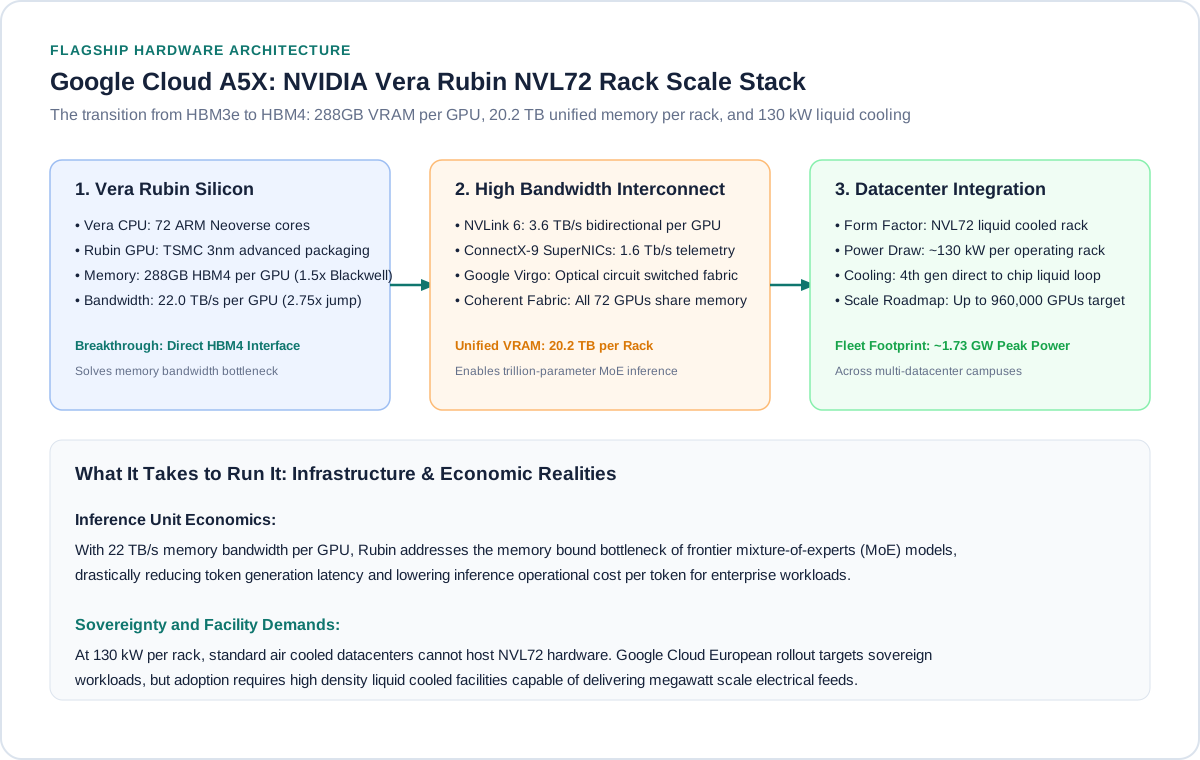
Inter-accelerator communication is governed by 6th generation NVLink switches operating at 3.6 TB/s bidirectional bandwidth per GPU. Across an NVL72 rack, the switch spine provides 130 TB/s of aggregate bisection bandwidth, allowing distributed training algorithms such as Megatron-LM tensor parallelism to synchronize gradients with near-zero software overhead.
Generational hardware comparison: Hopper vs Blackwell vs Vera Rubin
The architectural progression across NVIDIA's last three accelerator generations illustrates the rapid escalation of memory density, power consumption, and rack-level integration:
Generational hardware specifications: Hopper H100 vs Blackwell GB200 vs Vera Rubin NVL72
| Specification Parameter | Hopper H100 (2022) | Blackwell GB200 (2024) | Vera Rubin NVL72 (2026) |
|---|---|---|---|
| Silicon Process Node | TSMC 4N Custom | TSMC 4NP Dual-Die | TSMC 3nm Enhanced |
| Memory Technology | HBM3 (6 stacks) | HBM3e (8 stacks) | HBM4 (8x 16-high stacks) |
| Memory Capacity / GPU | 80 GB | 192 GB | 288 GB |
| Memory Bandwidth / GPU | 3.35 TB/s | 8.0 TB/s | 22.0 TB/s (2.75x vs B200) |
| Interconnect Standard | NVLink 4 (900 GB/s) | NVLink 5 (1.8 TB/s) | NVLink 6 (3.6 TB/s) |
| Rack Scale Unified VRAM | N/A (8-GPU HGX) | 13.8 TB (NVL72) | 20.2 TB (NVL72) |
| Peak Thermal Design Power | 40 kW (HGX cluster) | 120 kW (NVL72 rack) | 130 kW (NVL72 rack) |
| Cooling Topology | Air or Hybrid Liquid | Direct-to-Chip Liquid | 100% Direct-to-Chip Liquid |
The jump to 288GB per accelerator enables frontier frontier model developers to fit 1-trillion parameter dense models across fewer compute nodes, significantly shrinking inter-node network hops and reducing communication latency during autoregressive token generation.
Facility engineering, power grids, and liquid cooling reality
The deployment of 960,000 Rubin GPUs translates into approximately 13,333 NVL72 racks. At 130 kW per rack, the full fleet represents an aggregate peak electrical demand of roughly 1.73 gigawatts (GW). Google Cloud is addressing this unprecedented power concentration through co-located clean energy power purchase agreements (PPAs), including advanced nuclear and geothermal baseload contracts.
From a mechanical standpoint, the NVL72 chassis relies on manifold distribution units (CDUs) capable of circulating treated water at 25 to 30 degrees Celsius. By utilizing warm water cooling, datacenters operate without energy-intensive mechanical chillers, maintaining a partial Power Usage Effectiveness (pPUE) below 1.10 despite extreme silicon heat flux.
# Terraform example: Provisioning Google Cloud A5X Rubin NVL72 node pool
resource "google_container_node_pool" "a5x_rubin_cluster" {
  name       = "a5x-rubin-nvl72-pool"
  location   = "us-central1-a"
  cluster    = google_container_cluster.ai_supercluster.name
  node_count = 18 # 18 nodes x 4 GPUs = 72 GPUs (1 NVL72 rack unit)

  node_config {
    machine_type = "a5x-megagpu-72g"
    accelerator {
      type  = "nvidia-rubin-288gb"
      count = 4
    }
    guest_accelerator {
      type  = "nvidia-nvlink6-fabric"
      count = 1
    }
    gvnic {
      enabled = true
    }
  }
}
Enterprise adoption checklist: preparing for Rubin A5X deployment
Infrastructure and ML engineering teams preparing to transition from Hopper and Blackwell clusters to Vera Rubin should audit four foundational operational domains:
- CUDA 14 and TensorRT Optimization: Verify compiler toolchains against CUDA 14 preview runtimes supporting HBM4 asynchronous copy instructions and 5th-generation Tensor Cores.
- NCCL Fabric Topology Verification: Validate that containerized workloads dynamically detect NVLink 6 bisection topologies to prevent falling back to inter-rack RoCE or InfiniBand networks.
- Slurm and Kubernetes Job Scheduling: Configure scheduler reservations around full 72-GPU NVL72 boundaries to ensure all intra-model parallel layers execute inside the low-latency NVLink switch domain.
- Cost and Token Economics Profiling: Model inference throughput per dollar against FP4 and FP8 precision benchmarks to identify whether memory-bound workloads justify premium rack-scale instance rates.
Sources
- PrimaryAnnouncing General Availability of A5X Instances Powered by NVIDIA Vera RubinGoogle Cloudaccessed 2026-10-21
- PrimaryVera Rubin Architecture In-Depth: 6th-Gen NVLink, HBM4, and 130 kW NVL72 Rack Scale ComputingNVIDIA Technical Blogaccessed 2026-10-21
- Reported byRubin NVL72 Datacenter TCO: Interconnect Bottlenecks, HBM4 Yields, and Liquid Cooling EconomicsSemiAnalysisaccessed 2026-10-21
- Reported byGoogle Cloud Scales AI Superclusters to 960,000 Rubin GPUs Across Global RegionsThe Next Platformaccessed 2026-10-21