Singapore unveiled a data centre made of living human neurons. It is lower power only if you measure the cell and not the box, and no regulator cleanly owns it
The CL1 rack at NUS is a real and serious prototype. It also arrived wrapped in three claims the coverage repeated as one: lower power, a new frontier, and heading for cybersecurity use, and each hides a question the press release does not answer.
By Parminder Kumar Sharma · · 8 min read
What was actually unveiled
On 6 August 2026, at the NUS Life Sciences Institute, three parties showed a working prototype of what they call a Biological Data Centre. The Yong Loo Lin School of Medicine at the National University of Singapore is supplying the neurobiology, DayOne the data-centre infrastructure, and Cortical Labs of Melbourne the computing substrate. The announcement was published on 17 August 2026.
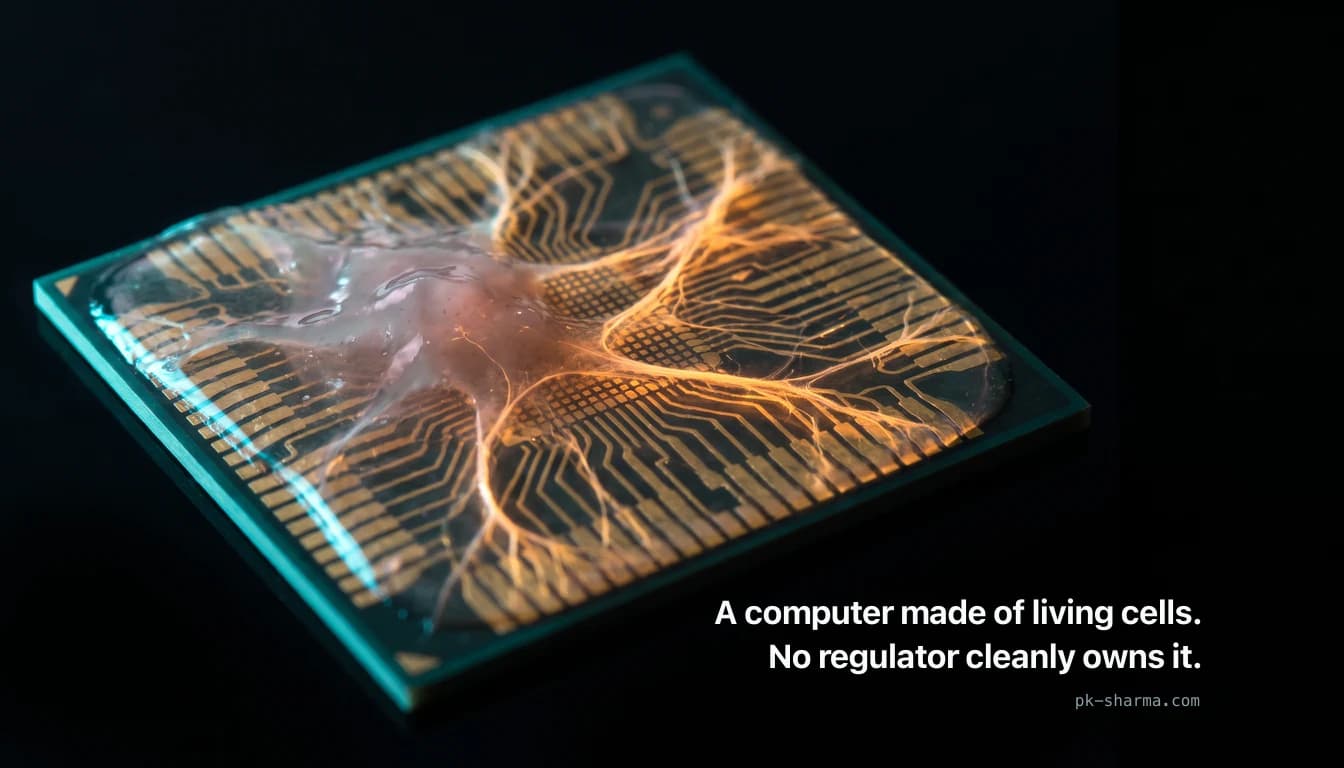
The substrate is the story. Instead of silicon alone, the prototype runs on living human neurons grown from stem cells, cultured on electrode arrays. The centrepiece is a 20-unit rack of Cortical Labs CL1 systems, described as the first independently operated biologically integrated server rack in the world. Each CL1, per Cortical Labs' 2025 specifications, hosts around 800,000 human neurons on a chip with a microelectrode array, keeps them alive for up to six months on a built-in life-support system, and sells for about US$35,000.
This is real, it is early, and it is a prototype. None of what follows disputes that the science is serious. Two things in the framing are worth reading more slowly than the press coverage did.
The Cortical Labs CL1, by the published numbers
- Attribute
- Human neurons per unit
- Figure
- About 800,000, grown from stem cells
- Attribute
- Interface
- Figure
- Silicon chip with a microelectrode array
- Attribute
- Neuron viability
- Figure
- Up to six months on built-in life support
- Attribute
- Power per unit
- Figure
- 850 to 1,000 watts
- Attribute
- Unit price
- Figure
- About US$35,000
- Attribute
- Prototype rack at NUS
- Figure
- 20 CL1 units, a biologically integrated server rack
- Attribute
- Classification used by the vendor
- Figure
- Synthetic Biological Intelligence
| Attribute | Figure |
|---|---|
| Human neurons per unit | About 800,000, grown from stem cells |
| Interface | Silicon chip with a microelectrode array |
| Neuron viability | Up to six months on built-in life support |
| Power per unit | 850 to 1,000 watts |
| Unit price | About US$35,000 |
| Prototype rack at NUS | 20 CL1 units, a biologically integrated server rack |
| Classification used by the vendor | Synthetic Biological Intelligence |
The efficiency claim is true of the neuron, not the box
The pitch for biological computing is power. DayOne's chief executive spoke of pursuing AI capacity and lower resource intensity together; the NUS release contrasts biological computing with "energy-intensive servers" and says brain-like cultures can run on "a fraction of the power" of digital computers.
The neurons can. A living cell computes on almost nothing, and for certain sparse, adaptive workloads the operations-per-joule story is genuinely interesting. But a CL1 is not a neuron. It is a sealed appliance that keeps 800,000 of them alive, which means holding a culture at body temperature, gassing it and perfusing it with media, continuously, or the computer dies. Published figures put the whole unit at 850 to 1,000 watts.
Where a CL1 unit's kilowatt goes
One CL1 unit, up to 1,000 watts
Cortical Labs CL1
The neurons compute on almost nothing. Keeping 800,000 of them alive is the load. A high-end datacentre GPU draws roughly 700 watts, so a single CL1 unit is in the same power class as the silicon it is offered as an efficient alternative to. The split shown is indicative; the total is the published figure and the point.
A high-end data-centre GPU draws roughly 700 watts. A single CL1 is in the same power class as the silicon it is offered as an alternative to, and the 20-unit rack at NUS therefore draws something on the order of 17 to 20 kilowatts before cooling. The efficiency argument is a claim about the neuron's computation. It is being heard as a claim about the data centre, and those are not the same claim. A data centre pays for wall power, and the wall power here is not a fraction of anything.
None of this makes the work pointless. It means the sustainability line needs its denominator attached before a procurement team quotes it.
The part no single regulator owns
The more interesting gap is not technical. A data centre made of living human neurons sits at the intersection of three regulatory regimes, and it was drafted into none of them.
Three regimes, and the case none was written for
Three regimes, and the case in the middle
Bioethics and stem-cell rules
Owns: The cells: their origin, donor consent, what may be done to them
Misses: Says nothing about compute, uptime or a commercial workload
AI governance
Owns: ISO 42001 and the EU AI Act, for the system and its risk
Misses: Both assume the system is software running on silicon
Data protection
Owns: Whatever data is processed, and by whom
Misses: Written for records in databases, not for living tissue
Owned cleanly by none of them
Living human neurons, grown from a donor’s stem cells, running a commercial AI workload for a paying customer, in a data centre, for profit. Each regime touches an edge of this. None was drafted for the middle.
Bioethics and stem-cell governance own the cells. They ask where the tissue came from, whether the donor consented to this use, and what may be done to it. They say nothing about uptime, tenancy or a commercial workload. AI governance, meaning ISO 42001 and the EU AI Act, owns the system and its risk, and both are written throughout for software running on hardware. Neither contemplates a substrate that is alive. Data protection owns whatever is processed, and it was built for records in databases.
Each regime touches an edge of a biological data centre. None was written for the middle, which is living human tissue, grown from a donor's stem cells, running a paying customer's AI workload for profit. This is not a fringe worry invented for a briefing. The peer-reviewed organoid-ethics literature states it directly: the science is moving faster than the ethics and the regulation, and existing stem-cell and animal-research frameworks give only partial guidance.
The consciousness question grabs the headlines and is the least urgent part. Current human neural cultures are very unlikely to be conscious, and honest researchers say so. The near-term issues are duller and realer: consent scope, who owns tissue derived from a named donor, what happens to the cells at end of contract, and which auditor signs off on any of it.
You cannot snapshot a living computer
For a security and assurance audience there is a third problem, and it is the one this site is placed to name.
Every control we use to trust a computing system assumes the system can be frozen and replayed. You snapshot a model, you re-run an input and get the same output, you diff two versions, you roll back a bad change. Reproducibility is the foundation the whole apparatus of AI assurance stands on.
Silicon compute, which assurance was built for
- Deterministic: the same input gives the same output
- Can be snapshotted, versioned, diffed and rolled back
- Adapts only when you retrain it, on your schedule
- An audit re-runs the system and checks the result
Biological compute, which it was not
- Non-deterministic: living tissue that varies run to run
- Cannot be frozen or copied; the state is the cells
- Adapts continuously and on its own, which is the selling point
- There is nothing to re-run, and the substrate ages and dies in six months
Cortical Labs names cybersecurity and fraud detection among its target use cases. Put a fraud model on a substrate that learns continuously, cannot be snapshotted, and is a different system next month than it is today, and you have a decision-maker you cannot audit in any sense a regulator currently recognises. That is not an argument against the technology. It is the assurance problem that arrives with it, and it has no answer yet.
What to ask, if this reaches a procurement conversation
Take this with you
For anyone offered biological compute, and it will be sooner than expected
- Ask for wall power per unit, not operations per joule. The second is where the efficiency case is real and the first is what your data-centre bill and sustainability report are measured in.
- Ask what happens to the cells at the end of the contract, and who owns tissue derived from a named donor. This is a consent and ownership question that software procurement has no template for.
- Ask how the system is audited when it cannot be snapshotted or re-run. If the answer is that outputs are checked statistically over time, understand that you are trusting a process, not verifying a result.
- Ask which regime the vendor believes governs the deployment, and get it in writing. If the honest answer is a bit of each and none cleanly, that is useful to know before, not after.
- Separate the science from the sales. The research is real and worth watching. The claim that it is a drop-in, lower-power, auditable alternative to a GPU rack is three claims, and today none of the three is established.
The position
Singapore has done something genuinely forward by hosting this, and the science under it deserves the attention it is getting. Growing human neurons and pairing them with rigorous engineering is a real achievement, and biological computing may well earn a place for the narrow workloads it suits.
The caution is not about the technology. It is that a prototype arrived this month wrapped in three claims that the coverage repeated as one. It is lower power, if you measure the neuron and not the box. It is a new computing frontier, which is true and also means no regulator cleanly owns it. And it is heading for commercial use in cybersecurity and fraud, which is precisely where not being able to audit the thing making the decision stops being interesting and starts being a liability.
This is the fifth artefact this fortnight that is accurate and answers a narrower question than the reader is asking, after a retention promise that was never about processing and the pieces before it. The pattern holds even at the edge of computing itself: the statement is true, and the question it settles is smaller than the one being asked.
Sources
- PrimaryNUS Medicine, DayOne and Cortical Labs Unveil Biological Data Center Prototype in SingaporeNUS Yong Loo Lin School of Medicineaccessed 2026-08-21
- PrimaryCL1 biological computer, product specificationsCortical Labsaccessed 2026-08-21
- PrimaryBeyond consciousness: ethical, legal and social issues in human brain organoid research and applicationBiology and Philosophy, via ScienceDirectaccessed 2026-08-21