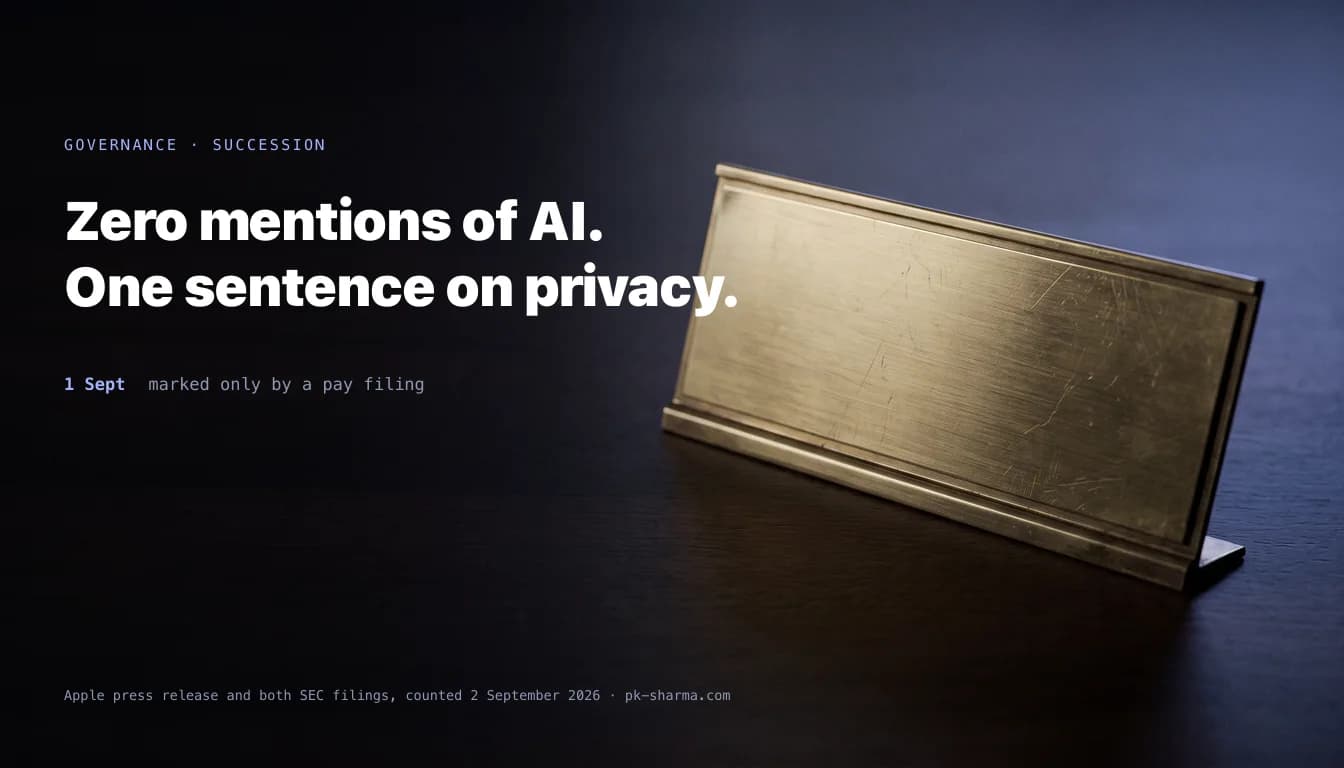
Apple changed chief executive on 1 September. Across all three succession documents, artificial intelligence is mentioned zero times.
The only thing Apple filed on the day was a compensation amendment. Privacy appears in one sentence, in the past tense, about the man who is leaving.
By Parminder Kumar Sharma · · 7 min read
John Ternus became chief executive of Apple on 1 September 2026. The company published nothing to mark it.
Apple's Newsroom feed has not carried an item since 27 August, an Apple Arcade update. The only document Apple filed on the day the transition took effect was an amended Form 8-K disclosing what the incoming and outgoing chief executives will be paid.
That is not a scandal, and this briefing is not going to pretend it is one. The transition was announced in full on 20 April and there is nothing hidden about it. But it does make the pay filing the most substantive thing Apple said on the day, and it invites the obvious question: what, in the whole succession record, did Apple commit to?
The answer, counted rather than asserted, is very little of what a security or governance reader would look for.
What the succession documents do not say
What actually changed
The board appointed Ternus on 17 April. Apple announced it on 20 April, in a press release whose operative sentence is this:
"Apple announced that Tim Cook will become executive chairman of Apple's board of directors and John Ternus, senior vice president of Hardware Engineering, will become Apple's next chief executive officer effective on September 1, 2026. The transition, which was approved unanimously by the Board of Directors, follows a thoughtful, long-term succession planning process."
Three roles moved. Ternus becomes chief executive and joins the board. Cook becomes executive chairman, with a remit stated narrowly: he "will assist with certain aspects of the company, including engaging with policymakers around the world". Arthur Levinson, non-executive chairman for fifteen years, becomes lead independent director.
Ternus is 50, joined Apple in 2001, and has led Hardware Engineering since 2021. The press release describes his work in those terms: iPad, AirPods, iPhone, Mac, reliability, durability, materials. No software, services, security or AI remit is named anywhere in his biography.
His own quote commits to values rather than direction: "I am humbled to step into this role, and I promise to lead with the values and vision that have come to define this special place for half a century."
The only filing on the day was about money
The Form 8-K/A landed on 1 September under Item 5.02. Its stated purpose, verbatim, is "to disclose John Ternus' new compensation arrangement in connection with his appointment to the role of CEO, and Tim Cook's new compensation arrangement in connection with his appointment to the role of Executive Chair". It closes the door on anything else: "Other than as set forth in this Form 8-K/A, all information in the Original Form 8-K remains unchanged."
What Apple disclosed on the day the transition took effect
| Person | Salary | Equity, target value | How it vests |
|---|---|---|---|
| John Ternus, CEO | $3 million from 1 September 2026 | $55 million annual award for fiscal 2027, plus a $2.5 million prorated award for fiscal 2026 service | 75% performance-based on total shareholder return relative to the S&P 500, 25% time-based over four years |
| Tim Cook, Executive Chair | $2 million from 26 September 2026 | $45 million for fiscal 2027 | Half performance-based, half time-based, with a retirement-vesting provision after the first anniversary |
What the documents do not say
Across the press release and both filings, counted on 2 September: artificial intelligence appears zero times. Apple Intelligence, zero. Siri, zero. Machine learning, zero. Encryption, zero. Substantive references to regulation, zero, once the two instances of "Regulation S-K" in legal boilerplate are set aside.
Privacy and security appear in exactly one sentence, in the press release, and it is retrospective and about the outgoing chief executive: Cook "has long advocated for privacy as a fundamental human right, has made privacy and security imperative at Apple, setting a standard for user protection that continues to set the company apart from the rest of the technology industry".
Read that sentence carefully. It is a tribute, in the past tense, to a man leaving the job. It contains no forward commitment, and no privacy or security portfolio is assigned to Ternus, to Cook in his new role, or to anyone else.
Why a security reader should care
Apple is the only company at its scale whose commercial position rests substantially on a security property. Not on having the best model, or the cheapest compute, but on the claim that data on the device stays on the device and that the company will fight in court to keep it that way. Cook made that claim personally and repeatedly, and the press release credits him with it in those words.
The question a governance reader has is whether that claim is institutional or personal. A succession is the one moment that would answer it, because it is when a company says out loud what it intends to carry forward. Apple did not answer it. The word that made the company distinctive appears once, attached to the man who is leaving.
The second reason is Cook's stated continuing remit. He will "assist with certain aspects of the company, including engaging with policymakers around the world". Apple is simultaneously under pressure from the Digital Markets Act, from the UK's Investigatory Powers regime, and from several US state and federal proceedings. Keeping the outgoing chief executive on the policy relationships while the incoming one is a hardware engineer is a legible arrangement, and it is not one Apple explains.
What is not a finding
Three things this piece is not claiming, because the temptation to overreach here is obvious.
It is not claiming Apple is abandoning privacy. Nothing in any of these documents suggests that, and Apple publishes a great deal about privacy elsewhere.
It is not claiming Ternus is unqualified for the security or AI parts of the job. He may be excellent at both. The documents simply do not address it, which is a fact about the documents.
And it is not claiming concealment. The transition was announced four and a half months in advance, filed correctly under Item 5.02 on the day of the board decision, and amended on the effective date exactly as the rules require. The disclosure is orderly. It is the content that is thin.
The pattern
This is the second time in a week that the authoritative record and the public one have told different stories about the same event. The Department of Justice published the same announcement twice and corrected only one copy, leaving two live documents that disagree. Apple published its succession in April and marked its arrival with a compensation amendment, so a reader looking at Newsroom on 1 September would have seen an Apple Arcade item and nothing else.
In both cases nothing was hidden and nothing was false. In both cases the version most people will read is not the version that carries the weight. If your organisation relies on vendor communications for situational awareness, the filings are frequently where the actual information is, and almost nobody in a security function reads them.
Take this with you
Worth doing, if Apple is in your supply chain
- Read the Form 8-K/A rather than the coverage. It is four pages, it is the authoritative record of who now runs the company, and it contains the only new information Apple published on 1 September.
- Do not assume continuity of posture from continuity of brand. The privacy position is currently credited in Apple’s own words to a named individual who has moved to a policy-facing role. That may hold perfectly well institutionally, and it has not been restated.
- Watch where the Hardware Engineering role lands. No successor to Ternus has been named in any of these documents, and for a company whose security story is silicon and on-device processing, that appointment carries more signal than the chief executive one.
- Track Cook’s policy remit as a separate thing from the chief executive change. He retains engagement with policymakers worldwide, which is the surface where the Digital Markets Act and the UK Investigatory Powers questions will actually be decided.
- Add the vendor’s filings to whatever you use for supplier monitoring. On the evidence of this week, the filing is where the substance is and the newsroom is where the marketing is.
The position
The most striking thing about Apple's succession is how ordinary the paperwork is. It is correct, timely and complete on every point the rules require, and silent on every point a reader would actually want.
That is a reasonable choice for a company that prefers to announce things when it has something to show. It also means that for now the answer to whether Apple's privacy commitment survives its author is simply not on the record, and the strongest available evidence is a sentence in the past tense.
Sources
- PrimaryTim Cook to become Apple Executive Chairman, John Ternus to become Apple CEO, press release dated 20 April 2026Appleaccessed 2026-09-02
- PrimaryApple Inc. Form 8-K, Item 5.02, filed 20 April 2026, reporting the board’s appointment of 17 April 2026US Securities and Exchange Commissionaccessed 2026-09-02
- PrimaryApple Inc. Form 8-K/A, Item 5.02, filed 1 September 2026, disclosing both compensation arrangementsUS Securities and Exchange Commissionaccessed 2026-09-02
- PrimaryApple Newsroom feed, whose most recent entry when checked was dated 27 August 2026Appleaccessed 2026-09-02
- PrimaryApple Leadership, listing Ternus as CEO, Cook as executive chair and Levinson as lead independent directorAppleaccessed 2026-09-02