Anthropic has opened a wet lab for AI-directed biology. The approval boundary is not public
Reuters reports that Claude will direct robotic experiments with limited human intervention. Anthropic has separately published detailed access controls for external life-science users, but not the operating controls for its own physical laboratory.
By Parminder Kumar Sharma · · 5 min read
What is confirmed and what is reported
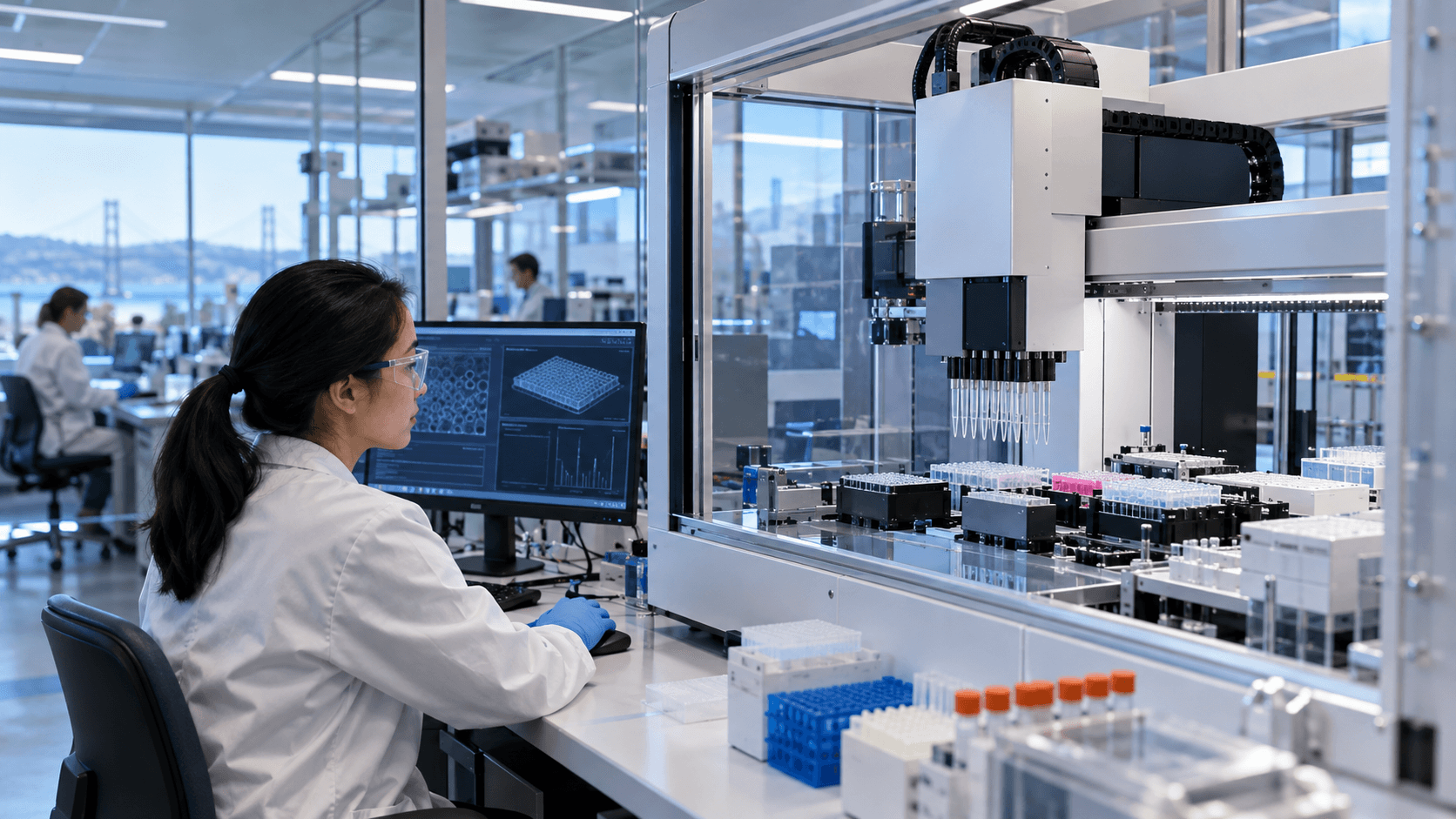
Reuters reported that Anthropic has established a wet laboratory in the San Francisco Bay Area. Anthropic's head of life sciences, Eric Kauderer-Abrams, confirmed the laboratory in an interview. Reuters cited people familiar with the work who said the company wants to test how Claude can direct robotic units to carry out experiments with limited human intervention.
That description establishes a physical research programme. It does not establish that Claude operates the laboratory autonomously, that high-risk experiments are being run, or that the site is a drug-manufacturing facility. Anthropic told Reuters that the laboratory is focused on fundamental biology rather than specifically on drug discovery. The article says people remain involved. Details such as the organisms, containment level, instrument permissions, approval process, stopping conditions and audit record have not been published.
Those missing details matter because a model connected to instruments crosses a different boundary from a model suggesting hypotheses in chat. A mistaken answer on screen can be rejected. An instruction executed by a liquid handler changes physical samples, consumes materials and may create biological output.
Evidence boundary for the wet lab
| Statement | Status | Source boundary |
|---|---|---|
| A Bay Area wet lab exists | Confirmed | Anthropic executive confirmed it to Reuters |
| Claude will direct robotic experiments | Reported objective | Reuters cites people familiar with the work |
| Human intervention is limited | Reported design | The exact human approval points are not public |
| The lab is for fundamental biology | Anthropic's stated focus | Not described as specifically a drug-discovery lab |
| Containment, organisms and instrument limits | Not published | No public laboratory operating protocol located |
The software and access stack already exists
The wet lab fits a broader Anthropic programme. Claude Science is an agentic workbench that can query more than 60 scientific databases, connect to specialist models through NVIDIA BioNeMo, run code and preserve auditable artefacts. Anthropic says researchers have used it for single-cell analysis, CRISPR screen design, protein structure prediction and cheminformatics.
The company has also previewed a Model Hardware Standard intended to let AI agents interact with programmable machines through common drivers. Together, these pieces create a plausible chain from literature and data, through hypothesis and protocol, to instrument control and result interpretation. That chain can reduce the repetitive work between an idea and an experiment. It also creates several independent control points that should not be collapsed into a single permission called “human oversight”.
A defensible experiment-control chain
| Stage | AI may assist with | Control needed before execution |
|---|---|---|
| Hypothesis | Literature synthesis and candidate generation | Scientific rationale, scope and dual-use review |
| Protocol | Steps, volumes, timing and instrument translation | Validated protocol, permitted ranges and incompatibility checks |
| Scheduling | Queueing instruments and materials | Identity, inventory and containment verification |
| Execution | Commands to robotic equipment | Human or policy gate for irreversible and high-risk actions |
| Observation | Quality control and anomaly detection | Independent sensors, stop conditions and retained raw data |
| Interpretation | Statistics and follow-up recommendations | Reproducibility review and approval of the next experiment |
Anthropic publishes more detail for customers than for its own lab
One day before the Reuters report, Anthropic launched a Life Sciences Verification Program. Applicants are assessed for research credentials, security standards and ethical oversight. Standard Use grants relax biology classifiers for general research. Project-specific High-risk Use grants remove life-science request blocks, require more vetting and must be renewed every six months. Cyber safeguards remain.
Anthropic names three threat models: account compromise, insiders and agents taking unintended dangerous actions. It monitors programme traffic against each organisation's declared use case. Monitoring moves from immediate blocking toward offline pattern analysis, with 30 days of retention for flagged activity. Anthropic says the retained data is compartmentalised and unavailable to its life-sciences research teams.
This is a substantive access-control model for external users. The public material does not say whether the same grant boundaries, retention period, independent review or misuse monitoring apply when Anthropic's own model directs Anthropic's own robots. The internal laboratory may have stronger controls. The point is that readers cannot currently assess them.
What a public control note should answer
Take this with you
Minimum questions for AI-directed wet-lab work
- Which organisms, materials, instruments and containment levels are in scope
- Which model outputs require human approval before a robot receives a command
- Which parameters are hard-limited outside the model and cannot be overridden by a prompt
- How the system detects contaminated samples, anomalous readings and unsafe sequences
- Whether a separate reviewer checks protocols proposed by the acting model
- How prompts, model versions, tool calls, instrument commands and raw results are retained
- Who can stop a run, quarantine material and investigate an unexpected result
- Which independent biosafety or institutional body reviews the programme
Key facts
Sources
- PrimaryIntroducing the Life Sciences Verification ProgramAnthropicaccessed 2026-09-20
- PrimaryClaude Science, an AI workbench for scientistsAnthropicaccessed 2026-09-20
- PrimaryPreviewing the Model Hardware StandardAnthropicaccessed 2026-09-20
- Reported byAnthropic quietly sets up biology lab as it ramps AI drug programReutersaccessed 2026-09-20