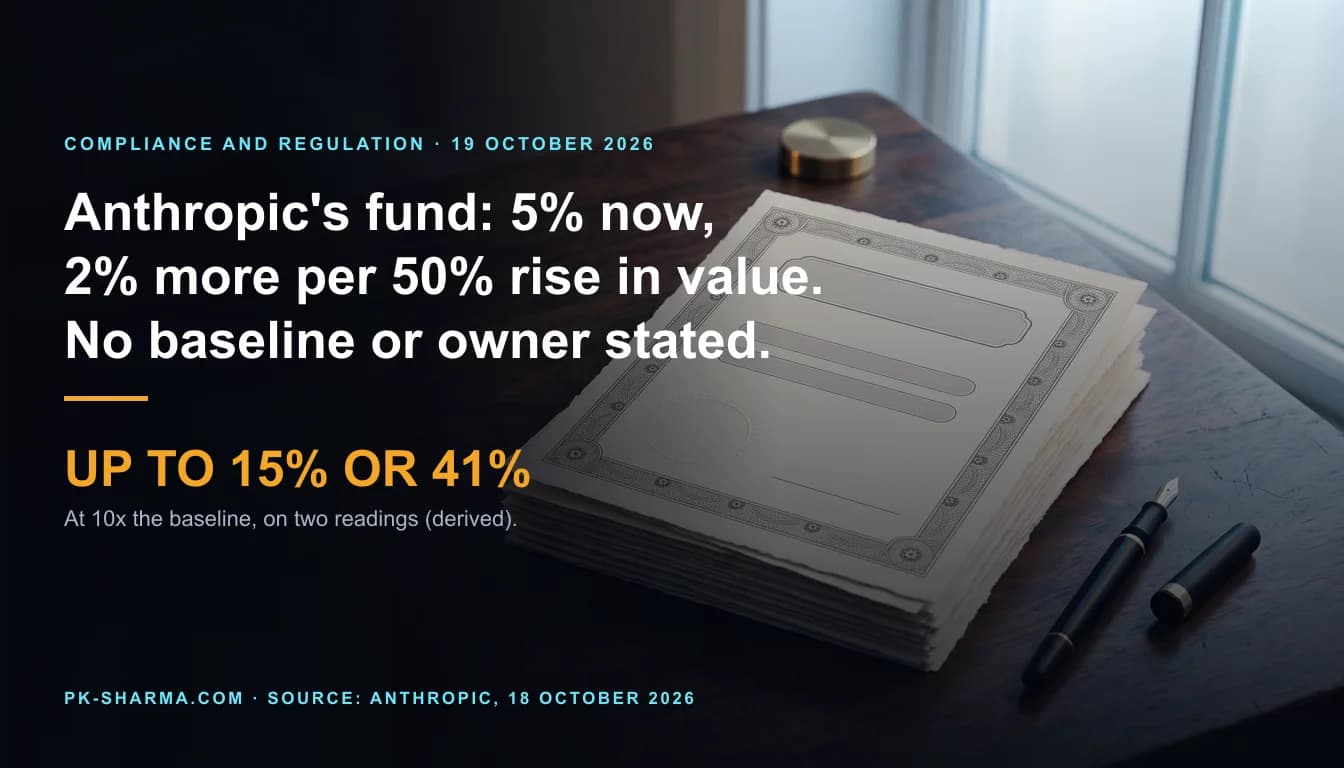
Anthropic's fund: 5% plus 2% per 50% rise reads as up to 15% or 41% at 10x, no baseline or owner stated
Anthropic says it will commit 5% of its shares to a wholly-owned LLC, with 2% more at the board's discretion for every 50% rise in value above a baseline. The post gives no baseline, cap, share class or owner, and its wording supports two schedules.
By Parminder Kumar Sharma · · 27 min read
Two readings of one sentence: up to 15% or up to 41% at ten times a baseline the post does not give
Anthropic's post of 18 October 2026, "Investing in the public benefit", says that, "Subject to stockholder approval", 5% of the company's shares "will be committed today" to the Anthropic Public Benefit Fund, "with an additional 2% added at the board's discretion for every 50% increase in the company's value above a set baseline". That one sentence supports two schedules. If each 50% increase compounds on the last, the Fund's stake steps up when the company's value reaches 1.5, 2.25, 3.375, 5.06 and 7.59 times the baseline. If each step is a further half of the baseline, it steps up at 1.5, 2, 2.5, 3 times and on. At ten times the baseline the Fund would hold up to 15% on the first reading and up to 41% on the second, if the board adds every step it may add (all derived). The post does not say which reading it means, gives no baseline and states no cap.
What that does not establish is most of what a reader would want to check. No share is shown to have moved: the commitment depends on a stockholder approval the post does not describe, "committed" is not defined, and the post says "We're establishing the Anthropic Public Benefit Fund" rather than that it exists. It names no baseline, no cap, no share class, no owner of the "wholly-owned" LLC, and no date for the structure and governance it promises to share "In the coming months".
This briefing read the post in full in a browser on Monday 19 October 2026, from 07:57 BST. Its page data gives a publication time of 16:49 UTC (17:49 BST) on 18 October and a modification time of 18:05 UTC (19:05 BST), 75.5 minutes later (derived); no change is marked on the page, and the wording quoted here is the version read on 19 October. Anthropic's interest, in one sentence: it wrote the announcement about its own governance arrangements, and the BBC reports that it comes as the company lays the ground for a possible stock-market listing, which the post does not mention. The BBC and CNBC reports were read as secondary sources and are compared with the post in a later section. No investment advice is given or implied: the arithmetic shows what the wording allows, not what Anthropic's shares are worth or will be.
The escalator written out, to scale
The table and the chart apply the post's wording two ways, with the baseline left as a multiple because the post gives none. Reading A treats each further 50% as a 50% rise on the previous step, so steps fall at 1.5 to the power of k times the baseline. Reading B treats each step as a further half of the baseline, so steps fall at one plus half of k times the baseline. Both give 5% below 1.5 times and 7% from 1.5 times; they part at 2 times, where B has stepped to 9% and A has not. Both assume the board adds every step, which the post makes a matter of discretion, and neither has a cap, because the post states none.
The Fund's stake by company value as a multiple of the unstated baseline, under two readings of 2% for every 50% increase. Derived by this site from the post; both assume the board adds every step it may add.
| Company value | Reading A: each step a further 50% on the last | Reading B: each step a further half of the baseline |
|---|---|---|
| 1x (the baseline) | 5% | 5% |
| 1.5x | 7% | 7% |
| 2x | 7% | 9% |
| 3x | 9% | 13% |
| 5x | 11% | 21% |
| 10x | 15% | 41% |
| 20x | 19% | 81% |
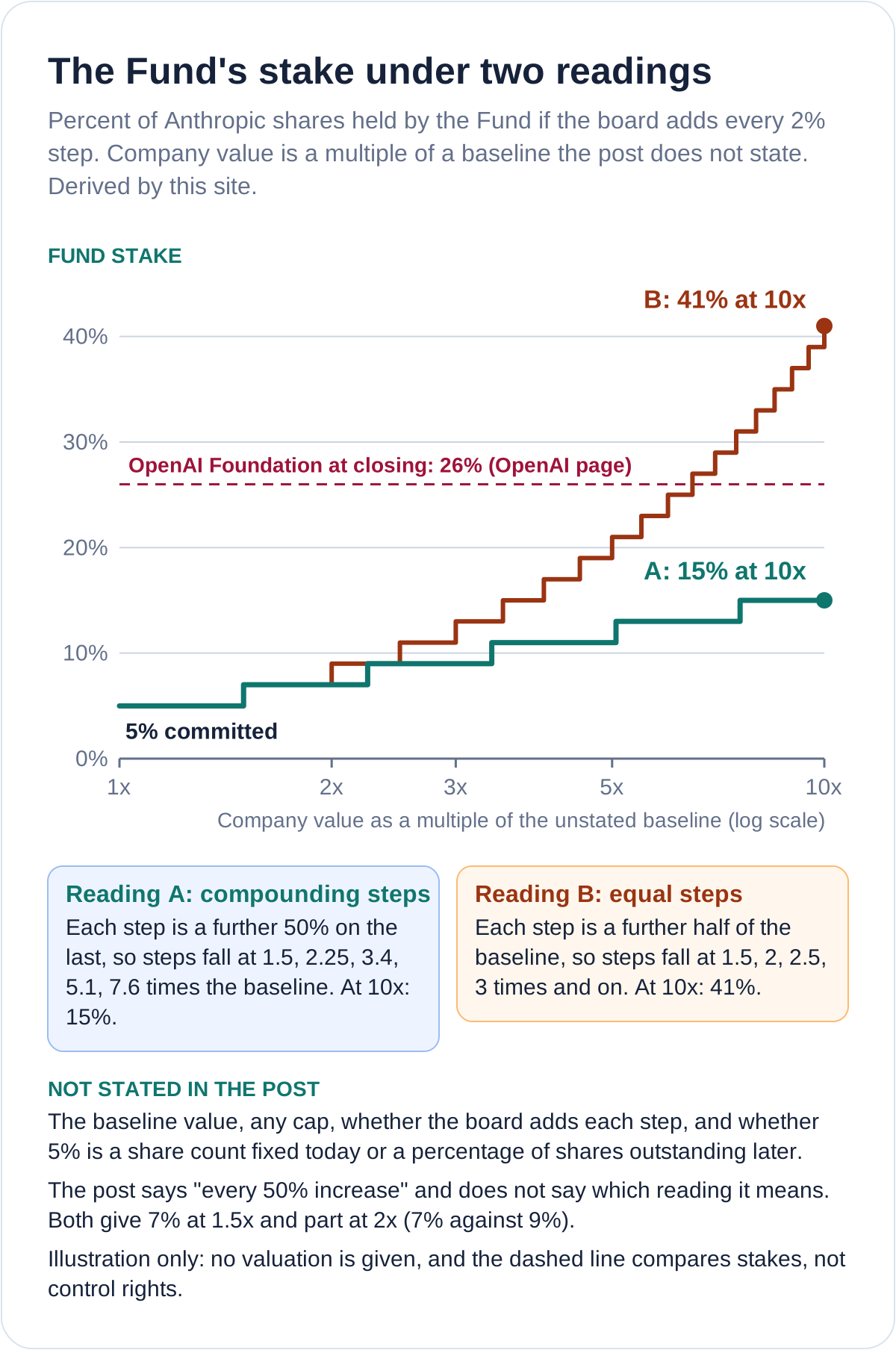
An uncapped schedule has consequences the post does not discuss. On reading B the Fund would hold more than half of the company's shares at 12.5 times the baseline, after 23 steps; on reading A it would take about 11,000 times the baseline (both derived). That is a reason to suspect that a cap exists, or that A is meant, but it is inference only: the post says nothing about either, and each step is at the board's discretion. Four more things the wording leaves open: whether steps are discrete or pro rata, how the company's value is measured (a financing price, a market capitalisation after a listing, or an independent valuation), whether the board may add less than 2%, and what 5% is a percentage of. If 5% is a share count fixed today and the total number of shares then rises by 10%, the Fund's stake falls to 4.55% unless it is topped up (derived: 5 divided by 1.10).
A scale check, illustration only, because the post gives no valuation. The BBC reports that a listing "could value the firm at more than $1tn". One per cent of $1 trillion is $10 billion, so 5% would be $50 billion and a first step to 7% would be $70 billion (derived). The post says Anthropic "has already committed $200 million" to studying and addressing labour-market effects; that is 0.4% of $50 billion (derived). The comparison is of scale and not a forecast: a listing valuation is not the baseline, and neither the baseline nor the value of the shares committed is published.
Stated and not stated: the post, line by line
The table sets what the post states, in its own words, against what it does not. "Not stated" means not found in the post or in Anthropic's other pages read for this briefing; it does not mean the information does not exist.
What Anthropic's post of 18 October 2026 states and does not state. Quotations are from the live page read on 19 October 2026.
| Item | Stated | Not stated |
|---|---|---|
| Size of the commitment | "5% of Anthropic's shares will be committed today", subject to stockholder approval. | The number of shares, their class and voting rights, whether 5% is a count fixed today or a percentage of shares outstanding later, and what "committed" means in law (issued, transferred, reserved or pledged). |
| The escalator | "an additional 2% added at the board's discretion for every 50% increase in the company's value above a set baseline". | The baseline, compounding or equal steps, any cap, how value is measured, what binds the board's discretion, and whether a fall in value reverses a step. |
| The approval | "Subject to stockholder approval". | Which approval, which stockholders, what vote, by when, and what happens if it is withheld. |
| The vehicle | "a wholly-owned LLC", "rather than a 501(c)(3) or other format", chosen "to give adjustability between different forms of giving". | Who owns it, who manages it, whether it has been formed (the post says "We're establishing"), where, under what governing document, and its tax classification. |
| The lobbying limit | "None of the Anthropic equity held by the LLC will be used for lobbying or political giving, in the US or abroad." | What instrument enforces it, whether it reaches proceeds from selling shares or any other asset, and who can change it. |
| Uses | The Fund "might explore large donations to traditional nonprofits or direct distributions to specific populations". | Any amount, schedule, recipient rule, or limit on benefit to Anthropic, its staff or its investors. |
| The wider total | "roughly 20% of Anthropic shares will be dedicated to the public good", counting the co-founders' pledge of 80% of their equity holdings and an employee match in which "Approximately half of our employees participate". | The split (about 15% sits outside the Fund, derived), whether pledged equity has moved, who holds it, when it must be given, and whether the company's match is inside the 5% or the 15%. |
| Governance and reporting | "we will share more about the Anthropic Public Benefit Fund's structure and governance" and report "in an upcoming public benefit report". | Any date, the contents, whether the report is public, audited, or the Delaware statement to stockholders, and whether the Fund will publish accounts. |
| The shares' rights | Nothing. | Voting, dividends, transfer limits, when and whether the LLC may sell, and what happens on a sale, merger or listing. |
Nine rows, and in each the numbers a reader would need to check the commitment sit in the right-hand column. The one thing the post does promise is more detail: it says it will share the structure, the governance and "the valuation milestones that may add to its stake" in the coming months, which implies the milestones have been set and are not yet public (inference). It gives no date.
Where "roughly 20%" comes from, and which labels do the work
The post says that, combined with the co-founders' pledge and the employee match, "roughly 20% of Anthropic shares will be dedicated to the public good", "plus any additional percentage" from the valuation milestones. Subtracting the Fund's 5% leaves about 15% in pledges (derived: 20 minus 5), so the new commitment is a quarter of the headline total (derived: 5 divided by 20). The post gives no split between founders and employees. A pledge is a promise by a holder, the Fund is a commitment announced by the company, and "dedicated" covers both; the 20% adds them together without saying whether any pledged share has moved to any vehicle.
Labels in the post, where each appears and what the record shows.
| The label | Where it appears | What the record shows |
|---|---|---|
| "Public Benefit Fund" | The entity's name. | A wholly-owned LLC, "rather than a 501(c)(3) or other format". It is not a public benefit corporation: Delaware's statute applies to corporations (next section). The post does not state its tax treatment. |
| "committed today" | First paragraph. | Subject to stockholder approval. Whether shares are issued, transferred, reserved or pledged is not stated. |
| "dedicated to the public good" | Penultimate paragraph. | A sum of different instruments (a Fund commitment and individual pledges). "Public good" is not defined and no outside body is named to judge it. |
| "None ... used for lobbying or political giving" | Fifth paragraph. | A promise about "Anthropic equity held by the LLC". For a 501(c)(3) the IRS pages state limits as conditions of exemption; here the instrument and its enforcement are not stated. |
| "at the board's discretion" | First paragraph. | Anthropic's pages say its board is elected by stockholders and its Long-Term Benefit Trust, and an April 2026 page says Trust-appointed directors now make up a majority. Whether the Trust has any part in the Fund is not stated. |
Method is separate from accusation. Nothing here shows the commitment is hollow, and announcing an intention first and the structure later is common. The gap is that the figures a reader needs to test the claim are the ones deferred, while the headline number, about 20%, is built from instruments the post does not document. This site's briefing on Anthropic's 15 October post about METR and other evaluators found a similar pattern: a post rewritten after publication and no funding term given.
Delaware's public benefit corporation law: what it requires and what it does not
Anthropic says on its own pages that it is a public benefit corporation (the Company page), and its Long-Term Benefit Trust page says a Delaware one (the Trust page). Sections 361 to 368 of Title 8 of the Delaware Code, which cover public benefit corporations, were read in full on the Delaware Code Online on 19 October 2026. The page shows no currency date.
What Delaware Code Title 8, sections 361 to 368, says about public benefit corporations, and what it does not say. Quotations are exact.
| Section | What it says | What it does not say |
|---|---|---|
| 362: definition | A public benefit corporation is a for-profit corporation "intended to produce a public benefit" and managed to balance stockholders' pecuniary interests, those materially affected, and the public benefits in its certificate, which must name one or more specific public benefits and state in its heading that it is one. | Nothing requires a gift of equity, money or profit, or any fund. |
| 365: directors | The board must balance those interests. By virtue of the public benefit provisions, a director has no duty to any person "on account of any interest" in the public benefit, and is deemed to satisfy fiduciary duties if the decision is "both informed and disinterested and not such that no person of ordinary, sound judgment would approve". | Nothing in the section gives people outside the stockholders a way to enforce the balance. Anthropic's 2023 Trust page says the form "does not make the directors of the corporation directly accountable to other stakeholders". |
| 366: statements | At least every two years the corporation must give its stockholders a statement with its objectives, standards, objective factual information and an assessment. The certificate or bylaws may require it to be public. | It is not public unless the certificate or bylaws say so. The post does not say its "public benefit report" is this statement, or when it comes. |
| 367: suits | An action to enforce the balancing duty needs plaintiffs holding at least 2% of outstanding shares or, for a listed corporation, the lesser of 2% or stock worth at least $2,000,000. | Who would hold the Fund's shares. A 5% holder is 2.5 times the unlisted threshold (derived); the post does not say whether the Fund, if it holds shares, could sue. |
| 361, 363, 364, 368 | Application, a bar on mergers with nonprofit nonstock corporations, stock certificate notices, and no effect on other corporations. | Nothing about an LLC, a fund or any vehicle that holds a public benefit corporation's shares. |
So the public benefit corporation form obliges Anthropic's board to balance, to say what it has done at least every two years and to name a public benefit. It does not oblige it to give anything away, and it does not govern a separate LLC. The Fund is therefore neither required nor regulated by that statute. Its terms are whatever its own documents say, and the post publishes none of them. One Delaware mechanism could make the Fund visible: a certificate or bylaw can require the biennial statement to be public. Whether Anthropic's does is not stated. Section 367 also changes with a listing, which the BBC reports Anthropic is laying the ground for: at a $1 trillion value, 2% is $20 billion and the listed test would be the $2 million figure, 10,000 times smaller (derived, illustration).
The US tax frame, read as a structural contrast only
Four IRS pages were read in full on 19 October 2026: exemption requirements for 501(c)(3) organisations (last reviewed 28 June 2026), lobbying (28 June 2026), public disclosure of exempt organisations' returns (28 June 2026) and single member limited liability companies (27 July 2026). They describe the form the post sets aside, a 501(c)(3), and the kind of vehicle it chose, an LLC. They do not mention this Fund, and the post states neither its owner nor its tax treatment, so nothing here says how the Fund is treated.
What the IRS pages say about a 501(c)(3) and about a single-member LLC, against what the post states. A structural contrast, not a finding about the Fund.
| Feature | 501(c)(3), per the IRS pages | Single-member LLC, per the IRS page |
|---|---|---|
| Basic test | "organized and operated exclusively for exempt purposes", and none of its earnings may inure to any private shareholder or individual. | For income tax, an LLC with one member is "disregarded as separate from its owner" unless it files Form 8832 and elects to be treated as a corporation. |
| Lobbying and politics | May not attempt to influence legislation as a substantial part of its activities and may not take part in any campaign activity for or against candidates. | No such rule on the page, which is about classification. The post makes its own promise about the LLC's equity. |
| What is open to the public | The exemption application and the annual return, such as Form 990, must be made available for public inspection, for a three-year period. Donor names need not be disclosed, except for private foundations. | The page says nothing about public inspection. It says the LLC's activities are reflected on its owner's return, as "a division of the corporation" if a corporation owns it. |
| Who the entity is | A separate exempt organisation with its own return. | Separate from its owner for employment tax and certain excise taxes. The post does not say who the owner is. |
The contrast is one of disclosure. For a 501(c)(3), an IRS page lists what must be open to inspection. For a disregarded LLC the page lists nothing, which is silence on that page and not a statement that nothing is disclosed elsewhere: state law, securities rules and the company's own reporting could all apply. The post's stated reason for the LLC is "adjustability between different forms of giving". It does not say what disclosure the choice brings with it.
Three arrangements, each in its own words
Anthropic describes two arrangements aimed at the public interest, the Trust and the Fund, and OpenAI describes one, its Foundation. Each is described here only from its own page, read in full on 19 October 2026: the post, the Long-Term Benefit Trust pages (2023 page, April 2026 board page, July 2026 page), and OpenAI's structure page and the OpenAI Foundation's update of 24 March 2026. OpenAI competes with Anthropic and wrote its own page.
Three arrangements as each organisation's own pages describe them, and what those pages do not state.
| Arrangement | Stated on its own pages | Not stated |
|---|---|---|
| Anthropic Public Benefit Fund (post, 18 October 2026) | A wholly-owned LLC. 5% of shares committed subject to stockholder approval, then 2% steps at the board's discretion. No lobbying or political use of its equity. | Owner, control, baseline, cap, share class, voting, tax treatment, dates. |
| Anthropic Long-Term Benefit Trust (page dated 19 September 2023, page data modified 9 September 2026) | A purpose trust under Delaware common law holding Class T stock, which can elect and remove board members; the Trust "will elect a majority of the board within 4 years". Trustees "hold no equity in Anthropic" (July 2026). An April 2026 page says Trust-appointed directors now make up a majority. | How Class T and the Fund's shares would interact, and whether the Trust has any role in the Fund. The pages disagree on size: five Trustees in 2023, four implied by the July 2026 page, three on the Company page read on 19 October. |
| OpenAI Foundation (structure page, undated; recapitalisation announced 28 October 2025) | A nonprofit that "continues to control" OpenAI Group PBC and, through special voting rights, appoints all of its directors. It holds 26% "worth approximately $130B" at closing, plus a warrant for more if the share price rises "greater than tenfold after 15 years". Its own note says it expects to invest "at least $1 billion" in the next year. | The warrant's "set price", any limit on the Foundation's sales, and its reporting. |
Two derived comparisons, with limits. OpenAI's 26% and $130 billion imply a value of $500 billion for OpenAI Group at closing, and the three holders it names sum to 100% (26, 27 and 47). The Fund's stake would first pass 26% (at 27%) after eleven steps: at 86.5 times the baseline on reading A and 6.5 times on reading B. Percentages are the only thing those figures compare. OpenAI states what its Foundation controls and when its stake was measured; the Anthropic post states a schedule with an unstated starting point and says nothing about who controls the Fund. The two Anthropic arrangements also divide the roles differently: the Trust's stated function is control, through Class T stock, with Trustees holding no equity, while the Fund is a block of equity with control not stated. Anthropic's own pages differ on counts too: its 14 April 2026 page names seven directors, while the Company page read on 19 October lists six, with no change announced on either.
No other AI developer's published equity or foundation arrangement was found in a limited search, so none is compared. The post says its structure is meant to give flexibility; the contrast with OpenAI is that its own page states the control and the stake at a date, where the Anthropic post states neither for the Fund.
What the BBC and CNBC add, and what they change
The BBC report (published 19 October 2026 at 03:41 BST, marked updated about two hours before it was read at 07:58 BST) and CNBC's (18 October, 6:55 pm Eastern, updated 7:36 pm) are secondary. Both were read in full. They add context the post does not contain and, in two places, restate the schedule differently.
How two news reports restate the post, against the post's own words.
| Report | What it says | Against the post |
|---|---|---|
| BBC, 19 October 2026 | Anthropic "will commit 5% of its shares to a fund that will make donations", and the Fund "could also receive another 2% of the firm's shares at its board's discretion". | The post says the Fund "might explore" donations. Its 2% repeats "for every 50% increase" above a baseline; the BBC's sentence reads as one extra 2% (7% in all), and the text read does not carry the stockholder-approval condition. |
| BBC, context | The announcement "comes as Anthropic lays the ground" for a possible listing valuing it at more than $1tn. The BBC says Anthropic told prospective investors that revenue rose 45% to $16.8bn in the three months to September. | None of this is in the post. The BBC also refers to an "initial public offering (IPO) filing" without linking it; no public Anthropic registration statement was found (see below). |
| CNBC, 18 October 2026 | "The board may add 2 percentage points for each 50% increase" above "an undisclosed baseline". | The post says "2%", not "percentage points"; that reading is CNBC's. "Undisclosed" matches the post's silence. CNBC also says a planned public offering is reportedly slated for November. |
Neither report adds a document. Both rest on the post, and neither gives the baseline, the owner, the share class or the stockholder-approval mechanism. The compression in the BBC's sentence matters for the arithmetic: one extra 2% would cap the Fund at 7% (derived), while a repeating step is the schedule in the chart.
The UK: what the pages say about comparable structures, and where they stop
Anthropic's UK presence, as its own pages state it: a Memorandum of Understanding with the Department for Science, Innovation and Technology (14 February 2025), selection by that department to help build and pilot an AI assistant for GOV.UK (27 January 2026), and, in the second page's words, "Our London office is home to a growing team of AI researchers". The pages state no UK legal entity, so they do not say whether any UK company law reaches any part of Anthropic's business. The table sets out what the UK pages read say about structures that resemble parts of the Fund, and where each stops. None addresses a US company's equity commitment.
UK law and guidance read on 19 October 2026 on legislation.gov.uk, gov.uk and the AI Security Institute's site, with where each stops for this Fund.
| UK instrument | What the page says | Where it stops |
|---|---|---|
| Companies Act 2006, section 172 and section 414CZA | A director must act in the way he considers, in good faith, would be "most likely to promote the success of the company for the benefit of its members as a whole", having regard to the long term, employees, the community and the environment. Where purposes include others than members' benefit, the duty is to achieve them. A strategic report must carry a section 172(1) statement, except for a medium-sized company. | A duty on every company's directors, not an opt-in status. No mention of Delaware or of equity gifts. Whether it reaches Anthropic's UK presence is not addressed. |
| Charity law: what makes a charity (CC4) and public benefit | A charity is established "for charitable purposes only" and subject to the High Court's charity jurisdiction, and every purpose must be for the public benefit. An organisation "cannot be a charity if it has some purposes that are charitable and some that are not". A registered charity's trustees' annual report, if sent to the Commission, is displayed on the public register. You "cannot set up a charity to help one specific person" (charitable purposes). | It describes UK charities. A fund able to make "direct distributions to specific populations" would have to pass the public benefit test to be one. The post says the Fund is an LLC "rather than a 501(c)(3) or other format". |
| Community interest companies and the Regulator | "All CICs have a compulsory Asset Lock that cannot be removed." A CIC must pass a community interest test, cannot be a political party or political campaigning organisation, and files an annual CIC report (form CIC34). The Regulator investigates complaints and takes action if necessary. | Shows what a statutory lock and an annual report filed with the accounts look like. The post states neither for the Fund. |
| HMRC on company gifts | A UK limited company can pay less Corporation Tax when it gives land, property or "shares in another company"; "You cannot claim for gifts or sales of shares in your own company." Page data dates it 8 December 2014. | A UK tax rule on UK limited companies. Anthropic is a Delaware corporation and no tax treatment is stated. |
| People with significant control | A UK company must tell Companies House who owns or controls it: anyone with more than 25% of shares or votes, or who can appoint or remove a majority of directors, with the level recorded in bands. | Shows that a UK company's owner is recorded on a register at Companies House, with protection from publication available to some individuals. The post does not name the owner of a "wholly-owned" LLC. |
| AI Security Institute and Parliament | The Institute is a research organisation within the Department for Science, Innovation and Technology that tests AI systems before release and collaborates with AI companies. A search of Parliament's bills data for "artificial intelligence" found three bills, all private members' bills and none from the government; the newest, an Artificial Intelligence (Regulation) Bill [HL], had its first reading in the Lords on 4 March 2025 and was last updated on 30 April 2026 (bill page). "Frontier" returned none. | Neither says anything about developers' equity, ownership or foundations. |
Two points follow. First, the vocabulary differs: in the UK "charity" and "community interest company" are statuses with a regulator, a lock or a public filing, while "public benefit" in Delaware's statute is a purpose a corporation states and its board balances. Second, nothing read says UK law requires Anthropic to disclose this Fund. A UK buyer's leverage is contractual and reputational: the questions in the checklist below. The one UK page that goes to the heart of the gap is the register of people with significant control, because for a UK company the answer to "owned by whom" is recorded at Companies House, and for this LLC the post leaves it blank.
What to ask for, in the order worth asking
For customers, procurement teams, boards and policymakers who assess AI developers. Each item is tied to something the post does not state, and none is advice about investing.
Take this with you
Questions for Anthropic, in order
- Ask for the instrument that creates the Fund: the LLC's governing document, the name of its owner and of its manager. Tied to: the owner, the control and whether the LLC has been formed.
- Ask which approval "subject to stockholder approval" refers to, by which stockholders, with what vote, by what date, and what happens if it is withheld. Tied to: the approval.
- Ask for the baseline (a figure, not a phrase), how value is measured, whether steps compound or are equal, whether there is a cap, and what limits the board's discretion. Tied to: the escalator, where the two readings give 15% or 41% at ten times.
- Ask what "committed" means in law (shares issued, transferred, reserved or pledged), and whether 5% is a fixed share count or a percentage of shares outstanding. Tied to: the size of the commitment.
- Ask for the share class, the voting and dividend rights, the transfer limits, and who votes the Fund's shares alongside the Trust's Class T stock. Tied to: the shares' rights.
- Ask who decides the 2% steps, how directors' conflicts are handled, whether the Trust has a role, and for the current lists of directors and Trustees with dates. Tied to: the board's discretion, and the pages' differing counts.
- Ask for the disposal and distribution rules: whether and when the LLC may sell, what share of proceeds must be given, what "public good" excludes, and limits on benefit to Anthropic, its staff and its investors. Tied to: uses.
- Ask for the dates and contents of the "public benefit report" and the structure and governance publication, whether the report is the Delaware statement to stockholders, whether it is public and audited, and whether the Fund will publish accounts. Tied to: governance and reporting.
- Ask for the Fund's tax classification and the instrument that enforces the lobbying and political-giving exclusion, and whether it covers sale proceeds and other assets. Tied to: the vehicle and the lobbying limit.
- Ask what happens to the Fund's stake on a sale, merger or listing, and ask counsel how a listing changes who can sue to enforce the balancing duty. Tied to: the missing events.
- Ask for the split of the roughly 20% between the Fund, founders and employees, with dates, before the figure is used in a risk assessment or a policy paper. Tied to: the wider total.
- For UK contracts, ask which entity contracts for the service and which UK filings it makes, and do not assume UK law reaches a US equity commitment. Tied to: the UK gap.
What could not be verified
- The Fund's documents. No governing document, resolution, term sheet or filing for the Fund was found. Everything about it rests on Anthropic's post.
- Stockholder approval. Nothing on the approval, its date or its outcome was found on Anthropic's pages.
- An Anthropic prospectus. The BBC mentions an "initial public offering (IPO) filing". On 19 October 2026, searches of the SEC's EDGAR company search and full-text search (read in a browser, because the SEC blocks automated fetching and that block was not bypassed) found no registration statement from Anthropic. A confidential draft would not appear there. The BBC's and CNBC's reports of revenue and a listing date were not checked against a primary.
- Delaware beyond Subchapter XV. The sections on issuing stock, stockholder votes and limited liability companies were not read. The Delaware page shows no currency date.
- IRS beyond four pages. The Form 990 instructions and Treasury regulations were not read.
- UK gaps. The Charity Commission guidance found concerns charities, not company gifts, so HMRC's page is the UK rule read on companies' gifts. The HMRC, CC4 and public benefit pages carry old publication dates (2014, 2013 and 2014) and were live on gov.uk when read. Whether a UK company is involved in Anthropic's structure is not stated.
- Comparators. The OpenAI structure page has no date and gives figures as of closing. No other AI developer's equity or foundation arrangement was found.
- Time-stamped. Sources were read from 07:57 to 08:22 BST on 19 October 2026. The promised structure and governance publication, a stockholder vote or a correction to the post could appear within hours, and the BBC's page was marked updated shortly before it was read.
The question that exposes the gap
Of the figures and names that would let anyone check this commitment, the baseline, the number of shares, their class, the owner of the LLC and the date of the stockholder vote, which has Anthropic published, and which is promised only for "the coming months"?
Key facts
Sources
- PrimaryAnthropic's post 'Investing in the public benefit', 18 October 2026 (page data modified 18:05 UTC): the 5%, the 2% per 50% rise above a set baseline, the wholly-owned LLC, the lobbying exclusion, the roughly 20% total and the promised detail. Read in full in a browser tab. The vendor's own pageAnthropicaccessed 2026-10-19
- PrimaryAnthropic's Long-Term Benefit Trust page (published 19 September 2023, page data modified 9 September 2026): Delaware public benefit corporation status, the purpose trust, Class T stock and the change note on Trustees. Read in full in a browser tabAnthropicaccessed 2026-10-19
- PrimaryAnthropic page of 14 April 2026 on a Trust-appointed director: the board is elected by stockholders and the Trust, Trust-appointed directors now make up a majority, and the directors named thenAnthropicaccessed 2026-10-19
- PrimaryAnthropic page of 9 July 2026 on a new Trustee: Trustees hold no equity and are chosen by existing Trustees, and the Trustees named thenAnthropicaccessed 2026-10-19
- PrimaryAnthropic Company page read on 19 October 2026: its governance statement and the lists of directors and TrusteesAnthropicaccessed 2026-10-19
- PrimaryAnthropic page of 14 February 2025 on its MOU with the UK Department for Science, Innovation and Technology: Anthropic's own account of its UK workAnthropicaccessed 2026-10-19
- PrimaryAnthropic page of 27 January 2026 on the GOV.UK AI assistant: Anthropic's own account of its London office and UK workAnthropicaccessed 2026-10-19
- PrimaryOpenAI's 'Our structure' page: the OpenAI Foundation's control, the 26% stake, the warrant and the other holders. Read in full in a browser tab. A rival developer's own pageOpenAIaccessed 2026-10-19
- PrimaryOpenAI Foundation update of 24 March 2026: its stated spending expectation and the previously announced commitment. Read in full in a browser tabOpenAI Foundationaccessed 2026-10-19
- PrimaryDelaware Code Title 8, Chapter 1, Subchapter XV, sections 361 to 368, public benefit corporations. Read in fullDelaware General Assemblyaccessed 2026-10-19
- PrimaryIRS 'Exemption requirements - 501(c)(3) organizations', last reviewed 28 June 2026. Read in fullInternal Revenue Serviceaccessed 2026-10-19
- PrimaryIRS 'Lobbying' page for 501(c)(3) organisations, last reviewed 28 June 2026. Read in fullInternal Revenue Serviceaccessed 2026-10-19
- PrimaryIRS page on what exempt organisations must make available for public inspection, last reviewed 28 June 2026. Read in fullInternal Revenue Serviceaccessed 2026-10-19
- PrimaryIRS 'Single member limited liability companies', last reviewed 27 July 2026. Read in fullInternal Revenue Serviceaccessed 2026-10-19
- PrimaryCompanies Act 2006 section 172, duty to promote the success of the company, as revised and up to date to 16 October 2026 on the pagelegislation.gov.ukaccessed 2026-10-19
- PrimaryCompanies Act 2006 section 414CZA, the section 172(1) statement in the strategic reportlegislation.gov.ukaccessed 2026-10-19
- Primary'What makes a charity (CC4)', published 1 September 2013: the two-part definition of a charityCharity Commission (GOV.UK)accessed 2026-10-19
- Primary'Public benefit: rules for charities': the public benefit requirement, only-charitable-purposes rule and public reportingCharity Commission (GOV.UK)accessed 2026-10-19
- Primary'Set up a charity: charitable purposes': the list of charitable purposes and the one-person ruleGOV.UKaccessed 2026-10-19
- PrimaryCommunity Interest Companies guidance, updated 4 April 2025: the asset lock, the community interest test, the dividend cap and the annual CIC reportOffice of the Regulator of Community Interest Companies (GOV.UK)accessed 2026-10-19
- PrimaryThe Regulator's page: what the office decides and investigatesOffice of the Regulator of Community Interest Companies (GOV.UK)accessed 2026-10-19
- Primary'Tax when your limited company gives to charity: land, property and shares': shares in the company's own shares do not qualify for relief. Page data dated 8 December 2014HMRC (GOV.UK)accessed 2026-10-19
- Primary'People with significant control (PSCs)': who must be registered and the thresholds, page data updated 30 July 2026Companies House (GOV.UK)accessed 2026-10-19
- PrimaryAI Security Institute 'About' page: what the Institute is and does; nothing on developers' equity or ownershipAI Security Instituteaccessed 2026-10-19
- PrimaryArtificial Intelligence (Regulation) Bill [HL], a private members' bill (Parliament bills data read on 19 October 2026: first reading in the Lords, last updated 30 April 2026)UK Parliamentaccessed 2026-10-19
- Reported byBBC News, 19 October 2026 (03:41 BST, marked updated): context on a possible listing and revenue, and its restatement of the 2%. Secondary, read in fullBBC Newsaccessed 2026-10-19
- Reported byCNBC, 18 October 2026: its restatement of the 2% as percentage points, the undisclosed baseline and the reported listing timing. Secondary, read in fullCNBCaccessed 2026-10-19