AlphaGenome Atlas scores 9 billion DNA changes. Prediction is now abundant; validation is the bottleneck.
Google DeepMind has precomputed molecular-effect predictions for every possible single-letter change in the human genome. The one-petabyte atlas could accelerate variant prioritisation, but it is a research map rather than a clinical answer.
By Parminder Kumar Sharma · · 3 min read

The model output has become an atlas
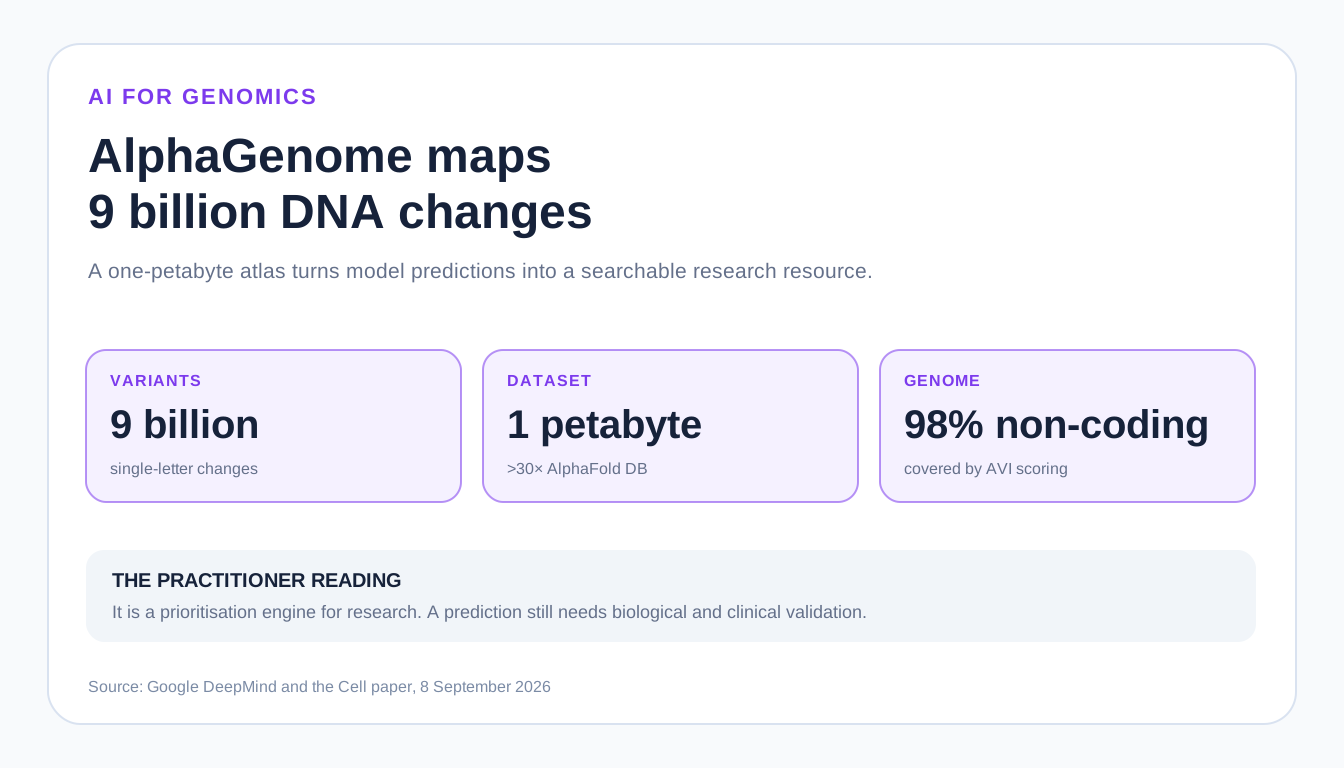
Google DeepMind’s AlphaGenome Atlas contains predictions for roughly 9 billion single-nucleotide variants, covering every possible single-letter change in the human genome. The one-petabyte dataset is more than 30 times the size of the AlphaFold Database, according to DeepMind.
The release adds an AlphaGenome Variant Impact, or AVI, score. It combines AlphaGenome’s regulatory predictions with AlphaMissense’s protein-impact predictions into one ranking signal, then exposes feature attributions that indicate which predicted biological processes drive that score.
The practical change is precomputation. A researcher can search a portal or API instead of running the model separately for every candidate variant.
The atlas links a score to predicted molecular mechanisms
Each variant can carry thousands of molecular-effect predictions across hundreds of human and mouse cell types and tissues. The atlas also includes more than 2,500 recurrent DNA sequence motifs and their genomic locations.
This matters because only about 2% of the genome codes for proteins. The remaining 98% helps regulate when and where genes act, and many trait-associated variants sit in those non-coding regions. AVI is designed to rank both coding and non-coding changes.
What a researcher can inspect
| Layer | Question it helps answer | Limit |
|---|---|---|
| AVI score | Which variants merit attention first? | A ranking is not causation |
| Feature attribution | Which predicted process drives the score? | Mechanism remains modelled |
| Molecular effects | How might regulation or splicing change? | Context varies by cell and tissue |
| Sequence motifs | Which recurring DNA pattern is affected? | Association needs experimental testing |
Early studies show the value and the limit
DeepMind reports that collaborators used AVI to prioritise a DNM1 variant associated with epileptic encephalopathy, then experimentally tested the predicted splice effect. Another analysis of more than 54,000 UK Biobank participants reportedly found 22% more non-coding associations after grouping rare variants by predicted molecular effects.
Those examples are promising because the model generated testable hypotheses and researchers supplied independent evidence. They do not establish that every high AVI score is pathogenic or that the system can diagnose an individual.
The position
AlphaGenome Atlas changes the economics of hypothesis generation. Predictions for billions of variants can be consulted quickly, including in the regulatory genome where interpretation is hardest.
That abundance moves the scarce resource downstream. Experimental capacity, diverse reference data, clinical interpretation and careful uncertainty reporting will decide whether a ranked variant becomes reliable knowledge.
Sources
- PrimaryAlphaGenome Atlas: A predictive map of every possible DNA letter changeGoogle DeepMindaccessed 2026-09-13
- PrimaryAlphaGenome Atlas research paperCellaccessed 2026-09-13